Royal, civic and national ceremonyEast AsiaSecular and civic
Arirang Mass Games
In its own language: 아리랑 축제
A massive civic spectacle of gymnastics, dance, and card stunts in Pyongyang

The Arirang Mass Games are a vast civic display of gymnastics, dance, and coordinated card mosaics held in Pyongyang, North Korea. Tens of thousands of performers take the field to stage elaborate historical and political narratives, typically during late summer or early autumn.
When is Arirang Mass Games kept?
Arirang Mass Games is kept on usually in August, September, or October.
The Arirang Mass Games are an enormous national performance of gymnastics, dance, and music staged in Pyongyang. Featuring tens of thousands of participants moving in close unison alongside vast stands of children forming shifting mosaic backdrops, the event presents key political milestones, historical epics, and civic symbols of North Korea.
Choreography and card displays
The spectacle relies on strict precision across the arena floor and throughout the stands. Tens of thousands of gymnasts and dancers move through synchronised routines, while more than thirty thousand seated schoolchildren create giant picture mosaics using coloured flip books in what is known as a card stunt. These living backdrops change swiftly to illustrate scenes from Korean history, national landmarks, and political themes. Training begins early in childhood, with young citizens chosen for their skill around five years old and continuing their involvement for decades until retirement.
Origins and symbolism
The festival draws its title from the traditional Korean folk story Arirang, which tells of a separated couple and is used here to evoke the division of the Korean peninsula. Throughout the routines, visual cues communicate specific civic messages. A rising sun honours Kim Il-sung, while depictions of firearms recall a weapon passed between leaders. Flower colours also carry meaning: red blooms represent the working class, while red begonias and purple orchids specifically signify Kim Jong-il and Kim Il-sung.
Milestones and attendance
First staged in 2002, the games ran annually until 2013, pausing briefly in 2006. In 2007, the showcase entered the Guinness World Records after fielding 100,090 performers during an inter-Korean summit visited by South Korean President Roh Moo-hyun. Following a multi-year pause, the festival resumed in 2018 under the title The Glorious Country for the republic's seventieth anniversary, where South Korean President Moon Jae-in spoke to 150,000 onlookers. Subsequent editions marked major party milestones, including an October 2025 gathering celebrating the Workers' Party.
How Arirang Mass Games is kept
The performance opens with grand musical arrangements as thousands of disciplined dancers and gymnasts fill the central grounds. Across the stadium tiers, tens of thousands of schoolchildren hold up colored boards, flipping them in concert to produce sweeping scenic pictures. Through successive acts, the ensemble presents dramatic tableaus that depict the nation's journey, accompanied by songs like Arirang, military imagery, and floral tributes.
When and where
Performances take place over several weeks, most frequently starting in August or September and sometimes continuing through October. Staging depends on state planning and national anniversaries.
The games take place in Pyongyang at the May Day Stadium, also known as the Rungrado 1st of May Stadium. All performances are held in this single venue in the North Korean capital.
What Arirang Mass Games means
The performance embodies collective solidarity and state identity. Its narrative uses the traditional ballad of Arirang to recall historical hardships and celebrate the emergence of a unified, self-reliant nation. Specific motifs like the sun, red working-class blossoms, and named hybrid orchids convey allegiance to the country's founding leaders and the Workers' Party.


Questions people ask about Arirang Mass Games
When is Arirang Mass Games kept?
Arirang Mass Games is kept on usually in August, September, or October.
What are the Arirang Mass Games?
They are an extensive civic performance in North Korea featuring tens of thousands of gymnasts, dancers, and schoolchildren who create massive animated mosaic murals using colored cards.
Where and when do the games take place?
The games take place in Pyongyang, North Korea, typically during August, September, or October. Performances are held inside the May Day Stadium over the course of several weeks.
Why is the performance named Arirang?
The title comes from an ancient Korean folk narrative about two separated lovers, which the state uses as a metaphor for the split of the Korean peninsula and the hope of overcoming national struggle.
How many people participate in the spectacle?
More than 100,000 performers have taken part in a single presentation. This includes tens of thousands of athletes and dancers on the arena floor, alongside more than 30,000 schoolchildren who coordinate the giant mosaic card displays.
See also
 Day of the SunNorth Korea's principal holiday, marking the birth anniversary of Kim Il Sung
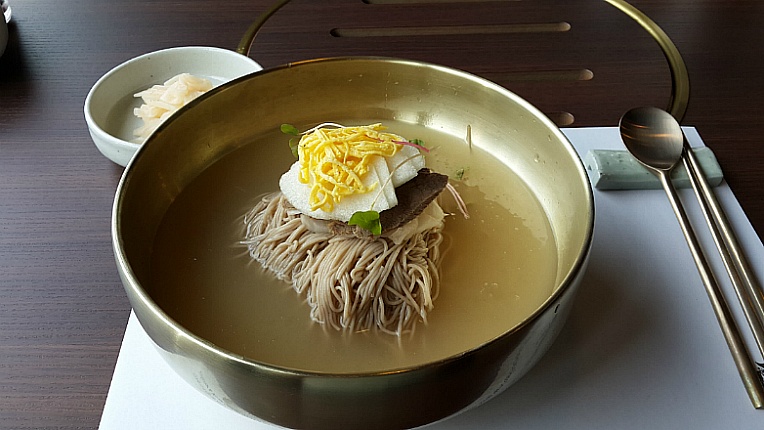 NaengmyeonLong buckwheat noodles in icy broth, born in North Korea and eaten most in summer
 GanggangsullaeA Korean harvest dance where women hold hands and sing in circles under the full moon
 Independence DayThe United States' national day of parades, barbecues and fireworks, kept each July 4
Good reading and sources
- Welcome to the strangest show on earthThe Guardian, Article
- Moon, Kim attend North Korea's mass gymnastics performanceThe Korea Times, Article
- Welcome to the strangest show on earthThe Guardian, Article
- Moon, Kim attend North Korea's mass gymnastics performanceThe Korea Times, Article
- Arirang Mass Games on WikipediaEncyclopedia
- More photos on Wikimedia CommonsPhotos and video
- Wikidata recordOpen data
The facts on this page come from the Wikipedia article "Arirang Mass Games", written by its contributors and used under the CC BY-SA 4.0 licence, and from its Wikidata record (CC0). EveryParampara rewrote the text in its own words, with AI assistance, and compares every page with the article to make sure no passage is copied. It may be reused under the same CC BY-SA 4.0 licence with a link back.
It may contain mistakes. Traditions differ from one family, village and community to the next, and the people who keep them know them best. If something is wrong, tell us. Last refreshed 2026-10-04.
More from North Korea
All the traditions of North Korea
🇰🇵 Pyongyang, North KoreaDay of the Sun태양절
North Korea's principal holiday, marking the birth anniversary of Kim Il SungCeremony
 🇰🇵 Pyongyang, North KoreaDay of the Shining Star광명성절
A two-day national holiday in North Korea honouring the birth of Kim Jong Il.Ceremony
🇰🇵 Pyongyang, North KoreaDay of the Shining Star광명성절
A two-day national holiday in North Korea honouring the birth of Kim Jong Il.Ceremony
 🇰🇵 Pyongyang, North Korea and 4 moreMass games
Disciplined, large-scale gymnastic spectacles celebrating unity and national prideCeremony
🇰🇵 Pyongyang, North Korea and 4 moreMass games
Disciplined, large-scale gymnastic spectacles celebrating unity and national prideCeremony
 🇰🇷 Seoul, South Korea and 1 moreNational Liberation Day of Korea광복절 (Gwangbokjeol)
A public holiday on 15 August marking Korea's liberation from Japanese rule in 1945Ceremony
🇰🇷 Seoul, South Korea and 1 moreNational Liberation Day of Korea광복절 (Gwangbokjeol)
A public holiday on 15 August marking Korea's liberation from Japanese rule in 1945Ceremony
The same idea elsewhere
All of this kind
🇺🇸 Philadelphia, United States and 1 moreIndependence Day
The United States' national day of parades, barbecues and fireworks, kept each July 4Ceremony
 🇺🇸 United StatesTalking stick
A carved staff that shows who may speak at a Northwest Coast gatheringCeremony
🇺🇸 United StatesTalking stick
A carved staff that shows who may speak at a Northwest Coast gatheringCeremony
 🇺🇸 Washington, United StatesState of the Union address
The US president's yearly report to Congress and the nation, given in the House chamberCeremony
🇺🇸 Washington, United StatesState of the Union address
The US president's yearly report to Congress and the nation, given in the House chamberCeremony
 🇮🇳 Kolkata, IndiaJana Gana Mana
India's national anthem, from a Bengali hymn of 1911, sung at civic occasionsCeremony
🇮🇳 Kolkata, IndiaJana Gana Mana
India's national anthem, from a Bengali hymn of 1911, sung at civic occasionsCeremony