Customs of food and drinkEast Asia
Naengmyeon
In its own language: 냉면
Long buckwheat noodles in icy broth, born in North Korea and eaten most in summer
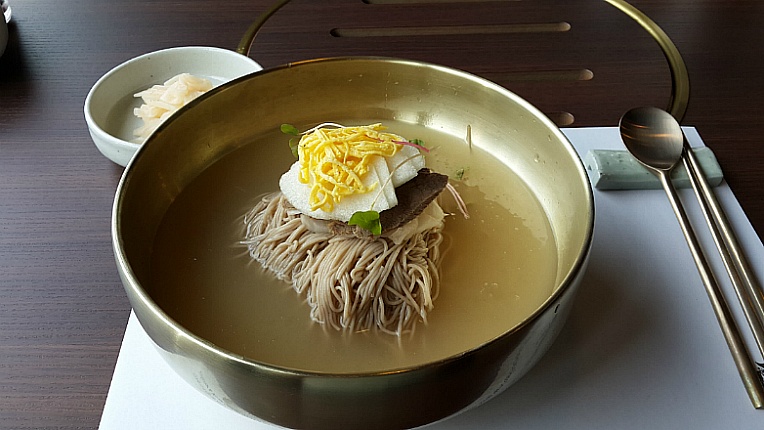
Naengmyeon is a bowl of long, thin handmade noodles served cold, first made in northern Korea and shaped by the cities of Pyongyang and Hamhung. Eaten in icy broth or mixed with chilli paste, it spread across both Koreas after the Korean War and is now a summer favourite that was once a winter dish.
When is Naengmyeon kept?
Naengmyeon is kept on eaten year round, most popularly in summer; historically a winter dish.
Naengmyeon is a bowl of long, thin noodles served cold, first made in northern Korea. They are made from buckwheat flour or potato starch, and come in iced broth or tossed with chilli paste. People eat them for refreshment in summer heat, and once ate them in deep winter. The long strands stand for a long, healthy life, so diners once slurped them whole, uncut.
A cold bowl
Naengmyeon simply means cold noodles, and the name says most of it. The diner gets a big metal bowl, usually brass or stainless steel, filled with long, thin noodles in a chilled, tangy broth. The noodles are handmade, worked from buckwheat flour, the most common base, or from the starch of potatoes, sweet potatoes or arrowroot, which gives a darker, chewier strand. Rarer doughs use kudzu root, seaweed or green tea. On top go shredded cucumber, slices of Korean pear, wide ribbons of lightly pickled radish, and a boiled egg or some cold sliced beef, often both.
Northern beginnings
The written trail starts with the Dongguksesigi, a nineteenth-century book of Korean seasonal customs, which records the dish as already established in the Joseon period. Naengmyeon began as a delicacy of the north, above all in Pyongyang and Hamhung, whose styles still carry the cities' names. For a long while it stayed a northern specialty; after the Korean War it spread widely, and it is now eaten and loved in both North and South Korea. It has even entered statecraft: at the first summit between the two Korean leaders, Kim Jong Un gave Moon Jae-in a gift of Pyongyang-style raengmyŏn.
Broth or chilli
Two kinds lead. Mul naengmyeon is a cold soup: noodles in an iced broth drawn from beef, chicken or dongchimi, a mild radish kimchi that is a Pyongyang signature, where this style began. The Pyongyang bowl uses buckwheat noodles, beef or pheasant broth and slices of radish. Bibim naengmyeon is the dry kind, tossed with a hot red dressing of gochujang, a chilli paste, and a side of broth arrives hot or cold, topped with boiled egg and cucumber. Hamhung's hoe naengmyeon adds marinated raw fish, most often skate, sometimes pollock. Yeolmu naengmyeon, a summer bowl, comes with kimchi of summer radish leaves. Around Jinju, on the south coast, the broth blends seafood with meat, garnished with abalone, sea cucumber and shiitake mushrooms.
At the table
The table manners are gentle ones. Servers at noodle houses usually ask whether the long noodles should be cut, and many provide scissors for the purpose, though the old habit was to swallow each strand whole. Mustard oil and vinegar are set out, with the oil often handed over only on request; in the Pyongyang style, sugar goes in too, while South Korean bowls leave it out. In South Jeolla Province, cooks stir red chilli paste straight into the mul broth, halfway to a bibim bowl. Each guest mixes the bowl to taste before eating.
Around the world
Naengmyeon travelled with Korean cooks. In Korean Chinese restaurants, jungguk-naengmyeon arrives with mustard and peanut butter alongside, a style shaped by Chinese tastes. Just over the border, Northeast China has its own cold noodle bowls, known there as Korean or Dongbei cold noodles, and the seasoning changes from town to town: Yanji's famous version is sour and sweet, while Jixi keeps its sour and salty. In Japan, Morioka in the northern Tohoku region counts reimen among its regional dishes, a style first made by Korean immigrants. For kitchens far from a noodle house, instant packs exist, broth prepackaged with the noodles and a sachet of mustard oil tucked in.
How Naengmyeon is kept
Naengmyeon is an everyday dish of homes and noodle houses rather than a ceremony. A cook forms long, thin noodles by hand from buckwheat or starch dough and chills them well. For mul naengmyeon they are set in a large brass or steel bowl of iced broth, beef, chicken or dongchimi; for bibim they are mixed with gochujang dressing. Garnishes follow: cucumber, Korean pear, pickled radish, a boiled egg or cold beef, or raw fish in the Hamhung style. Each diner then seasons the bowl with vinegar, mustard oil or sugar and eats, ideally without cutting the noodles.
When and where
No fixed date belongs to the dish. It was historically a winter food, but the chilled mul kind is now commonly eaten in summer, and people enjoy it all year. A nineteenth-century seasonal record, the Dongguksesigi, counted it among the customs of the Joseon year.
Naengmyeon comes from northern Korea and is tied above all to Pyongyang and Hamhung. Since the Korean War it has been common across both North and South Korea, and related bowls are kept in Northeast China, in Korean Chinese restaurants, and in Morioka in Japan.
What Naengmyeon means
The long, uncut strand is the heart of the custom: eaten whole, it stands for a long life and good health for whoever slurps it. The cold bowl itself has changed meaning over time, once a comfort of winter and now the dish people reach for in summer heat. Local styles carry civic pride: Pyongyang-style raengmyŏn could be offered as a gift from one Korean leader to another, and Jinju's extravagant seafood broth was recorded in a 1994 North Korean book on folk traditions.
On the table
- buckwheat noodles
- dongchimi
- Korean pear
- gochujang
- skate
- yeolmu kimchi
- mustard oil
- pollock


Questions people ask about Naengmyeon
When is Naengmyeon kept?
Naengmyeon is kept on eaten year round, most popularly in summer; historically a winter dish.
What exactly is naengmyeon?
A Korean dish of long, thin handmade noodles served cold, made from buckwheat flour or the starch of potatoes, sweet potatoes, arrowroot or kudzu. It comes either in an iced broth, called mul naengmyeon, or mixed with a spicy gochujang dressing, called bibim naengmyeon.
Where did it come from?
From northern Korea, above all the cities of Pyongyang and Hamhung, whose styles still carry their names. After the Korean War it spread through both North and South Korea, and related versions are now kept in Northeast China and in Morioka, Japan.
Why are the noodles so long, and can I cut them?
The long strands traditionally stood for a long life and good health, so they were eaten uncut. Restaurants usually ask whether you would like them cut, and often provide scissors, so guests who prefer shorter noodles can snip them without any trouble.
What is the difference between mul and bibim naengmyeon?
Mul naengmyeon is a cold noodle soup, its iced broth drawn from beef, chicken or dongchimi, a mild radish kimchi. Bibim naengmyeon has no soup: the noodles are tossed with a hot red gochujang dressing, and a bowl of broth, hot or cold, often comes on the side.
See also
 Mid-Autumn FestivalAn annual harvest festival celebrating family reunions, full moons and mooncakes
 HalloweenAn annual observance on 31 October marking the eve of All Saints' Day, rooted in Christian tradition and Celtic heritage
 NowruzThe Iranian new year at the March equinox, kept with fire, greenery and picnics
 St John's EveBonfires, feasting and worship on the short night before John the Baptist's feast
Good reading and sources
- 'Cold noodles are peace symbol': summit to savour for euphoric Koreans | South KoreaThe Guardian, Article
- 'Cold noodles are peace symbol': summit to savour for euphoric Koreans | South KoreaThe Guardian, Article
- Naengmyeon on WikipediaEncyclopedia
- More photos on Wikimedia CommonsPhotos and video
- Wikidata recordOpen data
The facts on this page come from the Wikipedia article "Naengmyeon", written by its contributors and used under the CC BY-SA 4.0 licence, and from its Wikidata record (CC0). EveryParampara rewrote the text in its own words, with AI assistance, and compares every page with the article to make sure no passage is copied. It may be reused under the same CC BY-SA 4.0 licence with a link back.
It may contain mistakes. Traditions differ from one family, village and community to the next, and the people who keep them know them best. If something is wrong, tell us. Last refreshed 2026-10-04.
More from North Korea
All the traditions of North Korea 🇰🇷 Seoul, South Korea and 1 moreTalchum탈춤
A Korean mask dance drama in which masked actors sing, dance and mock the powerfulPerformance
🇰🇷 Seoul, South Korea and 1 moreTalchum탈춤
A Korean mask dance drama in which masked actors sing, dance and mock the powerfulPerformance
 🇰🇷 South Korea and 1 moreDaeboreum대보름
A Korean festival of the first lunar full moon, marked by fires, wishes and feastsSeasonal · Feasts and festival meals
🇰🇷 South Korea and 1 moreDaeboreum대보름
A Korean festival of the first lunar full moon, marked by fires, wishes and feastsSeasonal · Feasts and festival meals
 🇰🇷 South Korea and 1 moreDoljanchi돌 (dol); 돌잔치 (doljanchi)
A Korean first-birthday rite where a baby picks an object that hints at the years aheadRite of passage
🇰🇷 South Korea and 1 moreDoljanchi돌 (dol); 돌잔치 (doljanchi)
A Korean first-birthday rite where a baby picks an object that hints at the years aheadRite of passage
 🇰🇷 South Korea and 1 moreGanggangsullae강강술래
A Korean harvest dance where women hold hands and sing in circles under the full moonPerformance
🇰🇷 South Korea and 1 moreGanggangsullae강강술래
A Korean harvest dance where women hold hands and sing in circles under the full moonPerformance
The same idea elsewhere
Healing, luck and protection compared 🇩🇪 Germany and 5 moreChristmas tree
A decorated evergreen or artificial tree placed indoors to mark the Christmas season.Festival
🇩🇪 Germany and 5 moreChristmas tree
A decorated evergreen or artificial tree placed indoors to mark the Christmas season.Festival
 🇫🇷 France and 5 moreCandlemas
A Christian feast of candle blessings marking the end of the Christmas seasonSpiritual
🇫🇷 France and 5 moreCandlemas
A Christian feast of candle blessings marking the end of the Christmas seasonSpiritual
 🇺🇸 United States and 4 moreFriday the 13th
A Western folk superstition regarding the unluckiness of a Friday falling on the 13th.Folklore
🇮🇪 Ireland and 2 moreJack-o'-lantern
A carved pumpkin lantern lit with a candle to brighten and protect Halloween nightsFolklore
🇺🇸 United States and 4 moreFriday the 13th
A Western folk superstition regarding the unluckiness of a Friday falling on the 13th.Folklore
🇮🇪 Ireland and 2 moreJack-o'-lantern
A carved pumpkin lantern lit with a candle to brighten and protect Halloween nightsFolklore