Royal, civic and national ceremonyEast AsiaSecular and civic
Day of the Shining Star
In its own language: 광명성절
A two-day national holiday in North Korea honouring the birth of Kim Jong Il.

The Day of the Shining Star is an annual two-day national holiday in North Korea observed on 16 February to commemorate the birth of Kim Jong Il. Across the country, citizens attend musical events, view military demonstrations, visit memorial halls, and join in organised mass dances.
When is Day of the Shining Star kept?
Day of the Shining Star is kept on annually for two days starting on 16 February.
The Day of the Shining Star is a major public holiday in North Korea, observed every year on 16 and 17 February. It marks the birth of the nation's second leader, Kim Jong Il. Alongside the Day of the Sun in April, it stands as one of the most prominent dates on the national calendar, celebrated with public gatherings, exhibitions, and state ceremonies.
Origins and history
The anniversary traces back to 1976 when unofficial commemorations began, but it was formally established as a public holiday in 1982 after Kim Jong Il entered the ruling party's Politburo. During his lifetime, the occasion was listed as the Spring of Humanity on state calendars, though he generally avoided public appearances on his birthdays. Following his death, authorities renamed the holiday in 2012 to honour him as the shining star of the country, a title drawn from official lore about his birth near Mount Paektu.
Public events and gatherings
Celebrations unfold across North Korea, with the largest gatherings taking place in the capital, Pyongyang. Streets are decorated with banners and national flags while public squares host synchronized mass dancing and musical performances. Large crowds visit the Kumsusan Palace of the Sun to pay respects where past leaders lie in state. The state also stages gymnastics demonstrations, military displays, and evening fireworks over the city, while banks, shops, and government offices close for the two-day break.
Family traditions and gifts
Beyond state spectacles, the holiday touches daily household routines. Families often receive larger rations of food and increased electrical power during the festivities. Children receive sweets, and school groups hold induction ceremonies for new members entering the Korean Children's Union. The day is also considered an auspicious time for personal milestones, leading many couples to schedule their weddings on 16 February. In flower halls, special exhibitions showcase Kimjongilia, a red begonia bred to blossom around this holiday.
How Day of the Shining Star is kept
The holiday opens on 16 February as public institutions and workplaces shut down across the country. Citizens gather at monuments and memorial halls, particularly the Kumsusan Palace of the Sun in Pyongyang, to offer formal tributes. In the capital, thousands take part in mass dances in public plazas, alongside gymnastics shows and musical concerts. The state distributes extra supplies of food, power, and sweets for children. Cultural halls display Kimjongilia blooms, and the evening concludes with fireworks.
When and where
The observance begins on 16 February and continues for two days every year. It falls two days after Generalissimo Day and marks the start of the two-month Loyalty Festival Period, which leads up to the Day of the Sun on 15 April.
The holiday is observed throughout North Korea. The most elaborate public ceremonies, mass dances, gymnastics, and fireworks displays take place in Pyongyang, the nation's capital.
What Day of the Shining Star means
Official accounts associate Kim Jong Il with the imagery of a shining or bright star that supposedly appeared over Mount Paektu on the night of his birth. The holiday reinforces state loyalty and veneration of national leadership, linking his legacy to the mythical origins of the Korean people and the nation's revolutionary history.
On the table
- Candy


Questions people ask about Day of the Shining Star
When is Day of the Shining Star kept?
Day of the Shining Star is kept on annually for two days starting on 16 February.
What is the Day of the Shining Star?
It is a two-day national holiday in North Korea that commemorates the birth of the country's former leader, Kim Jong Il. It is one of the nation's two most significant public holidays.
How do people celebrate the occasion in North Korea?
Citizens attend mass dancing gatherings, view gymnastics and military displays, visit memorial sites in Pyongyang, and attend flower shows featuring Kimjongilia begonias. Children also receive candy from the state.
What is the significance of the name?
The title comes from state accounts that compare Kim Jong Il to a bright star, asserting that a celestial light appeared over Mount Paektu at the time of his birth.
See also
 Day of the SunNorth Korea's principal holiday, marking the birth anniversary of Kim Il Sung
 Arirang Mass GamesA massive civic spectacle of gymnastics, dance, and card stunts in Pyongyang
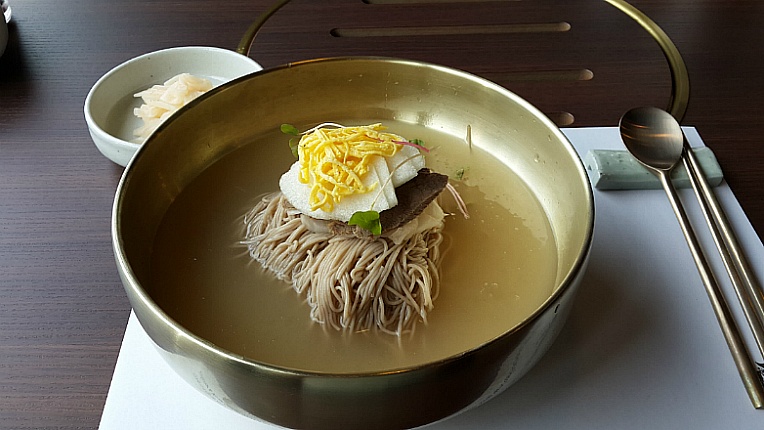 NaengmyeonLong buckwheat noodles in icy broth, born in North Korea and eaten most in summer
 GanggangsullaeA Korean harvest dance where women hold hands and sing in circles under the full moon
Good reading and sources
The facts on this page come from the Wikipedia article "Day of the Shining Star", written by its contributors and used under the CC BY-SA 4.0 licence, and from its Wikidata record (CC0). EveryParampara rewrote the text in its own words, with AI assistance, and compares every page with the article to make sure no passage is copied. It may be reused under the same CC BY-SA 4.0 licence with a link back.
It may contain mistakes. Traditions differ from one family, village and community to the next, and the people who keep them know them best. If something is wrong, tell us. Last refreshed 2026-10-04.
More from North Korea
All the traditions of North Korea
🇰🇵 Pyongyang, North KoreaDay of the Sun태양절
North Korea's principal holiday, marking the birth anniversary of Kim Il SungCeremony
🇰🇵 Pyongyang, North KoreaArirang Mass Games아리랑 축제
A massive civic spectacle of gymnastics, dance, and card stunts in PyongyangCeremony
 🇰🇵 Pyongyang, North Korea and 4 moreMass games
Disciplined, large-scale gymnastic spectacles celebrating unity and national prideCeremony
🇰🇵 Pyongyang, North Korea and 4 moreMass games
Disciplined, large-scale gymnastic spectacles celebrating unity and national prideCeremony
 🇰🇷 Seoul, South Korea and 1 moreNational Liberation Day of Korea광복절 (Gwangbokjeol)
A public holiday on 15 August marking Korea's liberation from Japanese rule in 1945Ceremony
🇰🇷 Seoul, South Korea and 1 moreNational Liberation Day of Korea광복절 (Gwangbokjeol)
A public holiday on 15 August marking Korea's liberation from Japanese rule in 1945Ceremony
The same idea elsewhere
All of this kind 🇺🇸 Philadelphia, United States and 1 moreIndependence Day
The United States' national day of parades, barbecues and fireworks, kept each July 4Ceremony
🇺🇸 Philadelphia, United States and 1 moreIndependence Day
The United States' national day of parades, barbecues and fireworks, kept each July 4Ceremony
 🇺🇸 United StatesTalking stick
A carved staff that shows who may speak at a Northwest Coast gatheringCeremony
🇺🇸 United StatesTalking stick
A carved staff that shows who may speak at a Northwest Coast gatheringCeremony
 🇺🇸 Washington, United StatesState of the Union address
The US president's yearly report to Congress and the nation, given in the House chamberCeremony
🇺🇸 Washington, United StatesState of the Union address
The US president's yearly report to Congress and the nation, given in the House chamberCeremony
 🇮🇳 Kolkata, IndiaJana Gana Mana
India's national anthem, from a Bengali hymn of 1911, sung at civic occasionsCeremony
🇮🇳 Kolkata, IndiaJana Gana Mana
India's national anthem, from a Bengali hymn of 1911, sung at civic occasionsCeremony