Australian rules football
A fast, high-scoring code of football with 18 players a side, first played in Melbourne

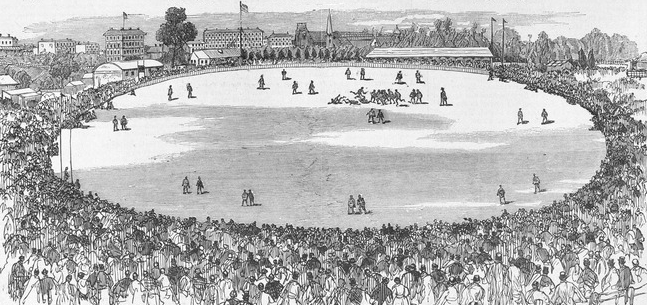
Australian rules football is a contact sport for two teams of 18 players, played on grass ovals that often double as cricket grounds. It began in Melbourne in the late 1850s and is now the most watched sport in Australia, with a professional league at the top and amateur games in many countries.
When is Australian rules football kept?
Australian rules football is kept on competitions run through the cooler months; the season closes with the Grand Final.
Australian rules football is a contact sport in which two sides of 18 players contest an oval ball on a grass field. It grew out of winter games played by Melbourne cricketers and schoolboys in the 1850s, and Australians now treat it as their own code, calling it footy. Matches are fast, high-scoring and full of catching and tackling.
What it is
Each side puts 18 players on the ground, with interchange players held in reserve. The object is to move an oval ball down the field and score. A kick that passes between the two middle posts is worth six points. A kick that goes between a middle post and an outer post scores one point, known as a behind. Players may use their hands or their whole body to obstruct an opponent, so contests are frequent and often rough. Play is quick and scoring is high.
Early history
Football games were played now and then in the Australian colonies before 1850, but they left no clear line to the modern code. In 1858 Melbourne schools began arranging matches modelled on English public school games. That July a letter in a Melbourne sporting paper, written by the cricket captain Tom Wills, called for a football club with its own set of laws so that cricketers could stay fit through winter. Cricketers then held informal kickabouts on the Richmond Paddock, using trees as goalposts.
The first laws
In May 1859 the Melbourne Football Club was formally set up, one of the oldest football clubs anywhere. Three days afterwards, four men met at a hotel near the Melbourne Cricket Ground and wrote ten rules. They wanted a simple game that suited Melbourne's hard grounds and did less damage to working men than English school football, where shin-kicking was allowed. Their code left out the offside rule altogether. Copies of the rules went around the colony, and the journalist among the group, J. B. Thompson, did much to spread them. Rival clubs later added small changes, and a common set known as Victorian rules took shape.
Spread and competitions
Adelaide formed a club in 1860, the earliest outside Victoria, and South Australia had the sport's first governing body in 1877. Tasmania came to a slightly altered version of the Victorian game in 1879. Clubs began touring, and Victoria met South Australia in Melbourne in 1879. Delegates from four colonies agreed on a common code in 1883. During the 1880s faster play and high marking drew large crowds, and payment of players grew, especially where gold rushes brought crowds and money. Rugby later overtook Australian rules in New South Wales and Queensland, though the Riverina stayed a stronghold.
Today and change
The Victorian Football League broke away from the older association in 1896 and played its first season the next year, cutting teams to 18 players and bringing in a finals series. It is now the Australian Football League, the only fully professional competition in the sport, and it draws the biggest crowds of any sport in the country. Its Grand Final, played each year at the Melbourne Cricket Ground, is the best attended club championship match of any football code. The AFL Commission governs the laws with its Laws of the Game Committee. Amateur and junior competitions run in many countries.
How Australian rules football is kept
Two teams of 18 take the field against each other. Play starts with the ball bounced or thrown up between two ruckmen. Players may stand wherever they like and move the ball by kicking it, striking it with a closed hand, or running with it, though a runner must touch the ball to the ground every so often. A catch from a kick that travels far enough earns a mark, giving the catcher a free, unchallenged moment with the ball. Opponents may be tackled by hand or blocked with the body. Free kicks punish pushes in the back, interference in a marking contest and deliberate slowing of play.
When and where
There is no single day for the sport. Competitions run through the cooler months of the year, and the professional season ends with a Grand Final, held each year at the Melbourne Cricket Ground. The first organised games belong to 1858, when school sides met in June and the Melbourne football club wrote its laws the following May.
The game's home is Melbourne and the state of Victoria, where it draws the largest crowds and gave the city the oval grounds that other sports now share. It is also strong in South Australia, Western Australia and Tasmania, and in the Riverina district of New South Wales. Amateur competitions are played in many countries.
What Australian rules football means
The sport gained a reputation as the people's game. It was the first football code to attract crowds on a mass scale, and long before television it set world records for sports attendance. A statue outside the Melbourne Cricket Ground marks the school match of 1858, and the two schools still meet each year in the Cordner-Eggleston Cup, the longest-running football competition anywhere. In Victoria, cricket grounds opened to football in winter, and the two sports have shared ovals ever since.


Questions people ask about Australian rules football
When is Australian rules football kept?
Australian rules football is kept on competitions run through the cooler months; the season closes with the Grand Final.
What is Australian rules football?
It is a contact sport for two teams of 18 players, played on a grass oval. Players kick, handpass and run with an oval ball, and score by sending it between goal posts. Marks, tackles and free kicks shape the play, and matches are known for speed and high scores.
Where did the game come from?
Melbourne, in the 1850s. School matches in 1858 followed English public school football, and in May 1859 the Melbourne Football Club issued ten rules. Those laws, later revised by other clubs into the Victorian rules, are the base of the modern game.
Is it related to Gaelic football or to Aboriginal games?
People have suggested a link with Irish Gaelic football since the 1920s, but no archive evidence supports it. A theory put forward in 1983 holds that Tom Wills may have seen the Aboriginal game Marn Grook, yet the evidence is only circumstantial. Wills's biographer Greg de Moore found he was shaped almost entirely by Rugby School.
Who runs the sport?
The AFL Commission governs the rules, advised by the Laws of the Game Committee. The Australian Football League is the sport's only fully professional competition, and it is the wealthiest sporting body in the country. Below it, amateur and junior competitions run in many countries, and the game has several variations.
See also
 Surf lifesavingA volunteer beach rescue and ocean sports tradition originating on Australian coasts.
 Pub quizA weekly social trivia game played by teams at tables in pubs and bars
 Good FridayA solemn Christian holy day commemorating the crucifixion and death of Jesus Christ.
 Mother's DayA worldwide annual celebration dedicated to mothers, maternal bonds and family care
Good reading and sources
- Encyclopaedia BritannicaArticle
- AFL headed to China for Port Adelaide v Gold Coast clashABC News Australia, Article
- Which sport won 2024? Australia audiences feast on free-to-air despite streaming boomThe Guardian, Article
- AFL headed to China for Port Adelaide v Gold Coast clashABC News Australia, Article
- Which sport won 2024? Australia audiences feast on free-to-air despite streaming boomThe Guardian, Article
- Australian rules football on WikipediaEncyclopedia
- More photos on Wikimedia CommonsPhotos and video
- Wikidata recordOpen data
The facts on this page come from the Wikipedia article "Australian rules football", written by its contributors and used under the CC BY-SA 4.0 licence, and from its Wikidata record (CC0). EveryParampara rewrote the text in its own words, with AI assistance, and compares every page with the article to make sure no passage is copied. It may be reused under the same CC BY-SA 4.0 licence with a link back.
It may contain mistakes. Traditions differ from one family, village and community to the next, and the people who keep them know them best. If something is wrong, tell us. Last refreshed 2026-10-05.
More from Australia
All the traditions of Australia
🇬🇧 United Kingdom and 4 morePub quiz
A weekly social trivia game played by teams at tables in pubs and barsGame
🇦🇺 Sydney, Australia and 5 moreSurf lifesaving
A volunteer beach rescue and ocean sports tradition originating on Australian coasts.Game
 🇦🇺 Melbourne, AustraliaBoxing Day Test
Cricket's annual Test match at the Melbourne Cricket Ground, starting each 26 DecemberGame
🇦🇺 Melbourne, AustraliaBoxing Day Test
Cricket's annual Test match at the Melbourne Cricket Ground, starting each 26 DecemberGame
 🇰🇭 Phnom Penh, Cambodia and 3 moreBokatorល្បុក្កតោ (lbŏkkâtaô)
Cambodia's battlefield martial art of strikes, locks and weapons, now a ring sportGame
🇰🇭 Phnom Penh, Cambodia and 3 moreBokatorល្បុក្កតោ (lbŏkkâtaô)
Cambodia's battlefield martial art of strikes, locks and weapons, now a ring sportGame
The same idea elsewhere
All of this kind 🇺🇸 Fairbanks, United States and 2 moreWorld Eskimo-Indian Olympics
An annual Arctic gathering of traditional survival games, athletics, and cultural artsGame
🇺🇸 Fairbanks, United States and 2 moreWorld Eskimo-Indian Olympics
An annual Arctic gathering of traditional survival games, athletics, and cultural artsGame
 🇨🇭 Aproz, Switzerland and 2 moreCombat de Reines
An annual Swiss pushing contest where Hérens cows compete for herd dominanceGame
🇨🇭 Aproz, Switzerland and 2 moreCombat de Reines
An annual Swiss pushing contest where Hérens cows compete for herd dominanceGame
 🇲🇽 MexicoRarájipari
A traditional endurance running ball game of the Rarámuri people in northern MexicoGame
🇲🇽 MexicoRarájipari
A traditional endurance running ball game of the Rarámuri people in northern MexicoGame
 🇸🇪 Mora, SwedenVasaloppet
A 90 km cross-country ski race from Sälen to Mora, run every March since 1922Game
🇸🇪 Mora, SwedenVasaloppet
A 90 km cross-country ski race from Sälen to Mora, run every March since 1922Game