Games, sport and playEuropeChristianSecular and civic
Calcio storico fiorentino
A fierce Renaissance ball game played on sand between four Florentine districts

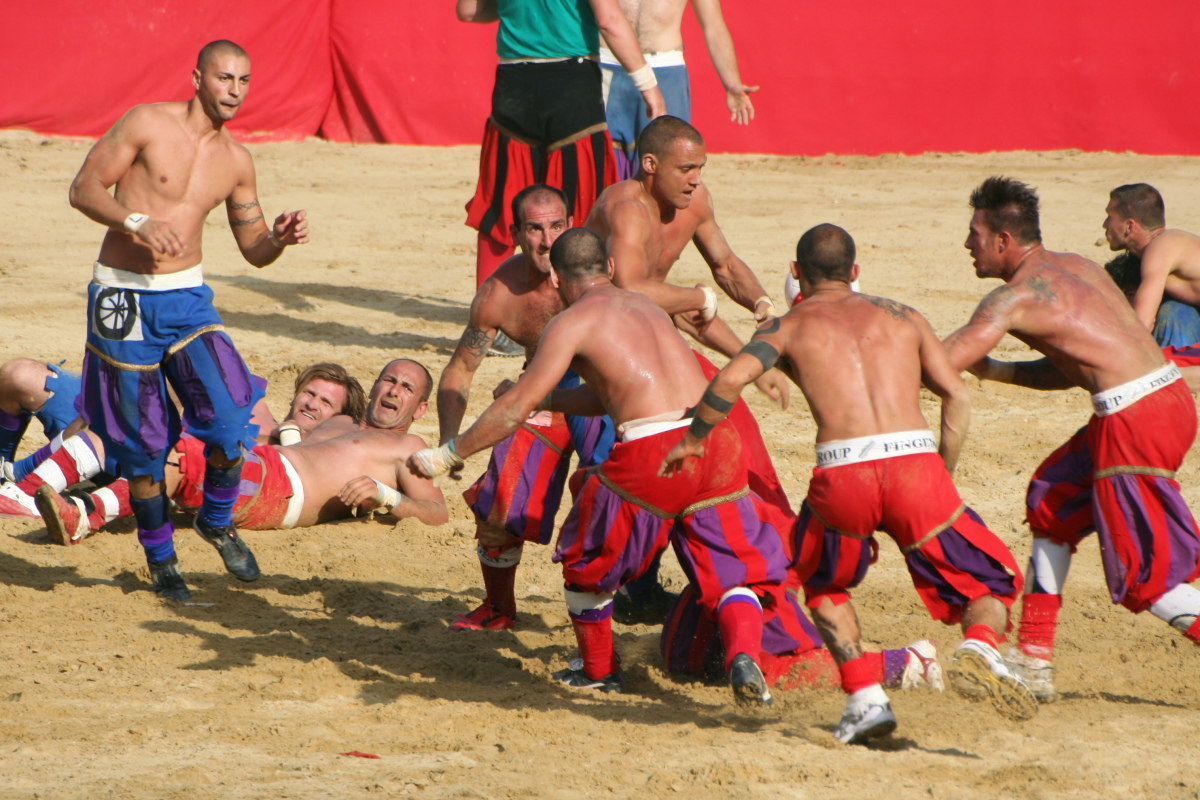
Calcio storico fiorentino is a centuries-old physical sport that pits the historic neighbourhoods of Florence against one another on a sand pitch. Staged every June, four squads of twenty-seven players battle through intense combat and tactical running to score goals during the city's midsummer festival.
When is Calcio storico fiorentino kept?
Calcio storico fiorentino is kept on annually in the third week of June, concluding on 24 June.
Calcio storico fiorentino is a bare-knuckle ancestor of modern football, contested annually in the heart of Florence. Originating in medieval military conditioning, the tournament brings together four historic city quarters in an open sand arena. Competitors rely on grappling, punching, and teamwork to drive a ball toward the opposing goal line. Florentines maintain the tradition to honour civic pride and keep their Renaissance sporting heritage alive.
Origins and Renaissance history
Legend traces the game to martial drills meant to condition young fighters, possibly evolving from the ancient Roman pursuit called harpastum. Italian aristocrats eventually refined these rough exercises into an organised competition. In a famous display of municipal defiance, citizens staged a contest in February 1530 while imperial troops besieged their walls. Noblemen, knights, and military commanders took part on the sand of Piazza Santa Croce. Near the close of the sixteenth century, Giovanni de' Bardi drafted the earliest recorded rules. Following a decline during the seventeenth century, the tournament was officially revived in 1930 within the Kingdom of Italy.
Pitch and team structure
Matches occur within a rectangular sand-covered court measuring roughly one hundred metres long and fifty metres wide. A central white boundary splits the area into equal halves, with netting stretched across both ends. Each side fields twenty-seven men: fifteen attacking runners, five halfbacks, three fullbacks, and four goalkeepers. Squads are led by a captain and an ensign stationed in tents beside the net, who direct strategy and help resolve disputes. On-field discipline is managed by a chief referee alongside six linesmen, while an off-pitch commissioner oversees the event. Substitutions are never permitted, even when men suffer injuries or ejections.
Match flow and scoring
Small cannon fire signals the start of the fifty-minute contest. Once the ball is tossed into the centre, front-line runners engage in physical combat, using wrestling, tackles, and strikes to disable defenders. After enough rivals are pinned or neutralised, teammates advance the ball toward the net. Putting the ball across the boundary secures a caccia, or goal, prompting the teams to switch ends. Inaccurate attempts that fly above the net yield half a point to the opposition. The squad with the highest tally of cacce wins. In earlier times, champions received a Chianina cow; today they receive a shared victory meal.
Neighbourhood rivalries and rules
Four city quarters compete every year: the Blues of Santa Croce, the Reds of Santa Maria Novella, the Whites of Santo Spirito, and the Greens of San Giovanni. Since 1979, the Blues have earned more than twenty titles. Because the sport permits head-butts, chokes, and punches, modern regulations have evolved to curb extreme hazards. Outright bans forbid surprise sucker punches, strikes to the head with feet, and multiple players ganging up on a single rival. Participants must also hold local roots, either through birth in Florence or a decade of residency, and individuals with criminal records are barred from competing.
How Calcio storico fiorentino is kept
Four Florentine districts enter a three-match knockout competition staged across the third week of June. Two semi-final fixtures decide which sides reach the final match on June 24. A culverin blast opens each fifty-minute game as twenty-seven players per side contest the sand arena. Forwards grapple, wrestle, and strike opponents to clear space, while ball carriers push toward the full-width netting at the far end. Successful goals prompt teams to trade sides of the pitch. When time expires, the district with the most goals claims victory, celebrating their triumph with a communal banquet and the pallio.
When and where
The tournament occurs annually across the third week of June. Two initial elimination matches determine the finalists, who clash on 24 June as part of Florence's midsummer festivities.
The games are held in the historic centre of Florence, Italy. The matches take place in Piazza Santa Croce, where the public square is transformed into a temporary sand arena for the tournament.
What Calcio storico fiorentino means
The tradition represents civic courage, local loyalty, and neighborhood pride. Staging the 1530 match during an imperial siege turned the sport into an enduring symbol of Florentine independence and defiance. Today, representing one of the four historic quartieri honors ancestral heritage, while victory brings esteem to the neighborhood and reinforces community identity through spirited athletic rivalry.


Questions people ask about Calcio storico fiorentino
When is Calcio storico fiorentino kept?
Calcio storico fiorentino is kept on annually in the third week of June, concluding on 24 June.
What is calcio storico fiorentino?
It is an early form of football from Renaissance Italy that combines ball play with wrestling and striking. Four teams of twenty-seven players compete on a sand field to score goals by carrying or throwing the ball into wide nets.
Where and when does the tournament take place?
The tournament is held in Piazza Santa Croce in Florence, Italy, during the third week of June, concluding with a final match on 24 June.
Which teams compete in the matches?
Four historic quarters of Florence field teams: Santa Croce wearing blue, Santa Maria Novella in red, Santo Spirito in white, and San Giovanni in green.
What physical moves are allowed during a match?
Players may tackle, punch, elbow, choke, and wrestle opponents to clear paths for the ball. However, kicking opponents in the head, blindside punches, and double-teaming a single opponent are strictly banned.
See also
 ChristmasA festival of Jesus's birth, kept on 25 December with gifts, lights and shared meals
 Valentine's DayA Christian feast day and cultural celebration of love kept on February 14 in many countries.
 Christmas treeA decorated evergreen or artificial tree placed indoors to mark the Christmas season.
 Holy WeekThe solemn seven days leading to Easter, recalling the final week and Passion of Jesus
Good reading and sources
- Calcio storico fiorentino on WikipediaEncyclopedia
- More photos on Wikimedia CommonsPhotos and video
- Wikidata recordOpen data
The facts on this page come from the Wikipedia article "Calcio storico fiorentino", written by its contributors and used under the CC BY-SA 4.0 licence, and from its Wikidata record (CC0). EveryParampara rewrote the text in its own words, with AI assistance, and compares every page with the article to make sure no passage is copied. It may be reused under the same CC BY-SA 4.0 licence with a link back.
It may contain mistakes. Traditions differ from one family, village and community to the next, and the people who keep them know them best. If something is wrong, tell us. Last refreshed 2026-10-04.
More from Italy
All the traditions of Italy 🇨🇭 Aproz, Switzerland and 2 moreCombat de Reines
An annual Swiss pushing contest where Hérens cows compete for herd dominanceGame
🇨🇭 Aproz, Switzerland and 2 moreCombat de Reines
An annual Swiss pushing contest where Hérens cows compete for herd dominanceGame
 🇮🇹 Naples, Italy and 5 moreGreasy pole
A slippery pole climbed, walked or crossed to win a prize at the top or the far endGame
🇮🇹 Montepulciano, ItalyBravio delle botti
An annual uphill wine barrel race between the eight historic districts of MontepulcianoGame
🇮🇹 Rome, Italy and 4 moreChristmas
A festival of Jesus's birth, kept on 25 December with gifts, lights and shared mealsFestival
🇮🇹 Naples, Italy and 5 moreGreasy pole
A slippery pole climbed, walked or crossed to win a prize at the top or the far endGame
🇮🇹 Montepulciano, ItalyBravio delle botti
An annual uphill wine barrel race between the eight historic districts of MontepulcianoGame
🇮🇹 Rome, Italy and 4 moreChristmas
A festival of Jesus's birth, kept on 25 December with gifts, lights and shared mealsFestival
The same idea elsewhere
All of this kind 🇺🇸 Fairbanks, United States and 2 moreWorld Eskimo-Indian Olympics
An annual Arctic gathering of traditional survival games, athletics, and cultural artsGame
🇺🇸 Fairbanks, United States and 2 moreWorld Eskimo-Indian Olympics
An annual Arctic gathering of traditional survival games, athletics, and cultural artsGame
 🇲🇽 MexicoRarájipari
A traditional endurance running ball game of the Rarámuri people in northern MexicoGame
🇲🇽 MexicoRarájipari
A traditional endurance running ball game of the Rarámuri people in northern MexicoGame
 🇰🇬 Cholpon-Ata, Kyrgyzstan and 2 moreWorld Nomad GamesДүйнөлүк көчмөндөр оюндары
A two-yearly contest of Central Asian nomadic sports, first staged in Kyrgyzstan in 2014Game
🇰🇬 Cholpon-Ata, Kyrgyzstan and 2 moreWorld Nomad GamesДүйнөлүк көчмөндөр оюндары
A two-yearly contest of Central Asian nomadic sports, first staged in Kyrgyzstan in 2014Game
 🇲🇽 Veracruz, Mexico and 3 moreMesoamerican ballgameōllamalīztli
An ancient Mesoamerican ball game, struck with the hips on stone courtsGame
🇲🇽 Veracruz, Mexico and 3 moreMesoamerican ballgameōllamalīztli
An ancient Mesoamerican ball game, struck with the hips on stone courtsGame