Music, dance and storytellingNorth AmericaChristianIndigenous and traditional
Chinelos
Masked dancers from Morelos who spoof colonial manners at Carnival

Chinelos are masked dancers whose tradition grew in Morelos, Mexico, out of indigenous and Catholic Carnival customs. Troupes perform in towns such as Tlayacapan and Tepoztlán at Carnival, on weekends from late January until Lent, and at other fiestas.
When is Chinelos marked?
Chinelos is kept as part of Candlemas, which is on Tuesday, 2 February 2027.
Chinelos are costumed dancers found mainly in Morelos, Mexico, and in the southern parts of Mexico City. They wear long velvet robes, gloves, mesh masks with turned-up beards and broad plumed hats. The dance started as mockery of European colonisers and their manners, and it is still performed at Carnival, at Independence Day events and at fiestas through the year.
What it is
Chinelos are groups of costumed dancers, and the word is used both for the people and for the practice itself. They are seen above all in Morelos, and also in parts of the State of Mexico and the south of Mexico City, in boroughs such as Milpa Alta, Tlalpan, Xochimilco and Magdalena Contreras. A troupe wears the same kind of outfit: a long tunic or robe, a mask with European features, a wide plumed hat and gloves. Each town and each group now has its own variations. The dancers often march with a brass band through a town, hopping and shuffling in time.
Origins and history
The name comes from a Nahuatl word meaning disguised. After the Spanish conquest, native rites and Christian festivals mixed, and Carnival gave people a few days when masks, role reversal and unusual behaviour were allowed. Dancers used that opening to make fun of the Europeans among them. The costume as it looks now was shaped between the middle of the 19th century and the start of the 20th, when it also mocked the ballroom manners of the wealthy and the push to make Mexico more European. Tlayacapan is often named as the likely birthplace of the dance in its present form.
The costume
Four pieces make up the outfit: robe or tunic, mask, hat and gloves. Velvet is common. The shape of the robe and its fine decoration give dancers a nearly androgynous look. Because the clothing is very hot, dancers tie bandannas around their heads to avoid losing too much water. The mask is built on mesh, always with a beard turned up and European features, and gloves cover the hands, so nobody can tell who is inside. Designs differ by town: Tepoztlán favours smooth black velvet with a painted image on the back, while Yautepec covers velvet with beads, sequins and imitation stones. Hats carry images from pre-Hispanic stories.
Carnival and other days
Carnival is the main setting. Troupes take turns over the weekends that fall before Lent, dancing from mid-afternoon on Friday until late on Sunday, always with a brass band. The Carnival in Tlayacapan is the most traditional, and a well known Morelos band grew out of it. Dancers also appear at Independence Day in Cuernavaca, at Candlemas on 2 February, at feasts for Our Lady of Sorrows, and at private parties, where groups can be hired. In Milpa Alta and Xochimilco no large festival takes place without them, and they walk in processions for the Niñopa image.
Today and change
Chinelos have become a recognised emblem of Morelos, and the number of towns with their own troupes keeps growing. Some groups are now hired for private celebrations, so the dancing is no longer tied only to Carnival. Costumes have grown heavier and more decorated, and making them is a trade in itself: in Tlayacapan several families work at it full time, and one hatter in Tepoztlán does nothing else. Competitions are held for the best outfit. The old tradition in Taxco has faded, though one group of about forty dancers remains.
How Chinelos is kept
Dancers, mostly young men, gather with a brass band. Feet apart and knees bent, they shuffle twice, then lean with one shoulder and hop to the side, repeating this for hours. Groups dance as long as the music lasts, and members join or leave a line as the day goes on. Roles pass from parents to children, and children may dance on a different day. Costumes are kept hidden and put on in separate houses so that no one is recognised.
When and where
Most Chinelos dance at Carnival. Events open on a weekend late in January, and towns take their turn on the weekends that follow until Lent begins. Dancing runs from Friday afternoon into Sunday night. Outside Carnival, troupes appear at Independence Day, at Candlemas on 2 February and at other local fiestas.
Morelos is the heart of the tradition, and Tlayacapan, Tepoztlán, Yautepec and Jiutepec are its best known towns. Dancers also work in the State of Mexico, in Mexico City boroughs such as Milpa Alta, Xochimilco and Tlalpan, and a small group keeps the custom going in Landa, near Taxco in Guerrero.
What Chinelos means
The dance began as mockery. Masked figures copied the fine clothes, pale faces and turned-up beards of the colonial and later Europeanised upper classes, and the haughty way they held themselves. Masks, gloves and headscarves hide who is dancing, and Carnival allows that kind of licence for a few days. The costume has since become a badge of local pride, especially in Morelos, where the troupe is a sign of the town.


Days Chinelos is marked
Questions people ask about Chinelos
When is Chinelos marked?
Chinelos is kept as part of Candlemas, which is on Tuesday, 2 February 2027.
What are Chinelos?
They are costumed dancers from central Mexico, best known in Morelos. Each one wears a long robe, a mesh mask with a turned-up beard, gloves and a wide hat with feathers. A brass band plays while the group shuffles and hops through the streets, usually at Carnival.
Where is the tradition strongest?
In the state of Morelos, particularly in Tlayacapan, Tepoztlán, Yautepec and Jiutepec. It also lives in the State of Mexico, in the southern boroughs of Mexico City, and in one small community near Taxco in Guerrero.
Why do they wear masks?
The mask hides the dancer's face, and gloves and a headscarf hide the rest, so nobody knows who is inside. The disguise also carries the old joke of the tradition: the mask copies European features and a beard, making fun of colonial and later upper-class manners.
See also
 Danza de los ViejitosA Purépecha masked dance honouring the sun and the four elements in Michoacán
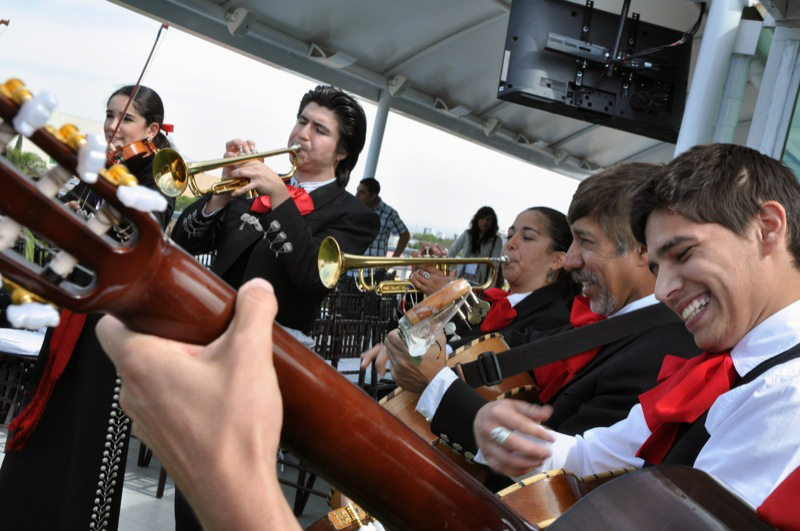 MariachiA Mexican string and trumpet music tradition featuring charro attire and communal singing.
 Mexican hat danceMexico's national courtship dance, in which a dancer's steps circle the brim of a hat
 Baile folklóricoStaged folk dances of Mexico and Central America, with regional dress and mariachi music
Good reading and sources
- Chinelos on WikipediaEncyclopedia
- More photos on Wikimedia CommonsPhotos and video
- Wikidata recordOpen data
The facts on this page come from the Wikipedia article "Chinelos", written by its contributors and used under the CC BY-SA 4.0 licence, and from its Wikidata record (CC0). EveryParampara rewrote the text in its own words, with AI assistance, and compares every page with the article to make sure no passage is copied. It may be reused under the same CC BY-SA 4.0 licence with a link back.
It may contain mistakes. Traditions differ from one family, village and community to the next, and the people who keep them know them best. If something is wrong, tell us. Last refreshed 2026-10-05.
More from Mexico
All the traditions of Mexico
🇲🇽 MexicoDanza de los ViejitosT'arche Uarakua
A Purépecha masked dance honouring the sun and the four elements in MichoacánPerformance
🇲🇽 Guadalajara, Mexico and 1 moreMariachi
A Mexican string and trumpet music tradition featuring charro attire and communal singing.Performance
🇲🇽 Veracruz, Mexico and 3 moreBaile folklórico
Staged folk dances of Mexico and Central America, with regional dress and mariachi musicPerformance
🇲🇽 Guadalajara, MexicoMexican hat danceJarabe tapatío
Mexico's national courtship dance, in which a dancer's steps circle the brim of a hatPerformance
The same idea elsewhere
All of this kind 🇹🇷 Kayseri, Turkey and 4 moreHalay
A traditional line and circle folk dance kept across Turkey, Azerbaijan, Armenia, Iran, and Syria.Performance
🇧🇷 BrazilBaião
A syncopated folk rhythm and partnered dance from northeastern BrazilPerformance
🇹🇷 Kayseri, Turkey and 4 moreHalay
A traditional line and circle folk dance kept across Turkey, Azerbaijan, Armenia, Iran, and Syria.Performance
🇧🇷 BrazilBaião
A syncopated folk rhythm and partnered dance from northeastern BrazilPerformance
 🇺🇦 Kyiv, UkraineBanduraБандура
A Ukrainian plucked string instrument played to accompany epic songs and folk balladsPerformance
🇺🇦 Kyiv, UkraineBanduraБандура
A Ukrainian plucked string instrument played to accompany epic songs and folk balladsPerformance
 🇳🇿 Auckland, New ZealandPoi
A Māori performing art of swinging tethered weights in rhythmical patterns.Performance
🇳🇿 Auckland, New ZealandPoi
A Māori performing art of swinging tethered weights in rhythmical patterns.Performance