Music, dance and storytellingNorth America
Mexican hat dance
In its own language: Jarabe tapatío
Mexico's national courtship dance, in which a dancer's steps circle the brim of a hat

Mexico's national dance, a courtship scene for one man and one woman, shaped in Guadalajara in the 19th century from older jarabe tunes and footwork. A woman in china poblana dress and a man in charro suit dance around a hat on the floor, usually to mariachi or string music.
When is Mexican hat dance kept?
Mexican hat dance is kept on all year round, at fiestas, festivals, school events and family celebrations.
The jarabe tapatío, called the Mexican hat dance in English, is the national dance of Mexico. It grew out of a courtship dance in Guadalajara in the 19th century, and dancers act out a man's pursuit of a woman and her first refusal. It is taught in nearly every Mexican grade school.
What it is
The jarabe tapatío is a dance for one man and one woman who act out a courtship. She turns him down at first, then accepts. The flirtation is explicit in the metaphor, and that is what made officials object to the dance long ago. The man circles the brim of his partner's hat, which rests on the floor, and this is why English speakers call it the Mexican hat dance. Mexicans commonly name it the country's national dance. The name has two parts. Jarabe comes from an Arabic word for syrup, and tapatío means a person or thing from Guadalajara. Jarabe is also a broad family of tunes and footwork dances from different regions, not one fixed piece.
Origins and history
Traces of the dance reach back to the late 1700s. Women danced it in pairs at first, a form they chose to avoid the disapproval of the church. Mixed couples took it up shortly before the war of independence, and a public performance was held at the Coliseo theater in Mexico City in 1790. Colonial and religious authorities answered with a ban, threatening excommunication, fines and lashes to anyone who composed, sang or danced it. They judged it morally offensive and a challenge to Spanish control. The ban made it more popular instead. People held dances in public squares and at neighbourhood festivals, and the jarabe became a way of showing dissent.
Dress and music
Women wear the china poblana. The name comes from a woman born in India who travelled to Mexico on a Manila galleon in the early 1800s and worked there as a servant. Her Asian dress was copied and then reworked in Puebla, and the skirt is now heavily embroidered and decorated, often with patriotic images. Men dress as charros, with silver trim worked over the suit. The music was written to be danced to. Mariachi groups play it, and so do ensembles of string instruments, among them several kinds of guitar, harps and violins. The instrumental arrangement heard most often today dates from the 1920s. Listeners sometimes mistake the tune for La Raspa, another Mexican dance.
A national emblem
With Spanish rule gone, the restrictions fell away and the fiestas of 1821 featured the jarabe. Folk dances came to stand for the young nation, and the jarabe led that change. The Guadalajara version gained national standing: it was danced by elites in Mexico City in the 1860s and later by poorer Mexicans. Guadalajara music teacher Jesús González Rubio wrote its standard melody, which became a symbol of unity and helped the dance take the name of national dance. Russian dancer Anna Pavlova put it in her repertoire after visiting Mexico in 1919, bringing it attention abroad. Scholars disagree about its roots, some stressing indigenous elements, others Hispanic ones, though most call it a mestizo creation.
Today and change
Nearly every grade school in Mexico teaches the jarabe tapatío. In Mexican communities in the United States, groups of performers are becoming more common, and dancers use the piece to reconnect with Mexican heritage or citizenship while living abroad. The melody has travelled far outside Mexico. It was used in Yakko's World on Animaniacs, as a mobile phone ringtone in the 1990s and 2000s, in Looney Tunes shorts and for the Bumblebee Man character in The Simpsons. A British supermarket chain used the tune in advertising from the 1980s into the 2000s and brought the jingle back in 2023. Aaron Copland quoted a jarabe on solo trumpet in his ballet Billy the Kid.
How Mexican hat dance is kept
A man and a woman dance as a pair. The woman begins by refusing the man's approaches, and as the piece goes on she accepts them. In the usual telling the man's steps carry him around the hat, which lies on the floor. Mariachi players or a string ensemble accompany the dancers, and the melody is a set piece that most Mexicans know at once. Women wear the china poblana and men the charro suit with silver trim. Groups also perform it, and Mexican communities in the United States have growing numbers of performing troops.
When and where
The jarabe tapatío has no fixed day in the calendar. It belongs to fiestas, neighbourhood festivals, school events and family celebrations rather than to a single date, and performances can happen at any time of year.
It took shape in Guadalajara, in the state of Jalisco, and is strongest in Mexico, where it is called the national dance. Mexico City has a long link with it, from an early public performance in 1790 to its vogue among the elite in the 1860s. Mexicans living in the United States also keep it through performing groups.
What Mexican hat dance means
For Mexicans the dance stands for the country itself. It began as an act of defiance when colonial authorities banned it, and after independence it was taken up as a sign of a shared national identity built around mestizo culture. The plot is a small courtship, but the piece carries a larger meaning: a Mexican art form that displaced imported fashion and became the dance the nation points to when it presents itself.


Questions people ask about Mexican hat dance
When is Mexican hat dance kept?
Mexican hat dance is kept on all year round, at fiestas, festivals, school events and family celebrations.
What is the jarabe tapatío?
It is Mexico's national dance, a courtship piece for a man and a woman. The woman refuses him at first and then accepts. The man's steps move around a hat on the floor, which is why English speakers call it the Mexican hat dance.
Where and when did it begin?
It began in Guadalajara, in the state of Jalisco, during the 19th century, though traces of the dance go back to the late 1700s. Its roots are disputed: some researchers stress indigenous elements, others Spanish ones, and most describe the result as mestizo.
Why was it banned?
Colonial and religious authorities banned the jarabe in the years before independence. They judged its sexual metaphor morally offensive and saw it as a challenge to Spanish rule, threatening excommunication, fines and lashes to anyone who composed, sang or danced it.
What do the dancers wear?
Women wear the china poblana, an embroidered blouse and skirt adapted in Puebla and named after a servant from India. Men wear the charro suit, usually with heavy silver trim. Both outfits are widely seen as representing Mexican men and women.
What music is it danced to?
The standard melody was written in the 19th century by Guadalajara music teacher Jesús González Rubio, and the arrangement most often heard today dates from the 1920s. Mariachi groups play it, or ensembles of guitars, harps and violins.
See also
 Danza de los ViejitosA Purépecha masked dance honouring the sun and the four elements in Michoacán
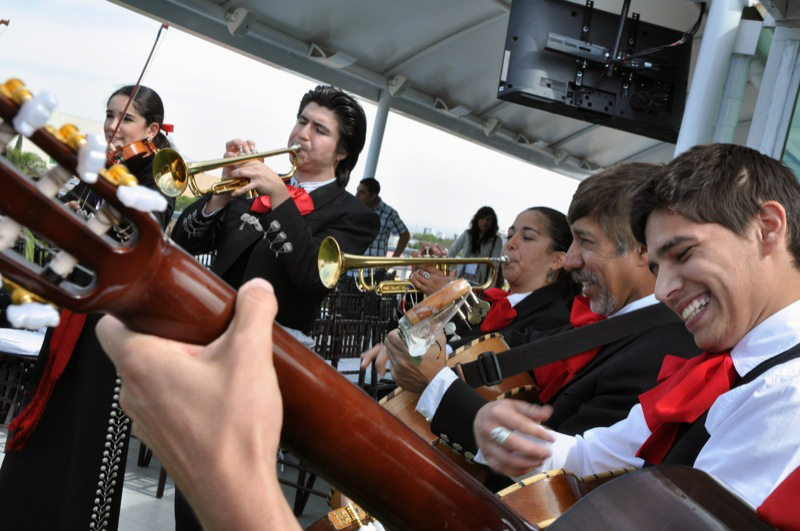 MariachiA Mexican string and trumpet music tradition featuring charro attire and communal singing.
 HalloweenAn annual observance on 31 October marking the eve of All Saints' Day, rooted in Christian tradition and Celtic heritage
 Day of the DeadA Mexican remembrance of deceased family and friends with altars, marigolds and feasts
Good reading and sources
- Mexican hat dance on WikipediaEncyclopedia
- More photos on Wikimedia CommonsPhotos and video
- Wikidata recordOpen data
The facts on this page come from the Wikipedia article "Mexican hat dance", written by its contributors and used under the CC BY-SA 4.0 licence, and from its Wikidata record (CC0). EveryParampara rewrote the text in its own words, with AI assistance, and compares every page with the article to make sure no passage is copied. It may be reused under the same CC BY-SA 4.0 licence with a link back.
It may contain mistakes. Traditions differ from one family, village and community to the next, and the people who keep them know them best. If something is wrong, tell us. Last refreshed 2026-10-05.
More from Mexico
All the traditions of Mexico
🇲🇽 MexicoDanza de los ViejitosT'arche Uarakua
A Purépecha masked dance honouring the sun and the four elements in MichoacánPerformance
🇲🇽 Guadalajara, Mexico and 1 moreMariachi
A Mexican string and trumpet music tradition featuring charro attire and communal singing.Performance
 🇲🇽 Veracruz, Mexico and 3 moreBaile folklórico
Staged folk dances of Mexico and Central America, with regional dress and mariachi musicPerformance
🇲🇽 Veracruz, Mexico and 3 moreBaile folklórico
Staged folk dances of Mexico and Central America, with regional dress and mariachi musicPerformance
 🇲🇽 Tlayacapan, MexicoChinelos
Masked dancers from Morelos who spoof colonial manners at CarnivalPerformance
🇲🇽 Tlayacapan, MexicoChinelos
Masked dancers from Morelos who spoof colonial manners at CarnivalPerformance
The same idea elsewhere
All of this kind 🇹🇷 Kayseri, Turkey and 4 moreHalay
A traditional line and circle folk dance kept across Turkey, Azerbaijan, Armenia, Iran, and Syria.Performance
🇧🇷 BrazilBaião
A syncopated folk rhythm and partnered dance from northeastern BrazilPerformance
🇹🇷 Kayseri, Turkey and 4 moreHalay
A traditional line and circle folk dance kept across Turkey, Azerbaijan, Armenia, Iran, and Syria.Performance
🇧🇷 BrazilBaião
A syncopated folk rhythm and partnered dance from northeastern BrazilPerformance
 🇺🇦 Kyiv, UkraineBanduraБандура
A Ukrainian plucked string instrument played to accompany epic songs and folk balladsPerformance
🇺🇦 Kyiv, UkraineBanduraБандура
A Ukrainian plucked string instrument played to accompany epic songs and folk balladsPerformance
 🇳🇿 Auckland, New ZealandPoi
A Māori performing art of swinging tethered weights in rhythmical patterns.Performance
🇳🇿 Auckland, New ZealandPoi
A Māori performing art of swinging tethered weights in rhythmical patterns.Performance