Music, dance and storytellingSub-Saharan AfricaSecular and civic
Congolese rumba
An African dance music and guitar tradition born along the Congo River

Congolese rumba is an African dance music genre created in Kinshasa and Brazzaville during the mid-twentieth century from local rhythms and Cuban son records. Built on intertwining guitar melodies, lyrical vocals in Lingala, and energetic dance sections called sebenes, it is celebrated across central Africa and beyond.
When is Congolese rumba kept?
Congolese rumba is kept on year-round during concerts, dance parties, and social gatherings.
Congolese rumba is a celebrated African dance music tradition that arose along the Congo River in the mid-twentieth century. Developing from older Bakongo partner dances and imported Afro-Cuban records, the style unites layered guitars, rich vocal harmonies, and dynamic drum rhythms. Recognized worldwide, including on UNESCO's intangible cultural heritage list, it remains a beloved soundtrack for social life, dancing, and community celebrations across Central Africa.
Origins and history
The roots of the genre trace back to maringa, a partnered dance practiced by Bakongo communities across the former Kingdom of Loango. During the 1920s and 1930s, maringa became central to urban nightlife in Brazzaville and Léopoldville, now Kinshasa. Musicians combined early frame drums, bottles, and accordions. In the 1940s and 1950s, records of Cuban son arrived in Central Africa and were marketed locally as rumba. Congolese artists absorbed these transatlantic sounds, blending them with local rhythms to create modern Congolese rumba. The name rumba itself may stem from nkumba, a Kikongo word referring to a traditional navel dance.
Instruments and guitar layers
Congolese rumba relies on an intricate arrangement of guitars supported by a steady rhythm section. Early groups used the likembe thumb piano, frame drums, and struck bottles before adopting acoustic guitars, accordions, and larger jazz-style orchestrations with brass sections. Guitarists often tuned their instruments to open Hawaiian tunings, using capos to create a characteristic buzzing tone. In performance, three distinct guitars interlock: the lead guitar weaves agile, high-pitched melodies, the rhythm guitar maintains the underlying cycle, and the mi-solo guitar bridges the gap between them. Electric bass and syncopated percussion anchor the harmony and clave rhythm.
Music and the sebene
A typical song opens with a slower vocal section featuring expressive singing, often in Lingala, French, or Kikongo, with harmonies arranged in thirds. The tempo then shifts into the sebene, an energetic instrumental bridge. During this section, rhythm players follow dynamic drumming cues while lead guitarists trade lively melodic patterns. Performers known as atalaku deliver rhythmic chants and spoken hype to energize dancers on the floor. Singers also practice libanga, shouting the names of friends and patrons during the show to show respect and encourage audience appreciation.
Evolution and wider reach
In the decades following its emergence, Congolese rumba continued to reshape African popular music. During the 1960s and 1970s, it gave rise to soukous, which quickened the tempo and introduced brighter, polyrhythmic brass arrangements. By the late 1990s, the style evolved further into ndombolo, incorporating modern electronic production and synthesizers. The music spread beyond Central Africa into East, West, and Southern Africa, while Congolese bands touring internationally built enthusiastic audiences in Europe and North America. Today, the tradition remains an influential sound across the continent.
How Congolese rumba is kept
Performances usually take place in dance halls, clubs, and concert stages. Bands begin pieces with slower, emotive vocal melodies accompanied by rhythmic guitars and horns. As the song progresses, the drummer signals a transition into the fast-paced sebene. The lead guitarist takes center stage with rapid, high-register lines, while atalaku hype performers direct chants to the crowd. Dancers fill the floor with rhythmic hip movements, and singers interject libanga shout-outs to acknowledge patrons and community figures throughout the performance.
When and where
Congolese rumba is played year-round without a fixed season. It is heard during weekend evenings in neighborhood bars, at family milestones, throughout public festivities, and at international music festivals.
The tradition is centered in the twin capital cities of Kinshasa and Brazzaville, facing each other across the Congo River. It is also actively performed across the Democratic Republic of the Congo, the Republic of the Congo, and neighboring African nations, as well as within the global Congolese diaspora.
What Congolese rumba means
Congolese rumba serves as an enduring symbol of identity and shared heritage for Central African communities. Through practices like libanga and call-and-response vocalizing, the music honors personal relationships, social solidarity, and ancestral connections. Its history of absorbing transatlantic sounds and making them distinctly Congolese reflects cultural resilience and creativity across generations.


Questions people ask about Congolese rumba
When is Congolese rumba kept?
Congolese rumba is kept on year-round during concerts, dance parties, and social gatherings.
What is Congolese rumba?
Congolese rumba is a dance music genre that blends indigenous Central African rhythms with Afro-Cuban musical influences. It is famous for its layered guitar melodies, polyrhythmic percussion, and energetic dance sections called sebenes.
Where did Congolese rumba originate?
The tradition arose in the mid-twentieth century along the Congo River, particularly in the neighboring capitals of Kinshasa in the Democratic Republic of the Congo and Brazzaville in the Republic of the Congo.
What is the sebene in Congolese rumba?
The sebene is a fast, high-energy instrumental section near the end of a rumba song. It spotlights interlocking guitar solos, rapid drumming, and rhythmic chanting from hype performers to encourage dancing.
What languages are used in Congolese rumba songs?
Vocalists perform primarily in Lingala, but songs also feature lyrics in French, Kikongo, Swahili, Tshiluba, and Spanish. The vocals often feature rich harmonies arranged in thirds alongside emotive melodic ornaments.
See also
 Zanzibar International Film FestivalAn annual ten-day arts, music and cinema gathering held across Zanzibar.
 LipizzanerA gray riding horse breed and centuries-old tradition of classical dressage kept by the Spanish Riding School.
 CastellA Catalan tradition of building multi-level human towers at festivals, requiring strength, balance, and community solida
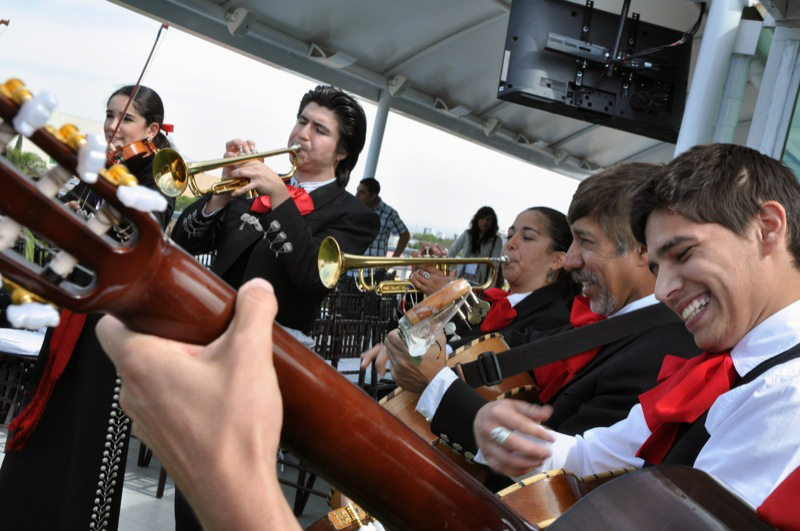 MariachiA Mexican string and trumpet music tradition featuring charro attire and communal singing.
Good reading and sources
- What made Papa Wemba so influential?BBC, Article
- ‘The soul of the Congolese’: Rumba added to UNESCO heritage listAl Jazeera, Article
- UNESCO : Building Peace through Education, Science and Culture, communication and informationUNESCO, Heritage listing
- How African music made it big in ColombiaThe Guardian, Article
- What made Papa Wemba so influential?BBC, Article
- ‘The soul of the Congolese’: Rumba added to UNESCO heritage listAl Jazeera, Article
- UNESCO : Building Peace through Education, Science and Culture, communication and informationUNESCO, Article
- How African music made it big in ColombiaThe Guardian, Article
- Congolese rumba on WikipediaEncyclopedia
- More photos on Wikimedia CommonsPhotos and video
- Wikidata recordOpen data
The facts on this page come from the Wikipedia article "Congolese rumba", written by its contributors and used under the CC BY-SA 4.0 licence, and from its Wikidata record (CC0). EveryParampara rewrote the text in its own words, with AI assistance, and compares every page with the article to make sure no passage is copied. It may be reused under the same CC BY-SA 4.0 licence with a link back.
It may contain mistakes. Traditions differ from one family, village and community to the next, and the people who keep them know them best. If something is wrong, tell us. Last refreshed 2026-10-04.
More from the Democratic Republic of the Congo
All the traditions of the Democratic Republic of the Congo 🇨🇩 Democratic Republic of the CongoKuba textiles
Elaborate raffia cloths from the Democratic Republic of the Congo, known for their complex geometric embroidery and velvCraft
🇨🇩 Democratic Republic of the CongoKuba textiles
Elaborate raffia cloths from the Democratic Republic of the Congo, known for their complex geometric embroidery and velvCraft
 🇰🇪 Kenya and 5 moreKitenge
A printed cloth tied at the waist or chest, worn as a wrap, head cover or baby slingDress
🇰🇪 Kenya and 5 moreKitenge
A printed cloth tied at the waist or chest, worn as a wrap, head cover or baby slingDress
 🇰🇷 South Korea and 4 moreParents' Day어버이날 (Eobeoinal)
Days set aside in several countries to thank mothers and fathersFestival
🇦🇴 Angola and 2 moreLusona
Sand drawings from Angola and Zambia that carry proverbs, fables and animalsCraft
🇰🇷 South Korea and 4 moreParents' Day어버이날 (Eobeoinal)
Days set aside in several countries to thank mothers and fathersFestival
🇦🇴 Angola and 2 moreLusona
Sand drawings from Angola and Zambia that carry proverbs, fables and animalsCraft
The same idea elsewhere
All of this kind 🇹🇷 Kayseri, Turkey and 4 moreHalay
A traditional line and circle folk dance kept across Turkey, Azerbaijan, Armenia, Iran, and Syria.Performance
🇧🇷 BrazilBaião
A syncopated folk rhythm and partnered dance from northeastern BrazilPerformance
🇹🇷 Kayseri, Turkey and 4 moreHalay
A traditional line and circle folk dance kept across Turkey, Azerbaijan, Armenia, Iran, and Syria.Performance
🇧🇷 BrazilBaião
A syncopated folk rhythm and partnered dance from northeastern BrazilPerformance
 🇺🇦 Kyiv, UkraineBanduraБандура
A Ukrainian plucked string instrument played to accompany epic songs and folk balladsPerformance
🇺🇦 Kyiv, UkraineBanduraБандура
A Ukrainian plucked string instrument played to accompany epic songs and folk balladsPerformance
 🇳🇿 Auckland, New ZealandPoi
A Māori performing art of swinging tethered weights in rhythmical patterns.Performance
🇳🇿 Auckland, New ZealandPoi
A Māori performing art of swinging tethered weights in rhythmical patterns.Performance