Festivals and celebrationsEast AsiaChristianSecular and civic
Parents' Day
In its own language: 어버이날 (Eobeoinal)
Days set aside in several countries to thank mothers and fathers

A day for thanking mothers and fathers, kept in several countries on different dates. South Korea marks it on 8 May with carnations. In the United States the date is the fourth Sunday in July. The Democratic Republic of the Congo keeps 1 August, the Philippines a Monday in December, and the United Nations 1 June, as the Global Day of Parents.
When is Parents' Day kept?
Parents' Day is kept each country sets its own date. South Korea keeps 8 May, the Democratic Republic of the Congo 1 August, and the United Nations 1 June. The U.
Parents' Day is a family observance, not one worldwide date. South Korea keeps it on 8 May with carnations. In the United States it falls on the fourth Sunday in July. The Philippines names a December Monday, the Democratic Republic of the Congo keeps 1 August, and the United Nations marks 1 June as the Global Day of Parents. Each version thanks mothers and fathers for raising children.
What it is
Parents' Day is kept in more than one country, and each place has its own date and its own way of marking it. There is no single worldwide day. South Korea and the United States, the Philippines, the Democratic Republic of the Congo and India all have a version of it. The United Nations adds a global one, the Global Day of Parents, on 1 June. The shared idea is simple: mothers and fathers are thanked for the work they do in raising children, and families are given a reason to gather and give something back.
Origins in Korea
Korean observance began with Christian communities in the 1930s, some of which had started to keep Mother's Day or Parents' Day. Those church habits met Korea's Confucian tradition of honoring elders, and the mixture produced a Mother's Day. In 1956 the State Council fixed 8 May as the yearly date. Talk then turned to fathers, and on 30 March 1973 a presidential decree, number 6615, renamed the day Parents' Day. At first the whole week around the eighth was set aside for respecting older people. That part ended in 1997, when October took over as the month for honoring elders.
Korea's day today
On 8 May, families turn their attention to their mother and father. A carnation is the usual gift, and wearing one is part of the day. Both the flower and the ceremony around it came from Christian practice in the United States. Ordinary families and the government alike take part. Public ceremonies are organized by the Ministry of Health and Welfare and take in awards as well as celebrations. The day also has official standing as one of the country's anniversaries, so it is recognized by the state as well as kept at home.
The American resolution
In the United States, Parents' Day exists because of a congressional resolution that President Bill Clinton signed in 1994. It is written into law at 36 U.S.C. § 135, and its purpose is to recognize, uphold and support the part parents play in bringing up children. Senator Trent Lott, a Republican, brought the bill forward, and the Unification Church lent its support. That church keeps a Parents' Day of its own, but on a different date. The American version has no fixed customs attached; it is simply set aside on the fourth Sunday in July each year.
Other countries
The Philippines has the most complicated history. A 1921 circular fixed the first Monday of December as Mothers' Day, after the Ilocos Norte Federation of Woman's Clubs asked for one. President Quezon's 1937 proclamation turned it into Parents' Day, because petitions for a separate Fathers' Day were judged unwise with so many holidays already set. Proclamations in 1980 and 1988 followed the international dates, and President Estrada tried to revive the observance in 1998. In the Democratic Republic of the Congo, 1 August is a public holiday called Siku ya Wazazi in Swahili. It dates from 1979, when Mobutu replaced All Saints' Day with it. Families tidy relatives' graves in the morning, then give cards and gifts to their parents. India keeps Parents' Worship Day on 14 February.
How Parents' Day is kept
Korean families mark 8 May with a carnation for each parent, and government ceremonies with awards follow. In the United States the day is simply kept on a Sunday in July, with no fixed rituals. Filipino families once pinned pink cadena de amor flowers on their chests, and white ones for children whose mothers had died. Congolese families begin 1 August at the cemeteries, cleaning graves, then hand cards and presents to their parents. India keeps Parents' Worship Day on 14 February. The United Nations marks 1 June as the Global Day of Parents.
When and where
There is no shared date. South Korea's is 8 May, and it has been fixed since 1973. The United States uses the fourth Sunday in July. The Philippines names the first Monday of December, though it is not strictly observed there. The Democratic Republic of the Congo keeps 1 August. The United Nations set 1 June as the Global Day of Parents.
It is strongest in South Korea, where it is both a family day and a national anniversary. The United States and the Philippines each have their own version, and the Democratic Republic of the Congo treats it as a public holiday. India keeps Parents' Worship Day on 14 February. The United Nations version belongs to no single country.
What Parents' Day means
At heart the day asks people to acknowledge what parents do: feeding, raising and providing for children. In Korea it also carries the Confucian value of respecting older people, which is why the week around 8 May was once set aside for elders. In the Democratic Republic of the Congo the meaning stretches further. Parents there are not only those who bore and raised you; the word covers everyone who helped build the foundations of your life, and the dead are remembered too.
Questions people ask about Parents' Day
When is Parents' Day kept?
Parents' Day is kept each country sets its own date. South Korea keeps 8 May, the Democratic Republic of the Congo 1 August, and the United Nations 1 June. The U.
What is Parents' Day?
It is a day for thanking mothers and fathers and for honoring the work they do in raising children. Several countries keep their own version, on their own date, and the United Nations adds a global one on 1 June.
Is it the same as Mother's Day and Father's Day?
No. It is a separate observance, though it grew out of Mother's Day in South Korea and the Philippines. The Philippines chose one day for both parents instead of two, and the American resolution was about parents generally.
What do people give or do?
Carnations are the common gift in South Korea, where wearing one is part of the day. Filipino children once wore cadena de amor flowers on their chests. In the Democratic Republic of the Congo families clean relatives' graves and then give cards and gifts to their parents.
Does it have official recognition?
In several places, yes. South Korea set it by presidential decree in 1973, the United States by a law signed in 1994, and the Democratic Republic of the Congo lists it as a public holiday. The United Nations proclaimed 1 June as the Global Day of Parents.
See also
 HalloweenAn annual observance on 31 October marking the eve of All Saints' Day, rooted in Christian tradition and Celtic heritage
 DiwaliA five-day festival of lights celebrated across India and its diaspora to mark the victory of light over darkness.
 HanukkahAn eight-day Jewish festival marking the rededication of the Second Temple in Jerusalem and the miracle of a single day'
 MawlidAn annual festival marking the birth of the Prophet Muhammad, marked by poetry, processions and feasts.
Good reading and sources
The facts on this page come from the Wikipedia article "Parents' Day", written by its contributors and used under the CC BY-SA 4.0 licence, and from its Wikidata record (CC0). EveryParampara rewrote the text in its own words, with AI assistance, and compares every page with the article to make sure no passage is copied. It may be reused under the same CC BY-SA 4.0 licence with a link back.
It may contain mistakes. Traditions differ from one family, village and community to the next, and the people who keep them know them best. If something is wrong, tell us. Last refreshed 2026-10-05.
More from South Korea
All the traditions of South Korea 🇮🇳 India and 4 moreWater lantern
Small lamps floated on water to honour the dead and ask for good fortuneFestival
🇮🇳 India and 4 moreWater lantern
Small lamps floated on water to honour the dead and ask for good fortuneFestival
 🇮🇳 India and 6 moreBuddha's Birthday佛诞 (Fódàn)
A festival marking the birth of Siddhartha Gautama, observed across Asia with temple rituals and community gatherings.Festival
🇮🇳 India and 6 moreBuddha's Birthday佛诞 (Fódàn)
A festival marking the birth of Siddhartha Gautama, observed across Asia with temple rituals and community gatherings.Festival
 🇨🇳 China and 5 moreChinese New Year's Evechúxī
A reunion day for ethnic Chinese families before the Lunar New Year, marked by feasts, rituals, and staying up late.Festival · Dinner
🇨🇳 China and 5 moreChinese New Year's Evechúxī
A reunion day for ethnic Chinese families before the Lunar New Year, marked by feasts, rituals, and staying up late.Festival · Dinner
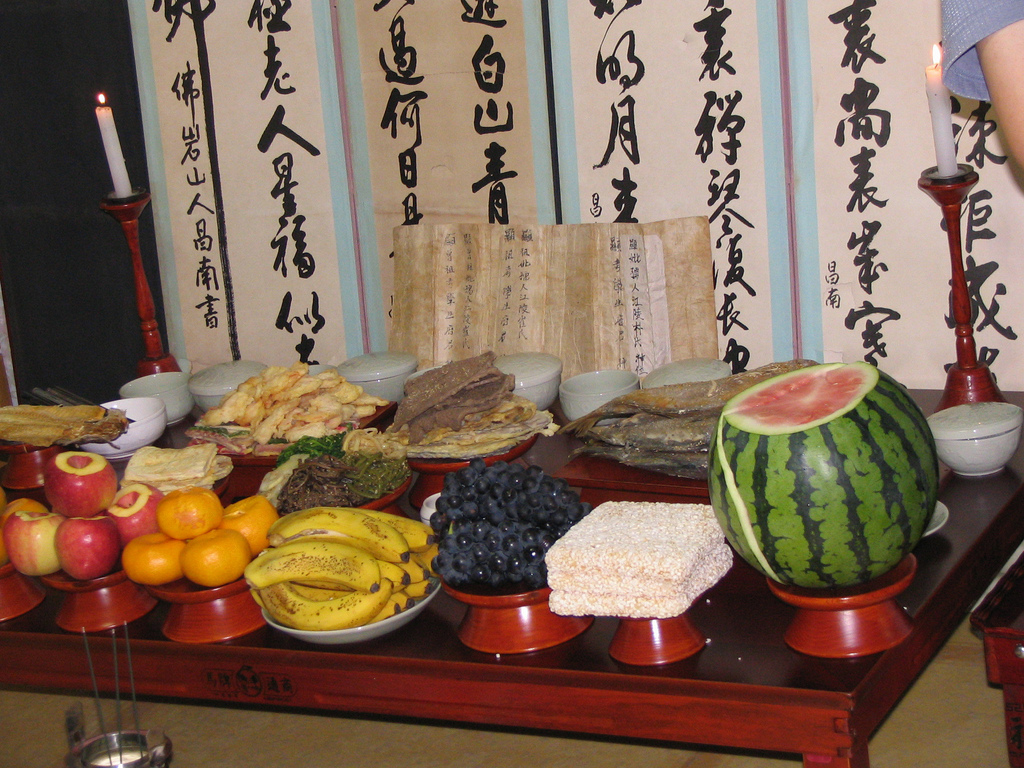 🇰🇷 South Korea and 1 moreChuseok추석
A Korean harvest festival of ancestral rites, seasonal rice cakes, and folk gamesFestival · Feasts and festival meals
🇰🇷 South Korea and 1 moreChuseok추석
A Korean harvest festival of ancestral rites, seasonal rice cakes, and folk gamesFestival · Feasts and festival meals
The same idea elsewhere
Remembering the ancestors compared
🇮🇪 Ireland and 5 moreHalloween
An annual observance on 31 October marking the eve of All Saints' Day, rooted in Christian tradition and Celtic heritageFestival · Sweets given and shared
🇮🇳 Ayodhya, India and 7 moreDiwaliदीपावली (Dīpāvalī)
A five-day festival of lights celebrated across India and its diaspora to mark the victory of light over darkness.Festival · Feasts and festival meals
 🇮🇷 Iran and 7 moreNowruzنوروز
The Iranian new year at the March equinox, kept with fire, greenery and picnicsSeasonal
🇮🇱 Jerusalem, Israel and 1 moreHanukkahחֲנֻכָּה
An eight-day Jewish festival marking the rededication of the Second Temple in Jerusalem and the miracle of a single day'Festival
🇮🇷 Iran and 7 moreNowruzنوروز
The Iranian new year at the March equinox, kept with fire, greenery and picnicsSeasonal
🇮🇱 Jerusalem, Israel and 1 moreHanukkahחֲנֻכָּה
An eight-day Jewish festival marking the rededication of the Second Temple in Jerusalem and the miracle of a single day'Festival