Cotswold Olimpick Games
Races, wrestling and shin-kicking on a Cotswold hillside, held since about 1612

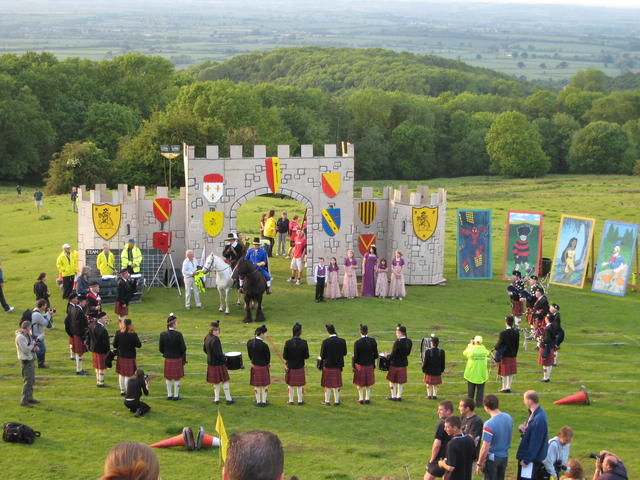
The Cotswold Olimpick Games are a public day of sports and games held each year on the Friday following the Spring Bank Holiday, on Dover's Hill above Chipping Campden in England. A lawyer named Robert Dover started them around 1612 with the approval of King James I, and after long gaps the event was taken up again in 1963.
When is Cotswold Olimpick Games kept?
Cotswold Olimpick Games is kept each year on the Friday following the Spring Bank Holiday; in earlier centuries over two days in Whitsun week.
For one day each year a hillside above Chipping Campden fills with runners, wrestlers and a crowd that comes to watch them. These are the Cotswold Olimpick Games, a public festival of sport and play. A local lawyer, Robert Dover, is credited with starting them around 1612, and the event carries on today, after a revival in 1963.
A day of contests
The programme has altered a great deal over four hundred years. In the earliest records the sports include running and jumping, wrestling, shin-kicking, throwing a sledgehammer, quarterstaff play, and fighting with swords or cudgels. Horse races were run, and hounds were used for coursing. Booths and tents went up where people played chess, cards and a board game called Irish for small stakes, and plenty of food was provided for those who came. A hunting horn called the competitors to the hillside, and cannon were fired to open the competitions. Silver trophies were among the prizes.
Robert Dover and 1612
The event takes its name from Robert Dover, a lawyer who most likely moved to Saintbury, close to Chipping Campden, in about 1611. He is thought to have been born in Norfolk between 1575 and 1582, a son of John Dover. The first meeting is usually dated to 1612, though some accounts put it as early as 1601. Dover is said to have had King James I's approval for the scheme. Whether he invented the games or took over an older gathering, perhaps a church ale, cannot be settled from the evidence.
Puritan objections
Plenty of people disliked the games. Many Puritans of the 17th century thought that even small pleasures could draw a person towards sin, and they were uneasy about merrymaking on church holidays. The coat, feather and ruff that Dover wore, sent to him by the king, looked to them like a challenge; one Puritan writer even condemned the starch used to stiffen linen. Wealthy landowners of Puritan outlook barred their servants from going. Quarrels of this kind hardened into the English Civil War in 1642, and the games lapsed. They returned after the Restoration of 1660.
Revivals and today
Without Dover, who died in 1652, the gathering was said by critics to have turned into little more than a drunken country fair, and for a time it was known as Dover's Meeting. It came to an end in 1852, when the common land used for the sports was divided among landowners and farmers and then enclosed. A third beginning came in 1963. Since 1966 the games have taken place on the Friday following the Spring Bank Holiday. Recent programmes have featured shin-kicking, tug of war, morris dancing, judo and motorcycle scrambling. According to the British Olympic Association, they are among the earliest forerunners of the British Olympic movement.
How Cotswold Olimpick Games is kept
A single day, in late May or early June. Crowds climb Dover's Hill above Chipping Campden. A horn call and a cannon shot have opened the sports in the past; the day then moves through athletics and wrestling, shin-kicking, sword and cudgel play, and in recent times tug of war, judo and motorcycle scrambling. Officials called sticklers keep the fighters apart, and the phrase 'a stickler for the rules' is traced to them. Local people and visitors take part, a committee runs the event, and fireworks close it.
When and where
The modern games fall on the Friday following the Spring Bank Holiday, so they land in late May or early June, and this has been the pattern since 1966. In their early centuries they were kept over two days in Whitsun week, a movable church season that also shifted between mid-May and mid-June.
Dover's Hill, above Chipping Campden in Gloucestershire, in the Cotswold hills of England. The sports are staged in a natural hollow in the hillside that used to be called Kingcombe Plain. In the 17th century spectators travelled in from Gloucestershire, Oxfordshire and Worcestershire, and Prince Rupert was among those who came to watch.
What Cotswold Olimpick Games means
Dover believed that physical training mattered for the defence of the kingdom, so the games had a practical as well as a festive purpose. He also seems to have wanted rich and poor to share the same occasion, and verse written about the games in 1636 presents them as a scene of social harmony and common enjoyment. Calling them 'Olimpicks' linked the sports to ancient Greece and gave them a classical gloss.


Questions people ask about Cotswold Olimpick Games
When is Cotswold Olimpick Games kept?
Cotswold Olimpick Games is kept each year on the Friday following the Spring Bank Holiday; in earlier centuries over two days in Whitsun week.
What are the Cotswold Olimpick Games?
They are a public day of games and sport held on Dover's Hill, above Chipping Campden in England. Contests over the years have included running, jumping, wrestling, sword fighting, shin-kicking and tug of war, with dancing and fireworks, and the day is often described as an early forerunner of British Olympic sport.
Who founded them?
A local lawyer, Robert Dover, is credited with the first meeting, probably in 1612, though some sources give dates from 1601. He acted with the approval of King James I and presided over the sports himself, dressed in clothes the king had sent.
Why did the games stop?
They were halted by the English Civil War in 1642, brought back after 1660, and described by critics as increasingly disorderly. In 1852 the common land where they were staged was divided up and enclosed, ending them again. They were revived in 1963.
What did Puritans think of them?
Many Puritans objected. They saw such festivities as pagan in origin and likely to encourage drinking and immorality, and they opposed celebrations on church holidays. Some Puritan landowners forbade their workers to attend. Supporters answered the criticism in verse, praising the games as peaceful and well run.
See also
 Chelsea Flower ShowA five-day May horticultural festival held in London by the Royal Horticultural Society
 Trooping the ColourThe annual British military parade marking the official birthday of the monarch.
 Saint David's DayThe national feast day of Wales, marked with parades, poetry contests and daffodils
 Waitangi DayNew Zealand's national day remembering the 1840 founding agreement.
Good reading and sources
- BBC NEWS | UK | England | GloucestershireBBC, Article
- BBC NEWS | UK | England | GloucestershireBBC, Article
- Cotswold Olimpick Games on WikipediaEncyclopedia
- More photos on Wikimedia CommonsPhotos and video
- Wikidata recordOpen data
The facts on this page come from the Wikipedia article "Cotswold Olimpick Games", written by its contributors and used under the CC BY-SA 4.0 licence, and from its Wikidata record (CC0). EveryParampara rewrote the text in its own words, with AI assistance, and compares every page with the article to make sure no passage is copied. It may be reused under the same CC BY-SA 4.0 licence with a link back.
It may contain mistakes. Traditions differ from one family, village and community to the next, and the people who keep them know them best. If something is wrong, tell us. Last refreshed 2026-10-09.
More from the United Kingdom
All the traditions of the United Kingdom 🇦🇺 Sydney, Australia and 5 moreSurf lifesaving
A volunteer beach rescue and ocean sports tradition originating on Australian coasts.Game
🇦🇺 Sydney, Australia and 5 moreSurf lifesaving
A volunteer beach rescue and ocean sports tradition originating on Australian coasts.Game
 🇮🇹 Naples, Italy and 5 moreGreasy pole
A slippery pole climbed, walked or crossed to win a prize at the top or the far endGame
🇮🇹 Naples, Italy and 5 moreGreasy pole
A slippery pole climbed, walked or crossed to win a prize at the top or the far endGame
 🇬🇧 United Kingdom and 4 morePub quiz
A weekly social trivia game played by teams at tables in pubs and barsGame
🇬🇧 United Kingdom and 4 morePub quiz
A weekly social trivia game played by teams at tables in pubs and barsGame
 🇬🇧 United Kingdom and 3 moreApple bobbing
A Halloween game where players try to catch floating apples with their teeth.Game
🇬🇧 United Kingdom and 3 moreApple bobbing
A Halloween game where players try to catch floating apples with their teeth.Game
The same idea elsewhere
Royalty and coronation compared 🇮🇱 IsraelRosh Hashanahרֹאשׁ הַשָּׁנָה
The Jewish New Year marked by shofar horn blasts, prayer and sweet foodsSpiritual
🇮🇱 IsraelRosh Hashanahרֹאשׁ הַשָּׁנָה
The Jewish New Year marked by shofar horn blasts, prayer and sweet foodsSpiritual
 🇵🇪 Cusco, Peru and 4 moreIntiinti (Quechua)
The Inca sun deity, honoured with temples, offerings and the June festival Inti RaymiSpiritual
🇹🇭 ThailandThai solar calendarปฏิทินสุริยคติไทย
The official solar calendar of Thailand, numbered in the Buddhist EraSeasonal
🇵🇪 Cusco, Peru and 4 moreIntiinti (Quechua)
The Inca sun deity, honoured with temples, offerings and the June festival Inti RaymiSpiritual
🇹🇭 ThailandThai solar calendarปฏิทินสุริยคติไทย
The official solar calendar of Thailand, numbered in the Buddhist EraSeasonal
 🇺🇸 United StatesTalking stick
A carved staff that shows who may speak at a Northwest Coast gatheringCeremony
🇺🇸 United StatesTalking stick
A carved staff that shows who may speak at a Northwest Coast gatheringCeremony