Spiritual and religiousNorth AmericaIndigenous and traditionalChristian
Danza de los Voladores
A Mesoamerican rite of dance and rope, flown from a tall pole to ask for rain

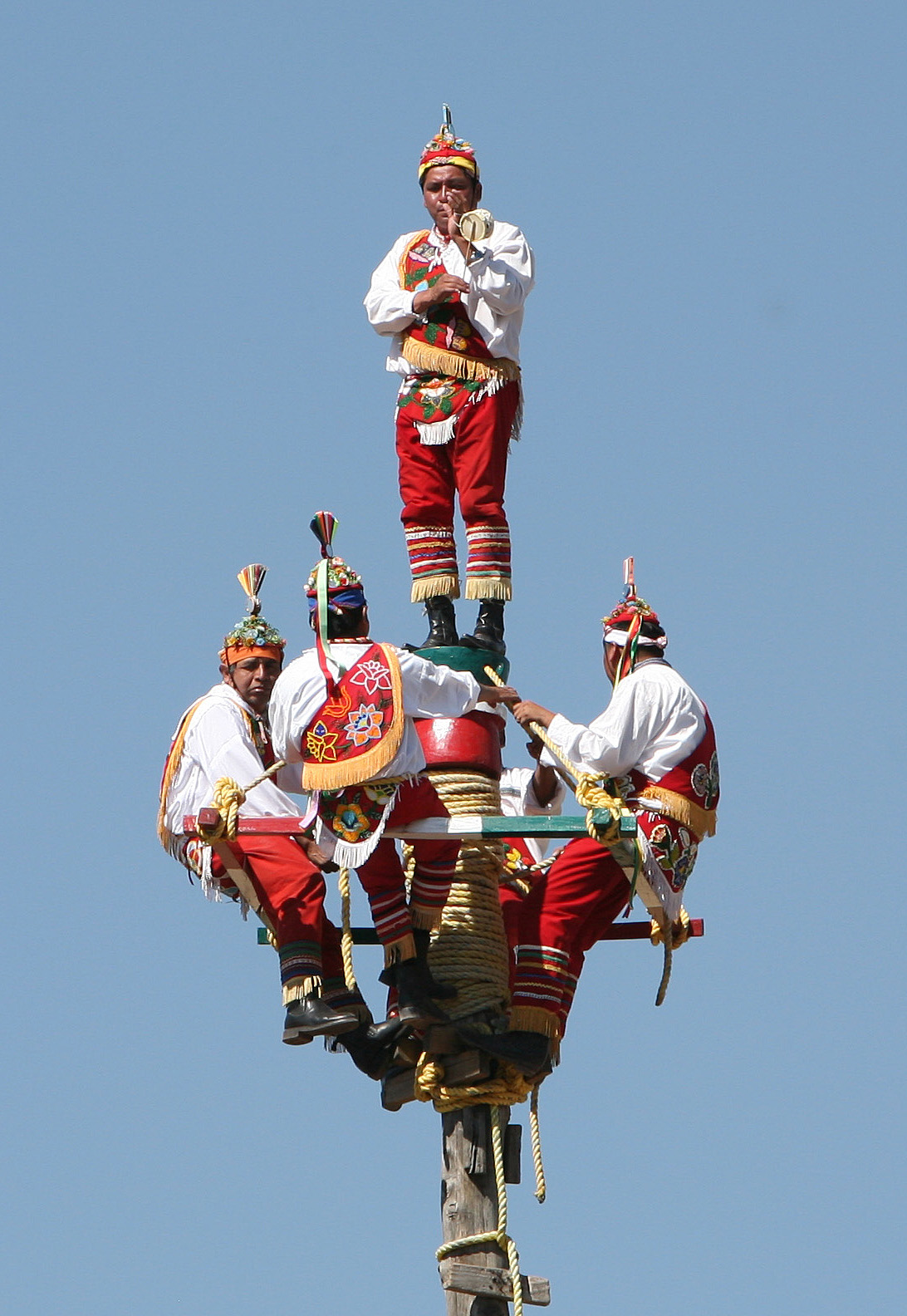
A Mesoamerican rite of dance, flute and drum in which four men tied to ropes swing down from a thirty-metre pole while a fifth stays above them. Totonac communities around Papantla in Veracruz keep it today, and towns in Guatemala keep it on fixed dates.
When is Danza de los Voladores marked?
Danza de los Voladores is kept as part of Spring Equinox, which is on Saturday, 20 March 2027.
The Danza de los Voladores is a Mesoamerican rite in which men climb a tall pole, rope themselves to it and spin down to the ground while a companion plays flute and drum above them. It began as a plea for rain and is still danced in Mexico, above all by Totonac communities near Papantla, and in parts of Guatemala.
Dress and the pole
Totonac dancers dress in a white shirt and red trousers, embroidered all over, and a cap. A decorated length of cloth is worn over the chest. It stands for blood. The cap carries flowers for fertility, mirrors for the sun and long coloured ribbons for the rainbow. The dancers make these clothes themselves. In the longest form of the rite, the tree is chosen and cut first, in a part called tsakáe kiki. The cutters ask pardon of Quihuicolo, the mountain god. Branches are stripped, the trunk is hauled to the village, and a hole is dug to hold it. Offerings of flowers, copal, alcohol, candles and a live chicken or turkey go into the hole, crushed as the pole rises.
Origins and history
No one knows exactly where the rite began. It is usually traced to the Huastec, Nahua and Otomi peoples of the Sierra de Puebla and the mountains of Veracruz, and from there it reached most of Mesoamerica, from northern Mexico down to Nicaragua. Pottery found in Nayarit points to the pre-Classic period, so it is very old. In early times it was longer and stricter, with taboos and meditation, and dancers dressed as parrots, macaws, quetzals and eagles. Records were destroyed after the Spanish conquest and the church discouraged such rites, so they were silenced or kept in secret. Juan de Torquemada left a detailed account, and Catholic elements were added later.
Numbers, birds and gods
The four men on the frame stand for the four directions, and for earth, air, fire and water. The caporal above them is the fifth sun. Every rope is wound thirteen times, and the four together make fifty-two turns, the count of years in a Mesoamerican great year. In Maya telling the pole is the world tree at the centre of the world and the five men are bird deities; the flute sounds like birdsong. The rite belongs above all to rain and to the sun, and is tied to Tlaloc, Xipe Totec and Tlazolteotl. Diego Durán recorded a story of an Aztec prince, Ezhuahuacatl, who killed himself by diving from a high pole.
Versions and rules
Practice varies. Nahua and Otomi dancers often begin at the top with no dance on the ground first. One variant uses a five-sided frame and six dancers instead of five, and is kept most traditionally on Holy Thursday, at the close of a festival called the Huapangueada. Some dancers fast for a day or more beforehand and abstain from sex, so that the gods will look on the rite with favour. In Papantla the Council of Totonac Elders has barred women from taking part, and Totonac ritual dancing has long been closed to them. A few towns in Puebla and Veracruz allow women, who must first seek forgiveness from the gods and the saints.
Today and change
Most dancers now use a permanent pole, often of steel; in Veracruz the oil industry has given many of them. The sharpest change concerns women. No one knows when the first woman flew, but Jesús Arroyo Cerón trained his daughter Isabel in 1972 and later his other daughters. He died in 2006, aged seventy, in a fall during the Cumbre Tajín festival. His family say he fell beside the gods; some elders call it a punishment. A wooden cross and flowers mark the place. About twenty women are known to have been voladores. UNESCO listed the ceremony as Intangible Cultural Heritage to help it live on.
How Danza de los Voladores is kept
The caporal climbs first and stays at his small platform, the manzana, near the top. A square frame, the cuadro, hangs below it. The other four take their places on the frame and wind the ropes. Then they tie themselves on, tip backwards and drop, and the ropes unwind and carry them in circles to the ground. All this time the caporal plays a flute and a drum, greeting the four directions and beginning with the east, then bending far back towards the sun. In the full traditional form, a last dance ends the ceremony once all have landed.
When and where
No single date governs it. In Mexico it may be danced at many points in the year, often around local festivals and the farming calendar, and the six-dancer version belongs most traditionally to Holy Thursday. Guatemalan towns keep it on fixed days: 15 August in Joyabaj, 17 to 23 January in Chichicastenango, 26 July in Cubulco.
Mexico is its main home, and Veracruz and Puebla states hold the strongest centres. Papantla in Veracruz is the town most closely linked with it, and Totonac dancers there are its best known keepers. Other towns in Puebla, among them Cuetzalan and Pahuatlán, and Zozocolco de Hidalgo in Veracruz, also keep it. In Guatemala it survives in Joyabaj, Chichicastenango and Cubulco.
What Danza de los Voladores means
The pole is a meeting place of sky, earth and the world below, treated as the world tree and as a fifth direction. The four who descend stand for the four directions and the four elements; the man above is the fifth sun, and their turning pictures the world made again and life returning. The flute is the birds' song. The Totonac say the gods asked to be watched in dance, and the old purpose of the whole rite is rain, fertile ground and food.


Days Danza de los Voladores is marked
Questions people ask about Danza de los Voladores
When is Danza de los Voladores marked?
Danza de los Voladores is kept as part of Spring Equinox, which is on Saturday, 20 March 2027.
What is the Danza de los Voladores?
An old Mesoamerican rite of dance and rope. Five men climb a pole about thirty metres tall. Four tie themselves to ropes and swing down in circles while the fifth stands above, playing a flute and a drum. It is still performed today, mainly in Mexico.
Where is it kept today?
Its strongest home is Veracruz and Puebla in Mexico, above all around Papantla, where Totonac communities keep it. Towns such as Cuetzalan, Pahuatlán and Zozocolco de Hidalgo also hold it. In Guatemala it is performed at Joyabaj, Chichicastenango and Cubulco.
Why is it performed?
The Totonac story tells of a long drought that brought hunger, because people had turned away from the gods. The rite was made to bring the rain back. When it was danced, Tlaloc, the rain god, and other gods were moved, the rain returned and the earth gave fruit again.
Can women take part?
Rarely. The Council of Totonac Elders in Papantla forbids it, and Totonac ritual dancing has long been closed to women. A few towns in Puebla and Veracruz permit women, who must first ask forgiveness of the gods and the saints. About twenty women are known to have flown.
How old is the tradition?
Its exact origin is unknown. It is usually traced to the Huastec, Nahua and Otomi peoples, and ceramics found in Nayarit suggest it goes back to the pre-Classic period. It spread across Mesoamerica, from northern Mexico to Nicaragua, and was partly lost after the Spanish conquest.
See also
 Holy WeekThe solemn seven days leading to Easter, recalling the final week and Passion of Jesus
 HalloweenAn annual observance on 31 October marking the eve of All Saints' Day, rooted in Christian tradition and Celtic heritage
 Carnival of MazatlánAn annual five-day festival of parades, fireworks, poetry and dance in coastal Mexico
 Eid al-FitrThe feast that ends Ramadan, opened with morning prayers, sweets and visits home
Good reading and sources
- Danza de los Voladores on WikipediaEncyclopedia
- More photos on Wikimedia CommonsPhotos and video
- Wikidata recordOpen data
The facts on this page come from the Wikipedia article "Danza de los Voladores", written by its contributors and used under the CC BY-SA 4.0 licence, and from its Wikidata record (CC0). EveryParampara rewrote the text in its own words, with AI assistance, and compares every page with the article to make sure no passage is copied. It may be reused under the same CC BY-SA 4.0 licence with a link back.
It may contain mistakes. Traditions differ from one family, village and community to the next, and the people who keep them know them best. If something is wrong, tell us. Last refreshed 2026-10-05.
More from Mexico
All the traditions of Mexico 🇺🇸 United States and 2 moreSweat lodge
A purification ceremony kept by Indigenous peoples of the Americas using a heated hut and steam.Spiritual
🇺🇸 United States and 2 moreSweat lodge
A purification ceremony kept by Indigenous peoples of the Americas using a heated hut and steam.Spiritual
 🇲🇽 Mexico City, Mexico and 1 moreOur Lady of GuadalupeNuestra Señora de Guadalupe
A Marian apparition to Juan Diego in Mexico City in December 1531, celebrated on December 12.Spiritual
🇲🇽 Mexico City, Mexico and 1 moreOur Lady of GuadalupeNuestra Señora de Guadalupe
A Marian apparition to Juan Diego in Mexico City in December 1531, celebrated on December 12.Spiritual
 🇲🇽 Mexico and 7 moreLas Posadas
A nine-night Christmas pageant remembering Mary and Joseph seeking shelterSpiritual · Feasts and festival meals
🇲🇽 Mexico and 7 moreLas Posadas
A nine-night Christmas pageant remembering Mary and Joseph seeking shelterSpiritual · Feasts and festival meals
 🇲🇽 Mexico City, MexicoPassion Play of Iztapalapa
A community passion play staged across Iztapalapa during Holy WeekSpiritual
🇲🇽 Mexico City, MexicoPassion Play of Iztapalapa
A community passion play staged across Iztapalapa during Holy WeekSpiritual
The same idea elsewhere
Fasting and feasting compared 🇮🇳 Ayodhya, India and 5 moreRama Navamiराम नवमी
A Hindu spring festival marking the birth of Rama with prayer, fasting and processionsFestival
🇮🇳 Ayodhya, India and 5 moreRama Navamiराम नवमी
A Hindu spring festival marking the birth of Rama with prayer, fasting and processionsFestival
 🇭🇺 Mohács, HungaryBusójárás
A six-day winter carnival of carved wooden masks, folk music, and parades in MohácsFestival
🇭🇺 Mohács, HungaryBusójárás
A six-day winter carnival of carved wooden masks, folk music, and parades in MohácsFestival
 🇬🇧 United Kingdom and 5 moreEgg rolling
A spring game of rolling decorated hard-boiled eggs down hills or along lawnsGame
🇬🇧 United Kingdom and 5 moreEgg rolling
A spring game of rolling decorated hard-boiled eggs down hills or along lawnsGame
 🇨🇴 Barranquilla, ColombiaBarranquilla CarnivalCarnaval de Barranquilla
A four-day street festival of music, masquerade and dance in coastal ColombiaFestival
🇨🇴 Barranquilla, ColombiaBarranquilla CarnivalCarnaval de Barranquilla
A four-day street festival of music, masquerade and dance in coastal ColombiaFestival