Festivals and celebrationsNorth AmericaIndigenous and traditionalChristian
Guelaguetza
An annual Oaxacan festival of indigenous dance, music, costumes and communal sharing

Guelaguetza is an annual cultural celebration held in Oaxaca, Mexico, and among migrant communities in the United States. Rooted in pre-Hispanic traditions of mutual sharing, indigenous groups come together each July to present regional dances, music, native foods and handmade textiles.
When is Guelaguetza kept?
Guelaguetza is kept on the two Mondays directly following July 16.
Guelaguetza is an annual festival celebrated in the Mexican state of Oaxaca and by Oaxacan communities abroad. Drawing its name from a Zapotec concept of reciprocal gift giving, the gathering brings together different native ethnicities, including Zapotec and Mixtec groups. Communities present their traditional dances, costumes, music and regional foods, sustaining indigenous heritage through collective performance and exchange.
Origins and meaning
The festival began as an earth-centred ritual honouring the maize deity and corn cultivation before the Spanish arrived. Its name derives from a Zapotec word describing reciprocal exchanges of gifts, services and mutual support within an extended community. Following colonization, these indigenous customs merged with Christian devotions dedicated to Our Lady of Mount Carmel. In the early twentieth century, after a 1920s earthquake damaged the city of Oaxaca, authorities revived the event as a statewide cultural gathering to uplift morale. Today it remains an essential venue for preserving indigenous languages and heritage across Oaxaca.
Dance and traditional dress
Performance lies at the heart of the celebration. Indigenous delegations from across the state perform traditional dances in gender-separated ensembles. Dancers wear distinct regional costumes, known as trajes, which carry local historical and symbolic meaning, often featuring pre-Hispanic textile techniques. Accompanied by live brass bands, each group presents its unique regional arts. The wider festival programme also includes native food stalls, exhibitions of statewide artisanal crafts, concerts, and an annual dramatic performance of the indigenous epic Princess Donají staged on the eve of the main dances.
Cerro del Fortín and gatherings
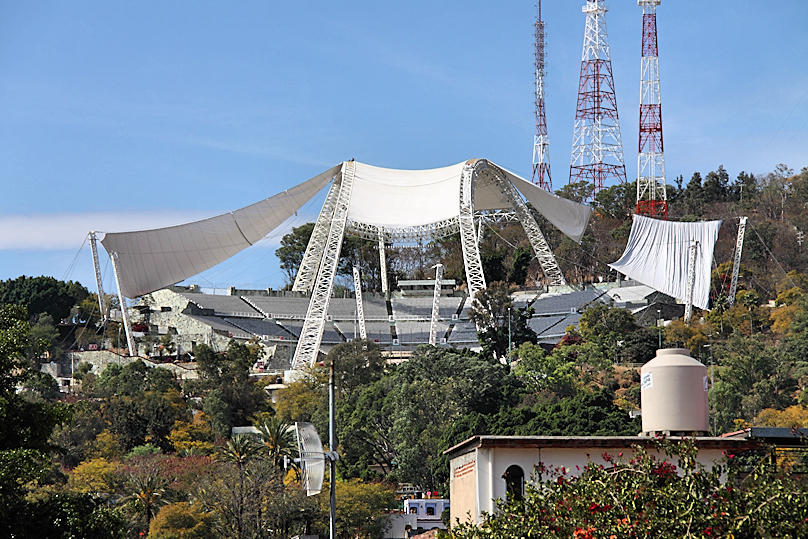
In Oaxaca, the primary performances take place on Fortín Hill, overlooking the historical city centre. During the 1970s, the city constructed a dedicated stadium on the hillside, later rebuilt in 2010 as a modern open-air amphitheatre equipped with enhanced stages and lighting. The festival draws major regional and international audiences, though tensions have arisen over commercialisation and state control. In response, grassroots groups such as the Popular Assembly of the Peoples of Oaxaca have organized alternative community gatherings to keep the celebration accessible and rooted in popular tradition.
Celebrations in the diaspora
Oaxacan immigrant communities have established Guelaguetza gatherings across the United States, especially in California and New York. Because of standard work weeks, diaspora events usually take place on summer Sundays. Community groups organize dance performances accompanied by brass musicians brought directly from Oaxaca or trained locally. These events feature stalls offering regional cuisine and imported goods, often alongside parades reminiscent of traditional calenda processions. Entry to many diaspora gatherings is free, supported by local businesses, community groups and scholarship organisations.
How Guelaguetza is kept
The festival opens around mid-July with theatrical stagings such as Princess Donají and communal processions. On the main performance days, indigenous groups gather at the open-air amphitheatre on Fortín Hill. Male and female dancer troupes perform separately, showcasing the distinct regional music, traditional attire and historical dances of their home communities. Throughout the city, artisans exhibit pre-Hispanic style textiles and local crafts, while food stalls serve native Oaxacan dishes.
When and where
In Oaxaca, the festival takes place on the two Mondays following July 16. If the first Monday coincides with July 18, the anniversary of President Benito Juárez's death, the dates shift back one week. In the United States, diaspora communities generally celebrate on Sundays between late June and early August.
The festival is centered in Oaxaca City, Mexico, particularly at the open-air amphitheatre on Fortín Hill and surrounding villages. In the United States, celebrations take place in cities such as Los Angeles, Santa Cruz, San Jose and New York.
What Guelaguetza means
The word Guelaguetza signifies mutual sharing, reciprocity and the exchange of gifts and services among neighbours. Rooted in ancient agricultural devotion to the corn god, the event affirms communal solidarity and serves as a vital safeguard for the distinct languages, textiles and artistic traditions of Oaxaca's diverse indigenous cultures.



Questions people ask about Guelaguetza
When is Guelaguetza kept?
Guelaguetza is kept on the two Mondays directly following July 16.
What is Guelaguetza?
Guelaguetza is an annual Mexican festival celebrating the heritage of Oaxaca's indigenous peoples. Groups from diverse native communities gather to perform traditional dances, wear regional attire, play live music, and share native food and artisanal crafts.
What does the name Guelaguetza mean?
Derived from the Zapotec language, Guelaguetza refers to the reciprocal exchange of gifts, assistance, and services, reflecting the value placed on mutual sharing and extended community support.
Why was the festival reorganized in the twentieth century?
After a severe earthquake destroyed much of Oaxaca in the 1920s, regional leaders reorganized the festival into a statewide cultural event to restore public morale and showcase the dances of different indigenous regions.
See also
 KwanzaaA seven-day African American celebration of heritage, family and community values
 TanabataA Japanese summer star festival of written wishes hung on leafy bamboo.
 OnamA ten-day harvest festival in Kerala celebrating the return of King Mahabali with feasts, flower carpets and boat races.
 SabantuyA summer festival of folk sports and feasting celebrated by Tatar, Bashkir, Chuvash, and Kazakh communities.
Good reading and sources
- Oaxaca festival in Mexico highlights indigenous prideBBC, Article
- Historic Centre of Oaxaca and Archaeological Site of Monte AlbánUNESCO, Heritage listing
- Oaxaca festival in Mexico highlights indigenous prideBBC, Article
- Historic Centre of Oaxaca and Archaeological Site of Monte AlbánUNESCO, Article
- Guelaguetza on WikipediaEncyclopedia
- More photos on Wikimedia CommonsPhotos and video
- Wikidata recordOpen data
The facts on this page come from the Wikipedia article "Guelaguetza", written by its contributors and used under the CC BY-SA 4.0 licence, and from its Wikidata record (CC0). EveryParampara rewrote the text in its own words, with AI assistance, and compares every page with the article to make sure no passage is copied. It may be reused under the same CC BY-SA 4.0 licence with a link back.
It may contain mistakes. Traditions differ from one family, village and community to the next, and the people who keep them know them best. If something is wrong, tell us. Last refreshed 2026-10-04.
More from Mexico
All the traditions of Mexico 🇲🇽 Mexico and 1 moreTamalada
A gathering where tamales are the main dish or a communal tamale-making party in Mexican and Hispanic cultures.Festival · Lunch
🇲🇽 Mexico and 1 moreTamalada
A gathering where tamales are the main dish or a communal tamale-making party in Mexican and Hispanic cultures.Festival · Lunch
 🇲🇽 San Salvador Huixcolotla, Mexico and 1 morePapel picado
A Mexican folk art of cutting intricate designs into tissue paper for festive and spiritual displays.Festival
🇲🇽 San Salvador Huixcolotla, Mexico and 1 morePapel picado
A Mexican folk art of cutting intricate designs into tissue paper for festive and spiritual displays.Festival
 🇪🇸 Madrid, Spain and 4 moreFeast of Saint Isidore the LaborerFiestas de San Isidro Labrador
A May festival honoring the patron saint of farmers, marked by processions and harvest gratitude in Spain and former colFestival · Feasts and festival meals
🇪🇸 Madrid, Spain and 4 moreFeast of Saint Isidore the LaborerFiestas de San Isidro Labrador
A May festival honoring the patron saint of farmers, marked by processions and harvest gratitude in Spain and former colFestival · Feasts and festival meals
 🇮🇪 Ireland and 5 moreHalloween
An annual observance on 31 October marking the eve of All Saints' Day, rooted in Christian tradition and Celtic heritageFestival · Sweets given and shared
🇮🇪 Ireland and 5 moreHalloween
An annual observance on 31 October marking the eve of All Saints' Day, rooted in Christian tradition and Celtic heritageFestival · Sweets given and shared
The same idea elsewhere
Harvest and thanksgiving compared 🇮🇱 Jerusalem, IsraelSukkotסוכות
A seven-day autumn Jewish festival of temporary booths, harvest prayers and hospitalitySpiritual
🇮🇱 Jerusalem, IsraelSukkotסוכות
A seven-day autumn Jewish festival of temporary booths, harvest prayers and hospitalitySpiritual
 🇨🇳 China and 5 moreMid-Autumn Festival中秋節
An annual harvest festival celebrating family reunions, full moons and mooncakesFestival · Sweets given and shared
🇨🇳 China and 5 moreMid-Autumn Festival中秋節
An annual harvest festival celebrating family reunions, full moons and mooncakesFestival · Sweets given and shared
 🇮🇳 India and 1 moreLakshmi Pujaलक्ष्मीपूजा
A Hindu festival of lamps, prayers and offerings welcoming the goddess of prosperitySpiritual · Sweets given and shared
🇮🇳 India and 1 moreLakshmi Pujaलक्ष्मीपूजा
A Hindu festival of lamps, prayers and offerings welcoming the goddess of prosperitySpiritual · Sweets given and shared
 🇮🇳 Guwahati, IndiaBohag Bihu
A multi-day Assamese New Year festival of cattle rites, music, gifts and feastsSeasonal · Feasts and festival meals
🇮🇳 Guwahati, IndiaBohag Bihu
A multi-day Assamese New Year festival of cattle rites, music, gifts and feastsSeasonal · Feasts and festival meals