Festivals and celebrationsEuropePagan and ancientSecular and civic
Jāņi
An annual Latvian summer solstice celebration of bonfires, singing and woven wreaths

Jāņi is Latvia's annual summer solstice holiday, held across the country and in diaspora communities on 23 and 24 June. People head to the countryside to light high bonfires, sing through the night, wear botanical wreaths, and share cheese and beer.
When is Jāņi in 2027?
Jāņi 2027 runs from 23 to 24 June 2027. Other years: 2026, 23 to 24 June 2026; 2028, 23 to 24 June 2028.
Jāņi is a traditional Latvian midsummer festival that welcomes the summer solstice. Marked every year as public holidays on 23 and 24 June, the celebration draws families and friends out of cities into the countryside. People come together to honour nature, fertility, and renewal through all-night singing, leaping over bonfires, wearing handcrafted botanical crowns, and sharing special cheese and beer until the morning sun rises.
Gathering plants and wreaths
Greenery plays a central part in preparing for the festival. People collect herbs, clovers, bedstraw, and leafy branches to decorate rooms, barns, gates, doors, and vehicles. Rowan, birch, linden, and oak are favored for decoration, while alder and aspen are avoided. Nettles and thistles are hung to ward off harm and evil spirits. Wreaths woven from nature are worn on the head: women and girls make crowns of flowers, grasses, and herbs, believed to protect against misfortune and disease. Men and boys wear rings of oak leaves, symbolising physical vigor, bee blessings, and healthy horses. Together with round cheeses and bright fires, these circular headpieces echo the form of the sun.
Bonfires and nighttime singing
Fires are lit at sunset on high ground and kept burning until dawn. Participants believe that elevating the flames lets their light reach across the land, bringing vitality and fertility to fields and households for the coming year. People fuel the fires with wood or burn tar barrels mounted on poles, and jumping over the embers is believed to bring health and good fortune. Singing special refrains, called Līgo songs, runs alongside the flames. The singing often begins after dinner and lasts all night. It accompanies house visits where guests sing to host families and are greeted with rounds of cheese and beer to encourage thriving dairy herds and barley crops.
Legends of witches and ferns
Traditional beliefs surround the shortest night of the year. Folk tales tell of milk witches disguised in white robes with loose hair, who try to cast spells on livestock or claim morning dew, requiring quick verbal replies to safeguard the milk supply. Another widespread legend centers on the mythical fern flower. Anyone brave enough to find one is said to gain immense happiness, wealth, and the ability to uncover hidden knowledge of the past and future. Finding the blossom requires riding a broomstick alone in silence. In everyday speech, searching for the fern flower has also become a playful euphemism for couples seeking privacy together during the celebration.
Centuries of midsummer customs
Written records describe midsummer dancing, singing, and leaping around fires in Livonia as early as 1584. In earlier centuries, Riga boatmen and workers crossed the Daugava river to islands and riverbanks to burn fires until dawn. By the late eighteenth century, regular herbal markets emerged in Riga where country farmers sold cut flowers, remedies, and wreaths to urban residents. After Latvian independence in 1918, midsummer gained formal status as a nationwide public holiday on 23 and 24 June. Today, the festivities remain a defining cultural event across Latvia, as well as among diaspora communities in countries like Australia, Argentina, Canada, and the United States.
How Jāņi is kept
Before the holiday, people gather wild herbs, grasses, and tree branches to decorate homes, buildings, and vehicles, weaving botanical wreaths to wear on their heads. At sunset on 23 June, high bonfires are ignited on hills or poles and tended through the dark. After dinner, participants sing traditional melodies and visit neighbours, where hosts welcome them with beer and round cheese. Throughout the night, people leap across fire embers for luck and venture outdoors in search of the legendary fern flower, keeping watch until the sun rises on Jāņi morning.
When and where
Jāņi is observed annually on 23 and 24 June, corresponding to the official public holidays of Līgo Day and Jāņi Day. Although the astronomical summer solstice occurs slightly earlier on 21 or 22 June, the traditional festivities take place across the night of 23 June until sunrise on 24 June.
The festival is celebrated throughout Latvia, where urban residents travel into rural landscapes, homesteads, and fields to celebrate outdoors. It is also actively kept by Latvian diaspora communities living in countries across the globe, including Australia, Canada, Argentina, and the United States.
What Jāņi means
The celebration centers on nature, renewal, and solar power. Bonfires, round cheeses, and head wreaths all represent the sun. Burning fires on elevated ground is believed to send light into the coming solar year and bestow fertility upon fields and humans. Oak leaves symbolise strength and endurance, while floral crowns and selected herbs are believed to shield against sickness, ward off harmful spirits, and invite good fortune.
On the table
- Jāņi cheese
- Beer

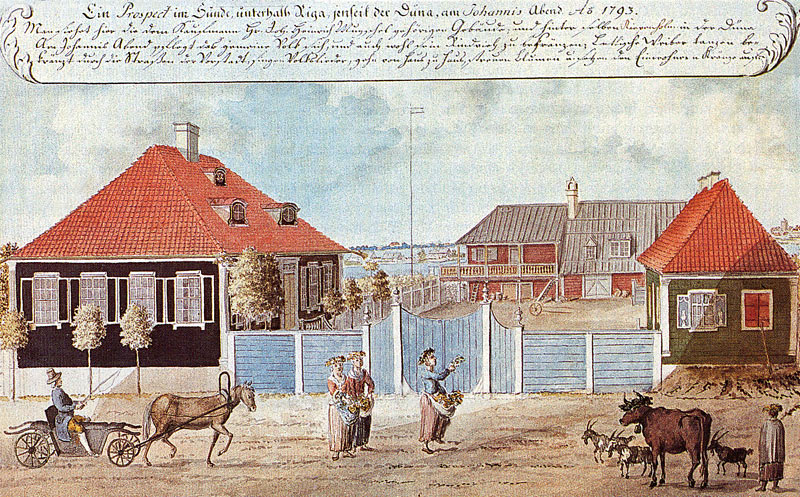


Jāņi dates: 2026, 2027, 2028
| Year | Jāņi date |
|---|---|
| 2026 | 23 to 24 June 2026 |
| 2027 | 23 to 24 June 2027 |
| 2028 | 23 to 24 June 2028 |
Questions people ask about Jāņi
When is Jāņi in 2027?
Jāņi 2027 runs from 23 to 24 June 2027. Other years: 2026, 23 to 24 June 2026; 2028, 23 to 24 June 2028.
What is Jāņi?
Jāņi is Latvia's yearly midsummer festival honouring the summer solstice. Grounded in folk customs of renewal and fertility, the observance brings people together to sing through the night, light hilltop bonfires, wear woven botanical crowns, and share celebratory food.
Why do people make wreaths for the festival?
People weave circular wreaths from flowers, grasses, and oak leaves as symbols of the sun. Women and girls wear herb and flower wreaths believed to prevent disease and repel misfortune, while men wear oak leaf wreaths to symbolise physical strength and invite blessings.
What foods and drinks are traditional during Jāņi?
Celebrants eat round Jāņi cheese and drink beer. These offerings are traditionally believed to help cow milk yields and barley growth in the coming year, and they are regularly shared with visiting singers throughout the solstice night.
See also
 MimounaA Maghrebi Jewish celebration marking the end of Passover with sweets and open doors
 ChristmasA festival of Jesus's birth, kept on 25 December with gifts, lights and shared meals
 HalloweenAn annual observance on 31 October marking the eve of All Saints' Day, rooted in Christian tradition and Celtic heritage
 Valentine's DayA Christian feast day and cultural celebration of love kept on February 14 in many countries.
Good reading and sources
- Jāņi on WikipediaEncyclopedia
- More photos on Wikimedia CommonsPhotos and video
- Wikidata recordOpen data
The facts on this page come from the Wikipedia article "Jāņi", written by its contributors and used under the CC BY-SA 4.0 licence, and from its Wikidata record (CC0). EveryParampara rewrote the text in its own words, with AI assistance, and compares every page with the article to make sure no passage is copied. It may be reused under the same CC BY-SA 4.0 licence with a link back.
It may contain mistakes. Traditions differ from one family, village and community to the next, and the people who keep them know them best. If something is wrong, tell us. Last refreshed 2026-10-04.
More from Latvia
All the traditions of Latvia 🇩🇪 Germany and 5 moreChristmas tree
A decorated evergreen or artificial tree placed indoors to mark the Christmas season.Festival
🇩🇪 Germany and 5 moreChristmas tree
A decorated evergreen or artificial tree placed indoors to mark the Christmas season.Festival
 🇩🇰 Copenhagen, Denmark and 5 moreFastelavn
A pre-Lenten carnival in Northern Europe where children dress up, sing for treats, and break candy-filled barrels.Festival · Sweets given and shared
🇩🇰 Copenhagen, Denmark and 5 moreFastelavn
A pre-Lenten carnival in Northern Europe where children dress up, sing for treats, and break candy-filled barrels.Festival · Sweets given and shared
 🇷🇺 Russia and 5 moreYuri's Night
An annual global celebration on April 12 marking milestones in space explorationFestival
🇷🇺 Russia and 5 moreYuri's Night
An annual global celebration on April 12 marking milestones in space explorationFestival
 🇱🇹 Lithuania and 5 moreNativity of John the Baptist
A Christian feast day on June 24 that marks the birth of John the Baptist and anticipates Christmas.Festival
🇱🇹 Lithuania and 5 moreNativity of John the Baptist
A Christian feast day on June 24 that marks the birth of John the Baptist and anticipates Christmas.Festival
The same idea elsewhere
Healing, luck and protection compared 🇨🇳 China and 5 moreLion dance舞獅
A dynamic ritual dance featuring costumed lions, drums and martial acrobaticsPerformance
🇨🇳 China and 5 moreLion dance舞獅
A dynamic ritual dance featuring costumed lions, drums and martial acrobaticsPerformance
 🇦🇺 AustraliaSmoking ceremonyNumbuk Yabbun
An Aboriginal Australian ritual of burning native plants to cleanse, heal and welcomeSpiritual
🇲🇦 Morocco and 4 moreMimounaמִימוּנָה
A Maghrebi Jewish celebration marking the end of Passover with sweets and open doorsFestival · Dinner
🇦🇺 AustraliaSmoking ceremonyNumbuk Yabbun
An Aboriginal Australian ritual of burning native plants to cleanse, heal and welcomeSpiritual
🇲🇦 Morocco and 4 moreMimounaמִימוּנָה
A Maghrebi Jewish celebration marking the end of Passover with sweets and open doorsFestival · Dinner
 🇨🇳 China and 6 moreRed envelope紅包 / 红包 (hóngbāo)
Money in a red packet, given at Lunar New Year, weddings and other big daysEtiquette
🇨🇳 China and 6 moreRed envelope紅包 / 红包 (hóngbāo)
Money in a red packet, given at Lunar New Year, weddings and other big daysEtiquette