Games, sport and playMiddle East
Jereed
In its own language: Cirit
Riders on horseback throw blunt wooden javelins at rivals in this Turkish team sport

Jereed is a traditional team sport on horseback in Turkey, played on an open field with blunt wooden javelins. Turks brought it from Central Asia to Anatolia in the 11th century, and today clubs and folklore societies in several provinces hold tournaments.
When is Jereed kept?
Jereed is kept at tournaments arranged by clubs and folklore societies in Turkey, in matches of two 45-minute periods.
Jereed is a team sport on horseback, long kept by Turks and played outdoors with blunt wooden javelins. Two sides of riders chase and throw, scoring when a stick touches an opponent. It grew out of the riding life of Central Asian Turkic peoples, became an Ottoman military exercise and court spectacle, and survives today in Turkish provincial tournaments.
What it is
Jereed is a sport for two teams of horsemen, played on an open field. Each rider carries sticks of dried oak or poplar, 70 to 100 centimetres long and 2 to 3 centimetres thick, with blunt rubber tips. Teams of six, eight or twelve line up facing one another inside a square field of 70 to 130 metres. The point is to score by touching a rival with a thrown stick. Riders also gain by forcing an opponent out or snatching a stick from the air. Matches are watched by spectators, and drums and reed pipes play while the horses work.
Origins and history
Horses were central and even sacred to the Turkic tribes of the Central Asian steppes, and jereed grew from that way of life. The word itself comes from Arabic, where it names a stick cut from stripped palm fronds. Turks brought the game west with them: it reached Anatolia with the migration of 1071. Ottoman Turks took it up as a war game in the 16th century, using it in peacetime to sharpen cavalry attack and defence. Some sultans played, and Bayezid I and Mehmed I put weight on it in army training. In the 19th century it reached its height as a court spectacle, until Mahmud II banned it in 1826; play resumed but never regained its old place.
How a match runs
Players are introduced to the crowd with praise, then shake hands at the centre and parade behind their team flag while drums and zurnas play military marches and Köroğlu folk music. Riders wear regional costume, a memory of the Ottoman sipahis, and ride locally bred horses trained for the sport. The youngest rider opens play by trotting at the other side, calling out an opponent's name and throwing from 30 to 40 metres, then galloping home while the challenger gives chase. The pursuit goes back and forth for two 45-minute periods. At the close a council of former players announces the winner, awards are given and a banquet follows.
Scoring and conduct
Referees are former players who are held in standing by the community. They count the hits and announce the winning side. A rider earns points by striking a rival, by riding him out, or by catching a thrown stick in mid-air. He loses points for rough riding that puts a horse in danger, for falling off, for throwing from the neutral zone, and for throwing from nearer than five metres while chasing. Aim that misses the rider and finds the mount is counted a beginner's fault, and that rider leaves the field. Long-standing rivals can be kept out of the same match, or placed together, by local elders or by the referees before play begins.
Today and change
Jereed no longer fills the place it held in Ottoman times, but it is still played for spectators, above all in Erzurum and Bayburt. It also survives in the eastern provinces of Artvin, Erzincan and Kars, in the west around Uşak, Balıkesir and Söğüt, in the south-east in Diyarbakır and Siirt, and in Konya in Central Anatolia. Around fifty clubs in nine provinces organise tournaments. Cultural societies also arrange local competitions so that the sport continues. The rounded rubber tips used today make hurt rare, though a blow to a rider's head, eyes or ears can still cause injury.
How Jereed is kept
Two teams of horsemen, six, eight or twelve a side, meet on a marked field. Players greet the crowd and each other, parade with their flags and hear drums and reed pipes. The youngest rider starts the action by calling out an opponent and throwing at him from 30 to 40 metres, then turns and gallops away while the other gives chase. Riders take turns to pursue and flee, throwing sticks at rivals as they go. Referees record hits and faults, and after two 45-minute periods they name the winner. Prizes follow and a meal is shared.
When and where
Jereed is not fixed to a day of the year. Tournaments are arranged by clubs and folklore societies in Turkey, and a single match is played in two periods of 45 minutes. The sport has been played for centuries: it came to Anatolia in 1071 and became an Ottoman war game in the 16th century.
Jereed belongs to Turkey, where the sport is strongest in the eastern provinces of Erzurum and Bayburt. Clubs and societies also keep it in Artvin, Erzincan and Kars in the east, Uşak, Balıkesir and Söğüt in the west, Diyarbakır and Siirt in the south-east, and Konya in Central Anatolia.
What Jereed means
Jereed carries the memory of a people who lived in the saddle. It began as the game of tribes who were born, grew up and fought on horseback, and it shows that history in what it asks of riders: speed, aim, balance and nerve. Players dress in regional costume that recalls the Ottoman cavalry. Skill is respected, since the best riders rarely miss and can dodge a stick with acrobatics on horseback. A rider whose aim lands on a horse rather than its rider is thought inexperienced rather than bold.
Questions people ask about Jereed
When is Jereed kept?
Jereed is kept at tournaments arranged by clubs and folklore societies in Turkey, in matches of two 45-minute periods.
What is jereed?
It is a team sport on horseback from Turkey. Two sides of riders throw blunt wooden sticks, or javelins, at each other on an open field and score points for hits. In Turkish it is called cirit, and the English name sometimes used is Equestrian Javelin.
What are the sticks made of?
They are cut from dried oak or poplar and measure 70 to 100 centimetres long and 2 to 3 centimetres across. The ends are blunt and tipped with rubber. In earlier times the sticks were heavier and thicker, and players later chose poplar because it grows lighter as it dries.
Who takes part and who watches?
Two teams of six, eight or twelve riders take part, and referees who used to play the sport judge the match. Spectators watch from the field side while drums and reed pipes play. At the end the winning team receives awards and a banquet is held.
Is it dangerous?
The sport once caused falls, injuries and deaths, and Sultan Mahmud II banned it in 1826 after dissolving the Janissary Corps. Today the tips are rounded rubber and serious harm is rare, though a stick can still injure a rider struck on the head, eyes or ears.
See also
 Persian miniatureA tradition of small, brightly coloured paintings created for books and albums.
 World Nomad GamesA two-yearly contest of Central Asian nomadic sports, first staged in Kyrgyzstan in 2014
 VasaloppetA 90 km cross-country ski race from Sälen to Mora, run every March since 1922
 Archery in BhutanBhutan's national sport, played with bamboo bows at targets 145 metres away
Good reading and sources
- Jereed on WikipediaEncyclopedia
- More photos on Wikimedia CommonsPhotos and video
- Wikidata recordOpen data
The facts on this page come from the Wikipedia article "Jereed", written by its contributors and used under the CC BY-SA 4.0 licence, and from its Wikidata record (CC0). EveryParampara rewrote the text in its own words, with AI assistance, and compares every page with the article to make sure no passage is copied. It may be reused under the same CC BY-SA 4.0 licence with a link back.
It may contain mistakes. Traditions differ from one family, village and community to the next, and the people who keep them know them best. If something is wrong, tell us. Last refreshed 2026-10-05.
More from Turkey
All the traditions of Turkey
🇰🇬 Cholpon-Ata, Kyrgyzstan and 2 moreWorld Nomad GamesДүйнөлүк көчмөндөр оюндары
A two-yearly contest of Central Asian nomadic sports, first staged in Kyrgyzstan in 2014Game
 🇹🇷 Edirne, Turkey and 3 moreOil wrestlingYağlı güreş
Oiled wrestlers in leather trousers: Turkey's national sport, centred on KırkpınarGame
🇹🇷 Edirne, Turkey and 3 moreOil wrestlingYağlı güreş
Oiled wrestlers in leather trousers: Turkey's national sport, centred on KırkpınarGame
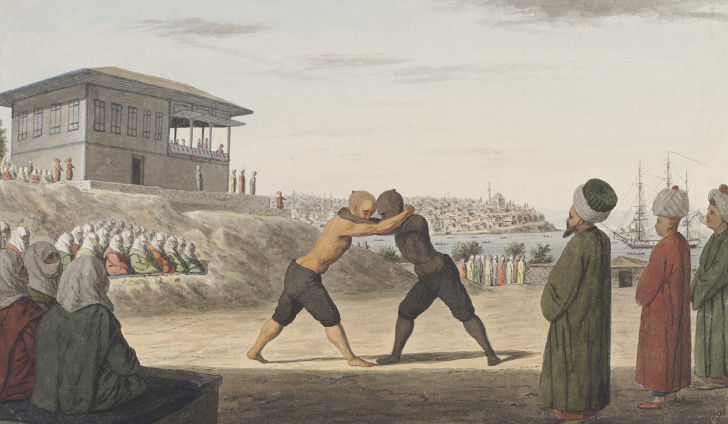 🇹🇷 Edirne, TurkeyKırkpınar
A three-day Turkish oil wrestling contest near Edirne, held each June since 1360Game
🇹🇷 Edirne, TurkeyKırkpınar
A three-day Turkish oil wrestling contest near Edirne, held each June since 1360Game
 🇺🇿 Uzbekistan and 5 moreKurashкөрәш
Central Asian traditional upright folk wrestling using cloth belts or towelsGame
🇺🇿 Uzbekistan and 5 moreKurashкөрәш
Central Asian traditional upright folk wrestling using cloth belts or towelsGame
The same idea elsewhere
Royalty and coronation compared
🇸🇪 Mora, SwedenVasaloppet
A 90 km cross-country ski race from Sälen to Mora, run every March since 1922Game
 🇵🇪 Cusco, Peru and 4 moreIntiinti (Quechua)
The Inca sun deity, honoured with temples, offerings and the June festival Inti RaymiSpiritual
🇵🇪 Cusco, Peru and 4 moreIntiinti (Quechua)
The Inca sun deity, honoured with temples, offerings and the June festival Inti RaymiSpiritual
 🇺🇸 United StatesTalking stick
A carved staff that shows who may speak at a Northwest Coast gatheringCeremony
🇺🇸 United StatesTalking stick
A carved staff that shows who may speak at a Northwest Coast gatheringCeremony