Games, sport and playMiddle EastMuslim
Kırkpınar
A three-day Turkish oil wrestling contest near Edirne, held each June since 1360
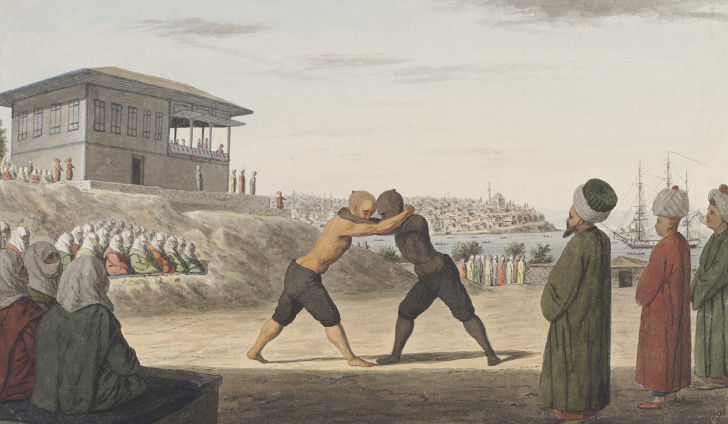
Kırkpınar is a Turkish oil wrestling (yağlı güreş) tournament held near Edirne since 1360, usually in late June and over three days. Wrestlers known as pehlivans compete in leather shorts after oiling their bodies, and the last day decides the winners of each category.
When is Kırkpınar kept?
Kırkpınar is kept every year in late June, over three days.
Kırkpınar is a Turkish oil wrestling contest, held near Edirne every year since 1360 and lasting three days. Wrestlers called pehlivans, their bodies slick with olive oil, meet in bouts that end on the final afternoon. People keep it as the oldest of Turkey's traditional sports and as a festival that brings crowds to the meadows by the city.
What it is
The tournament takes its name from the Turkish words for forty springs. For three days each year, pehlivans wrestle near Edirne, and the Kırkpınar Festival runs alongside them. Bouts are grouped in categories, and on the closing day the first, second and third places in each are settled. Oil wrestling sits at the front of Turkey's traditional sports. In Ottoman times fairs across the empire staged wrestling, but only the man who won at Kırkpınar carried the chief's title, and he held it until the following year's meeting. That custom still shapes the contest.
Origins and history
Evidence for oiled wrestling reaches back far beyond Edirne. A small Babylonian bronze shows two athletes with oil vessels on their heads, and limestone from a tomb at Saqqara in Egypt, from about 2650 BC, records the practice. A painting roughly four thousand years old, in a tomb near Beni Hasan, follows a wrestler from greasing to triumph. Persian tradition tells of Rostam, hero of Ferdowsi's Shahnameh, and of the zurkhane, the house of strength where the peshrev opening ceremony belongs. The organisers of the Edirne contest take 1360 as their starting point, when Ottoman soldiers are said to have begun wrestling there.
How it is kept
Modern bouts take place on Sarayiçi island near Edirne, where the contest has been held since 1924. Before a pairing begins, each wrestler coats himself in olive oil. The men wear kıspets, leather shorts reaching the knee, and nothing else. Competition runs through several categories across three days, and the finals fall on the last one. An agha, chosen before the event, acts as host: he greets guests, houses them, gives dinners and hands out the prizes. Younger wrestlers still kiss the hands of older ones they have beaten, a mark of respect kept today.
Dress and objects
The kıspet, a pair of knee-length leather shorts, is the wrestler's only clothing. Its shape is traced to a peace treaty signed in 1590 between Murat III and the Persian shah. Iranian wrestlers wear a similar garment, the pirpet, but theirs is silk while the Turkish one is leather. Olive oil is the other essential object: every competitor pours it over his whole body before a bout, and the gleaming skin is central to how people picture the sport. The old prize of the Edirne contest, the Altın Kemer or Golden Belt, weighs no more than 1450 grams of 14-carat gold.
Today and change
Kırkpınar has been reorganised more than once, and in 2010 Unesco added the festival to its Representative List of intangible heritage. After the Balkan War of 1912 the original site was lost, so the meeting moved to Virantekke, at what is now the Kapitan Andreevo crossing on the Bulgarian border, and in 1924 to Sarayiçi island. In the early Turkish Republic, Atatürk brought the wrestling organisations under his sponsorship and asked Selim Sırrı Tarcan to reshape them. The winner became Champion of Turkey rather than Başpehlivan of the Kırkpınar, and medals replaced animals and the Golden Belt. A compromise later restored the title Başpehlivan of the Year and animal prizes.
How Kırkpınar is kept
The event runs for three days and the bouts are organised by category. On the closing day the finals decide first, second and third place in each group. Before any pairing, both men strip to leather shorts and pour olive oil across their bodies. An agha leads the occasion. He receives guests, lodges them, holds dinners and presents awards. Before the final, the next year's agha is chosen at an auction, where bids are offered for a ram or a sheep, and the person who offers the most becomes host and chief sponsor of the following tournament.
When and where
Kırkpınar takes place once a year, over three days, usually in late June. The organisers date the tournament from 1360 and have kept it annual since. The finals close the meeting on the third day, and the winners of each category are decided then.
The tournament belongs to Turkey and is held outside Edirne, in the northwest of the country. Since 1924 the bouts have taken place on Sarayiçi island near the city. Before that the meeting moved to Virantekke, at today's Kapitan Andreevo border crossing, after the Balkan War of 1912.
What Kırkpınar means
The pehlivan stands for strength, honesty and generosity. Old stories call him stronger than other men, well built and clad in heavy leather, and describe him as a knightly hero who is free in spirit and true to his word. Because a bout can last until neither man can continue, wrestling also carries ideas of endurance and fair dealing. Winners and losers are bound by respect: younger wrestlers kiss the hands of older opponents they have defeated.


Questions people ask about Kırkpınar
When is Kırkpınar kept?
Kırkpınar is kept every year in late June, over three days.
What is Kırkpınar?
It is a Turkish oil wrestling tournament, called yağlı güreş, held each year near Edirne. Wrestlers known as pehlivans compete for three days, their bodies covered in olive oil, wearing only leather knee-length shorts. In 2010 Unesco added the festival to its Representative List of intangible heritage.
Where does it take place?
Near Edirne in Turkey. Since 1924 the bouts have been held on Sarayiçi island beside the city. An earlier site was lost after the Balkan War of 1912, and the event moved for a time to Virantekke, now the Kapitan Andreevo crossing on the Bulgarian border.
Who is the agha?
The agha is the host and sponsor of the tournament. He welcomes guests, finds them accommodation, gives dinners and awards the prizes. Before the final, an auction is held and bids are made for a ram or a sheep; the person offering the most becomes agha of the next year's contest.
Why do wrestlers wear leather shorts?
The knee-length leather shorts, called kıspet, are the only clothing a wrestler wears, apart from the olive oil on his skin. Their design is traced to a 1590 peace treaty between Murat III and the Persian shah, and Iranian wrestlers wear a similar silk version named pirpet.
See also
 Eid al-FitrThe feast that ends Ramadan, opened with morning prayers, sweets and visits home
 Ramadan in TurkeyA holy month of fasting, prayer, and community meals, observed across Turkey with unique local customs.
 Caffè sospesoAn anonymous gift of a paid cup of coffee for a stranger in need
 SamovarA heated urn that brews tea for a slow, sociable pour, from Russia to Iran and Kashmir
Good reading and sources
- Kırkpınar oil wrestling festivalUNESCO, Heritage listing
- Kırkpınar oil wrestling festivalUNESCO, Article
- Kırkpınar on WikipediaEncyclopedia
- More photos on Wikimedia CommonsPhotos and video
- Wikidata recordOpen data
The facts on this page come from the Wikipedia article "Kırkpınar", written by its contributors and used under the CC BY-SA 4.0 licence, and from its Wikidata record (CC0). EveryParampara rewrote the text in its own words, with AI assistance, and compares every page with the article to make sure no passage is copied. It may be reused under the same CC BY-SA 4.0 licence with a link back.
It may contain mistakes. Traditions differ from one family, village and community to the next, and the people who keep them know them best. If something is wrong, tell us. Last refreshed 2026-10-05.
More from Turkey
All the traditions of Turkey 🇰🇬 Cholpon-Ata, Kyrgyzstan and 2 moreWorld Nomad GamesДүйнөлүк көчмөндөр оюндары
A two-yearly contest of Central Asian nomadic sports, first staged in Kyrgyzstan in 2014Game
🇹🇷 Edirne, Turkey and 3 moreOil wrestlingYağlı güreş
Oiled wrestlers in leather trousers: Turkey's national sport, centred on KırkpınarGame
🇰🇬 Cholpon-Ata, Kyrgyzstan and 2 moreWorld Nomad GamesДүйнөлүк көчмөндөр оюндары
A two-yearly contest of Central Asian nomadic sports, first staged in Kyrgyzstan in 2014Game
🇹🇷 Edirne, Turkey and 3 moreOil wrestlingYağlı güreş
Oiled wrestlers in leather trousers: Turkey's national sport, centred on KırkpınarGame
 🇺🇿 Uzbekistan and 5 moreKurashкөрәш
Central Asian traditional upright folk wrestling using cloth belts or towelsGame
🇺🇿 Uzbekistan and 5 moreKurashкөрәш
Central Asian traditional upright folk wrestling using cloth belts or towelsGame
 🇹🇷 Erzurum, TurkeyJereedCirit
Riders on horseback throw blunt wooden javelins at rivals in this Turkish team sportGame
🇹🇷 Erzurum, TurkeyJereedCirit
Riders on horseback throw blunt wooden javelins at rivals in this Turkish team sportGame
The same idea elsewhere
Hospitality and welcome compared 🇮🇩 Indonesia and 2 moreKenduri
A communal prayer meal and gathering shared across Indonesia, Malaysia and BruneiSpiritual · Feasts and festival meals
🇮🇩 Indonesia and 2 moreKenduri
A communal prayer meal and gathering shared across Indonesia, Malaysia and BruneiSpiritual · Feasts and festival meals
 🇳🇪 In-Gall, NigerCure Salée
A yearly gathering of Tuareg and Wodaabe nomads in In-Gall to mark the end of the rainy season.Festival
🇳🇪 In-Gall, NigerCure Salée
A yearly gathering of Tuareg and Wodaabe nomads in In-Gall to mark the end of the rainy season.Festival
 🇳🇿 New Zealand and 2 moreMarae
A cleared, sacred gathering place at the heart of Māori and Polynesian community lifeSpiritual
🇳🇿 New Zealand and 2 moreMarae
A cleared, sacred gathering place at the heart of Māori and Polynesian community lifeSpiritual