Music, dance and storytellingEast Asia
Jiuchi
In its own language: 地打ち
The steady base beat that holds traditional Japanese music and taiko ensembles together
Jiuchi is the base beat under traditional music in Japan, known to players as the ji. In the folk tradition it is a plain, even pulse, sung with kuchi shoka syllables as 'do ko do ko', while swung and festival forms also exist. Taiko drummers use it to keep an ensemble together.
Jiuchi is the beat underneath traditional Japanese music, a repeating figure that players call the ji. It is often sung aloud before it is played, using syllables such as 'do ko do ko'. Its steady shape lets other instruments move freely on top. Drummers in the taiko tradition lean on it most, because there the drums carry the music.
What it is
Jiuchi, which players usually shorten to ji, is the beat that lies under traditional music in Japan. It is not a tune but a short pattern that repeats. In the folk tradition the pattern is even, with no note given more weight than another, and it is taught by singing it. The syllables used for this, kuchi shoka, imitate drum sounds: 'do ko do ko' stands for the plain form. English speakers often call that plain form the straight ji, a way of naming it that keeps it separate from the swung and festival versions played in the same repertoire.
Straight and swung
In its plain form the ji moves evenly, each stroke the same distance from the last. Players can also swing it, and this version is named dongo after the syllables used to voice it: 'don go don go'. Here the offbeat, the 'go', does not fall halfway between the main beats. It comes late, sitting near the end of the beat, as it does in jazz. Each pair of strokes then falls into a long-short shape, the second much shorter than the first, and the pulse takes on a lilting, three-part swing. Because of the swing rhythm in North American jazz, English speakers often just call dongo the swing ji.
Other patterns
Beyond the plain and swung forms, players use several named ji. One is the horse-beat ji, sung as 'don dogo don dogo' and written in Western drum notation as '1.&a2.&a3.&a4.&a'. Another is the matsuri ji, the festival pattern, where the syllables are 'DON doko don DON, DON doko don DON' and the accented notes fall on the strong beats. Each pattern keeps the same job, which is to mark a steady frame for the piece, but the spacing of the strokes and the weight given to them differ, so the music can move from a calm tread to something more driving.
In taiko
Taiko is the Japanese art form in which drums stand at the centre, and it is there that the ji is most common. Because the pattern runs the whole way through a piece, it keeps the other players in step. On taiko the ji is often kept simple and loud. It is usually given to the shime-daiko, a small drum tied with rope, pitched high, with a sharp attack that carries above the rumble of the larger drums. Almost any drum can take it, though. Players also put it on the ōdaiko, the biggest drum, either to back the group or to steady a soloist playing on the other head.
How Jiuchi is kept
A player starts the ji and repeats it for as long as the piece lasts. Often the figure is voiced first in kuchi shoka, the sung syllables that stand for drum strokes, and only then taken onto a drum. Given to the shime-daiko, a small rope-tied drum with a high pitch, the strokes stay clear above the deeper drums around them. Meanwhile the rest of the group plays over the pattern. On the ōdaiko, the largest drum, the same ji can sit behind the ensemble or support a solo on the far head.
When and where
There is no fixed date or season for the ji. It sounds for the whole length of a piece rather than at one moment in it. A player keeps it going from the first stroke to the last, and the pattern continues under everything else that is played.
The ji belongs to traditional music in Japan, and it is in the folk repertoire that its plain form is heard. Taiko is where it is most at home, since the drums there carry the music and the beat has to be heard clearly. Players use it on small and large drums alike.
What Jiuchi means
For the people who play it, the ji is the shared pulse that lets a group move as one. It gives everyone a common frame, so the other parts can travel without losing their place. Its plainness is what makes it useful: it steadies rather than leads. The swung and festival versions show that the same steady frame can carry very different moods, from an easy swing to a driving festival sound.
Questions people ask about Jiuchi
What is jiuchi?
Jiuchi, also called the ji, is the base beat that runs under traditional Japanese music. It is a short repeating figure, in the folk tradition a plain, even one that players voice as kuchi shoka syllables: 'do ko do ko'.
Where is it played?
It belongs to Japanese traditional music and is heard most in taiko, where drums are the central instrument. The pattern suits a small, high-pitched drum called the shime-daiko, though players use it on almost any drum, including the large ōdaiko.
When do you hear it?
The ji has no season or fixed date. It sounds through the whole of a piece, from beginning to end, rather than at one point in it. That is why it is described as the underlying rhythm: it runs continuously while the other parts come and go.
What is the dongo or swing ji?
Dongo is a swung form of the ji. Instead of landing evenly, the offbeat sits late, toward the end of the beat, a habit also found in jazz. In English it is often simply called the swing ji, a name borrowed from the swing rhythm of North American jazz.
What other patterns are there?
Two named forms are the horse-beat ji, voiced 'don dogo don dogo', and the matsuri, or festival, ji, with its heavier accents. English speakers often call the plain, even pattern the straight ji, to set it apart from the swung and festival versions.
See also
 RakugoJapanese solo comic storytelling told from a cushion using a fan and a cloth
 IkebanaThe Japanese art of arranging cut branches and flowers in a vessel
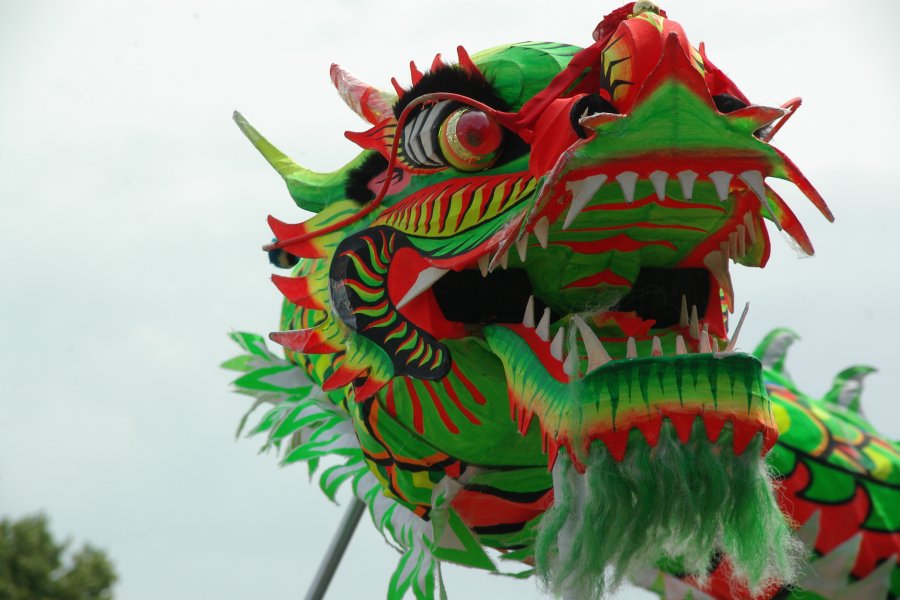 Dragon danceA long dragon puppet on poles, danced by a team at Chinese New Year and other festivals
 KyōgenA traditional Japanese comic theatre of short farces, spoken dialogue and satire
Good reading and sources
The facts on this page come from the Wikipedia article "Jiuchi", written by its contributors and used under the CC BY-SA 4.0 licence, and from its Wikidata record (CC0). EveryParampara rewrote the text in its own words, with AI assistance, and compares every page with the article to make sure no passage is copied. It may be reused under the same CC BY-SA 4.0 licence with a link back.
It may contain mistakes. Traditions differ from one family, village and community to the next, and the people who keep them know them best. If something is wrong, tell us. Last refreshed 2026-10-09.
More from Japan
All the traditions of Japan 🇨🇳 China and 5 moreLion dance舞獅
A dynamic ritual dance featuring costumed lions, drums and martial acrobaticsPerformance
🇯🇵 Kyoto, JapanKyōgen狂言
A traditional Japanese comic theatre of short farces, spoken dialogue and satirePerformance
🇯🇵 Tokyo, JapanRakugo落語
Japanese solo comic storytelling told from a cushion using a fan and a clothPerformance
🇨🇳 China and 3 moreDragon dance舞龍 / 舞龙
A long dragon puppet on poles, danced by a team at Chinese New Year and other festivalsPerformance
🇨🇳 China and 5 moreLion dance舞獅
A dynamic ritual dance featuring costumed lions, drums and martial acrobaticsPerformance
🇯🇵 Kyoto, JapanKyōgen狂言
A traditional Japanese comic theatre of short farces, spoken dialogue and satirePerformance
🇯🇵 Tokyo, JapanRakugo落語
Japanese solo comic storytelling told from a cushion using a fan and a clothPerformance
🇨🇳 China and 3 moreDragon dance舞龍 / 舞龙
A long dragon puppet on poles, danced by a team at Chinese New Year and other festivalsPerformance
The same idea elsewhere
All of this kind 🇹🇷 Kayseri, Turkey and 4 moreHalay
A traditional line and circle folk dance kept across Turkey, Azerbaijan, Armenia, Iran, and Syria.Performance
🇧🇷 BrazilBaião
A syncopated folk rhythm and partnered dance from northeastern BrazilPerformance
🇹🇷 Kayseri, Turkey and 4 moreHalay
A traditional line and circle folk dance kept across Turkey, Azerbaijan, Armenia, Iran, and Syria.Performance
🇧🇷 BrazilBaião
A syncopated folk rhythm and partnered dance from northeastern BrazilPerformance
 🇺🇦 Kyiv, UkraineBanduraБандура
A Ukrainian plucked string instrument played to accompany epic songs and folk balladsPerformance
🇺🇦 Kyiv, UkraineBanduraБандура
A Ukrainian plucked string instrument played to accompany epic songs and folk balladsPerformance
 🇳🇿 Auckland, New ZealandPoi
A Māori performing art of swinging tethered weights in rhythmical patterns.Performance
🇳🇿 Auckland, New ZealandPoi
A Māori performing art of swinging tethered weights in rhythmical patterns.Performance