Music, dance and storytellingEast Asia
Dragon dance
In its own language: 舞龍 / 舞龙
A long dragon puppet on poles, danced by a team at Chinese New Year and other festivals
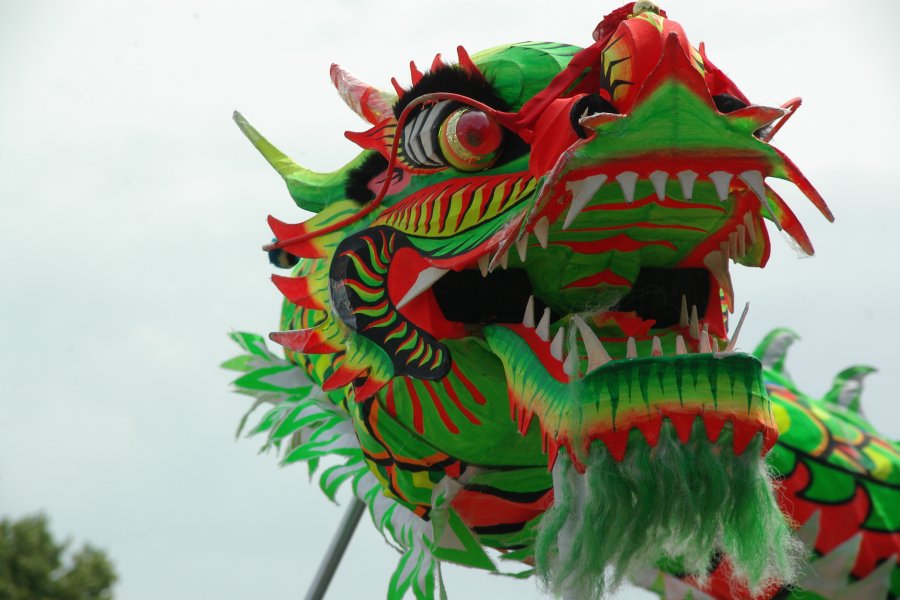
The dragon dance is a traditional Chinese performance in which a team of dancers carries a long, flexible dragon puppet on poles and moves it in flowing, wave-like patterns. It is seen at festive times, especially Chinese New Year, in China and in Chinese communities abroad, where the dragon is believed to bring good luck.
When is Dragon dance marked?
Dragon dance is kept as part of Lunar New Year, which runs from 7 to 21 February 2027.
A dragon dance is a team performance in which dancers lift a long dragon puppet on poles and move it in waves. It belongs to Chinese culture and appears most often at festivals, above all Chinese New Year. Teams train like athletes and perform like a theatre troupe. Many communities believe the dragon brings good luck, and that a longer dragon brings more of it.
What it is
A dragon dance is a performance by a trained team. The team carries a long, bendable dragon puppet, the sections of which rest on poles spaced along its body. Lifting and swinging the poles in turn makes the dragon rise, dip and coil. Teams work with a drum, and the head must follow the beat; the tail follows the head. A person often walks ahead holding a round object that stands for a pearl, and the dragon is shown chasing it. Dancers learn the basic swing quickly, but the harder formations take years of practice, because one wrong move upsets the whole line.
Origins and history
Texts from the Han dynasty describe several dragon acts. In dry years, people made clay dragons and danced as part of a ritual asking for rain, since the Chinese dragon was linked to rain; the number, length and colour of the dragons changed with the season. Court shows of the same period included performers dressed as beasts, fish and dragons, and a fish-dragon act in which a fish turned into a dragon. These older acts did not look like today's dance, and their props were heavy. Dragon lanterns carried at night during the Lantern Festival appear in a Song dynasty account. In the modern era, government promotion of folk dances helped the present, lighter form spread.
Dragon body and colour
A dragon puppet is a serpentine body of hoops and sections, with an ornamental head at the front and a tail at the back. Older dragons were built of wood, bamboo and cloth; today aluminium, cane and plastic make them lighter. Length depends on money, materials, skill and the number of available hands. Small two-person dragons measure about two metres; acrobatic ones run 25 to 35 metres; parade dragons reach 50 to 70 metres. Colour carries meaning: green for a good harvest, yellow for the empire, gold or silver for prosperity, red for excitement. The scales and tail are usually silver and glittery.
Patterns and movement
Swinging each section in turn gives the wave-like motion that is the base of the dance. Around that, teams build set figures with names such as "Cloud Cave", "Whirlpool", "threading the money" and "dragon encircling the pillar". In a spiral, the body twists back on itself and dancers jump over or through it. Skilled teams add corkscrew turns, or stand on each other's shoulders and legs to lift the dragon higher. Competition routines usually last eight to ten minutes, with percussion playing throughout. Rarer versions pair two dragons from two troupes, or use nine dragons, a number held to be perfect.
Today and change
Competitions are held in many places, with rules on the size and build of the dragon and on the routine danced. Competition dragons are made for speed: a small, light head that can be whipped around, cane and aluminium in the body, thin plastic hoops. Some teams use luminous dragons, painted so that they glow under black light. Outside China, the dance is kept mostly by Chinese communities overseas, rather than taking root as a local form the way the lion dance has in several Asian countries. In Japan there is a dragon dance known as ja odori, or the snake dance.
How Dragon dance is kept
A team of experienced dancers takes the poles and lifts the puppet. The dragon head sets the pace and follows the drum; the tail keeps time with the head; the middle sections stay alert because the movement shifts. The dancers swing their sections one after another so the body ripples, then tighten into spirals and other set figures, sometimes jumping over or through the body. Someone leads with a pearl on a pole, and the dragon chases it. Retired dragons are usually burned rather than stored. Old ones that survive are kept in museums, among them Loong in Bendigo, Australia.
When and where
Most performances fall at Chinese New Year, and dragon lanterns were carried at night during the Lantern Festival. The dance also appears at other festive occasions through the year, and competitions are held on dates of their own. In the Han dynasty rain rituals, the timing changed with the time of year, and so did the number, length and colour of the dragons.
The dance belongs to Chinese culture and is strongest in China. Whole regions keep their own versions, among them Zhanjiang in Guangdong and Pujiang and Fenghua in Zhejiang, and Tongliang. Elsewhere it survives mainly among Chinese communities overseas, for example in Bendigo and Ballarat in Australia and Marysville and Green River in the United States. Japan has a dragon dance of its own, ja odori.
What Dragon dance means
To those who keep it, the dragon stands for power, dignity, fertility, wisdom and good fortune. Its look is fierce, but its nature is kindly. It is believed to bring luck, and the longer the dragon, the more luck it brings to the community. Green cloth asks for a good harvest, yellow recalls imperial authority, gold and silver speak of prosperity, red of excitement. In the figure called "dragon chasing the pearl", the dragon is shown in pursuit of wisdom.


Days Dragon dance is marked
Questions people ask about Dragon dance
When is Dragon dance marked?
Dragon dance is kept as part of Lunar New Year, which runs from 7 to 21 February 2027.
What is a dragon dance?
It is a Chinese performance in which a trained team carries a long dragon puppet on poles and swings it into wave-like and coiling shapes. The head follows a drum, and the tail follows the head. It belongs to festive occasions, and is most often seen at Chinese New Year.
Where is it kept?
In China above all, where regions such as Zhanjiang, Pujiang, Fenghua and Tongliang each have their own form. Elsewhere it is kept mainly by Chinese communities overseas, including in Australia and the United States. Japan has a separate dragon dance called ja odori, the snake dance.
How long is a dragon?
Small display dragons can be about two metres and need two people. Acrobatic ones are usually 25 to 35 metres; ceremonial and parade dragons run 50 to 70 metres. A common recommended body length is 34 metres in nine sections. Longer dragons are believed to bring more luck, so communities sometimes build very long ones.
What happens to old dragons?
They are usually burned and not saved. A few survive in museums: the head of Moo Lung, dated 1878, is at the Bok Kai Temple in Marysville, California, and Loong, the oldest complete dragon, dated 1901, is at the Golden Dragon Museum in Bendigo, Australia.
See also
 Jingle dressA healing dance and regalia worn by First Nations women at pow wows across North America.
 Lion danceA dynamic ritual dance featuring costumed lions, drums and martial acrobatics
 HanukkahAn eight-day Jewish festival marking the rededication of the Second Temple in Jerusalem and the miracle of a single day'
 Christmas EveThe evening before Christmas, marked by church services, family meals, and gift preparations across Christian cultures.
Good reading and sources
- Dragon dance on WikipediaEncyclopedia
- More photos on Wikimedia CommonsPhotos and video
- Wikidata recordOpen data
The facts on this page come from the Wikipedia article "Dragon dance", written by its contributors and used under the CC BY-SA 4.0 licence, and from its Wikidata record (CC0). EveryParampara rewrote the text in its own words, with AI assistance, and compares every page with the article to make sure no passage is copied. It may be reused under the same CC BY-SA 4.0 licence with a link back.
It may contain mistakes. Traditions differ from one family, village and community to the next, and the people who keep them know them best. If something is wrong, tell us. Last refreshed 2026-10-05.
More from China
All the traditions of China
🇨🇳 China and 5 moreLion dance舞獅
A dynamic ritual dance featuring costumed lions, drums and martial acrobaticsPerformance
 🇹🇼 Yilan, Taiwan and 4 moreTaiwanese opera歌仔戲
A Taiwanese theatrical art of Hokkien balladry, stylized staging, and expressive song.Performance
🇹🇼 Yilan, Taiwan and 4 moreTaiwanese opera歌仔戲
A Taiwanese theatrical art of Hokkien balladry, stylized staging, and expressive song.Performance
 🇨🇳 Quanzhou, China and 3 moreGlove puppetry布袋戲
A traditional theatre of cloth-bodied puppets with carved wooden heads and live musicPerformance
🇨🇳 Quanzhou, China and 3 moreGlove puppetry布袋戲
A traditional theatre of cloth-bodied puppets with carved wooden heads and live musicPerformance
 🇨🇳 China and 5 moreShadow play
A storytelling art using flat puppets and light to cast moving silhouettes on a screen.Performance
🇨🇳 China and 5 moreShadow play
A storytelling art using flat puppets and light to cast moving silhouettes on a screen.Performance
The same idea elsewhere
New Year compared 🇮🇩 IndonesiaOgoh-ogohᬳᭀᬕᭀᬄᬳᭀᬕᭀᬄ
Giant handcrafted statues paraded and burned on the eve of the Balinese Saka New YearFestival
🇮🇩 IndonesiaOgoh-ogohᬳᭀᬕᭀᬄᬳᭀᬕᭀᬄ
Giant handcrafted statues paraded and burned on the eve of the Balinese Saka New YearFestival
 🇬🇧 United Kingdom and 5 moreYule log
A log kept burning on the hearth through the twelve days of Christmas, for luckSeasonal
🇬🇧 United Kingdom and 5 moreYule log
A log kept burning on the hearth through the twelve days of Christmas, for luckSeasonal
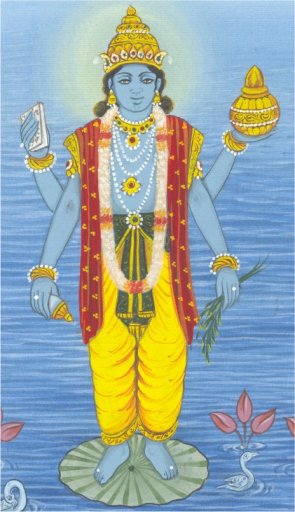 🇮🇳 India and 1 moreDhanterasधनतेरस (Hindi), धनत्रयोदशी (Sanskrit)
The first day of Diwali, a festival of lamps, health and wealth kept across India and Nepal.Festival
🇮🇳 India and 1 moreDhanterasधनतेरस (Hindi), धनत्रयोदशी (Sanskrit)
The first day of Diwali, a festival of lamps, health and wealth kept across India and Nepal.Festival
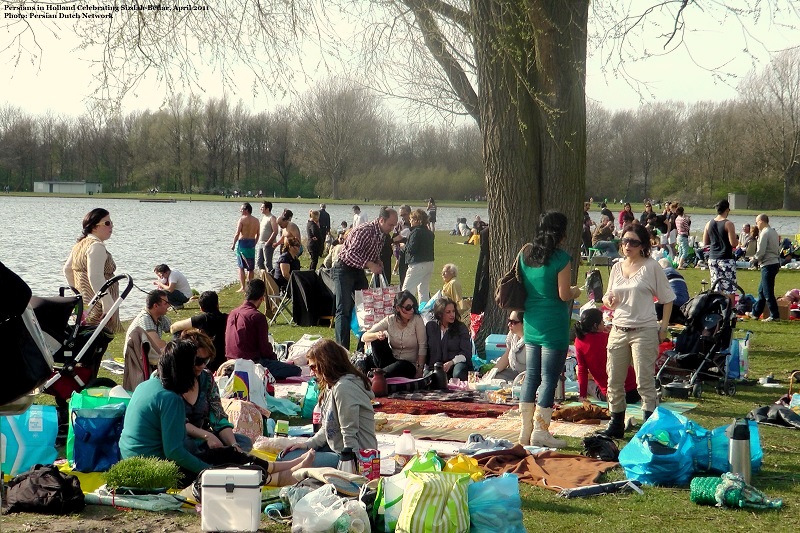 🇮🇷 Iran and 4 moreSizdah Bedarسیزدهبدر
An open-air picnic holiday concluding the Iranian New Year celebrationsFestival
🇮🇷 Iran and 4 moreSizdah Bedarسیزدهبدر
An open-air picnic holiday concluding the Iranian New Year celebrationsFestival