Spiritual and religiousOceaniaIndigenous and traditionalChristian
Marae
A cleared, sacred gathering place at the heart of Māori and Polynesian community life

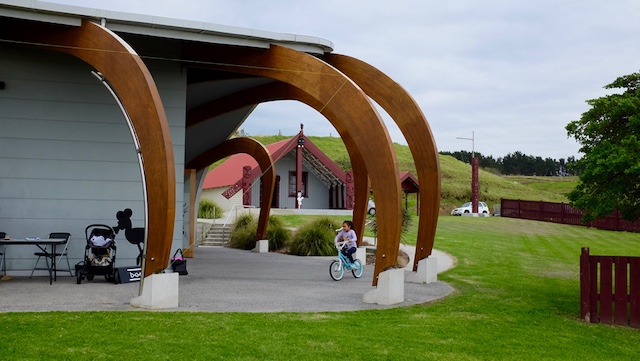
A marae is a communal and sacred place in Polynesian societies, an area of cleared land that may hold a meeting house, a dining hall and carved posts. Māori in New Zealand keep it as a living centre for welcomes, oratory, family gatherings and funerals, while in tropical Polynesia many old marae stand as archaeological sites that remain tapu, or sacred.
When is Marae kept?
Marae is kept on kept all year, whenever a welcome, a meeting, a family occasion or a tangihanga is held.
A marae is a cleared, open place that Polynesian communities set aside as communal and sacred ground. In Aotearoa New Zealand it is still at the centre of Māori life: a courtyard, a meeting house and a dining hall together. People gather there to speak the language, settle obligations between tribes, hold family occasions and mourn their dead.
What it is
The word marae names ground that has been cleared. In Māori, Cook Islands Māori and Tahitian the same form is used; Tongan says malaʻe, Samoan malae and Marquesan meʻae. Linguists trace the term back to an Eastern Oceanic root, *malaqe, for an open space used for meeting or ceremony. A marae is usually a roughly rectangular plot, edged with stones or wooden posts, and sometimes with terraces known as paepae. On Rapa Nui a central stone platform, the ahu, stands within it, and that word came to stand for the whole complex instead. In Māori the word does not change in the plural.
Origins and history
Polynesian marae are old. Archaeologists date the Taputapuātea marae on Rarotonga to the 13th century, and Rarotongan tradition credits Tangi'ia with building it, carrying the central stone from the marae of the same name at Ra'iātea. Lifting a stone from that Ra'iātea site and setting it up far away was a familiar practice, founding another marae in a new district. In Tahiti, marae were tied to particular gods and to the family lines said to have built them; during restoration work at Ra'iātea in 1994, human bones were found under some structures, possibly offerings to the god ʻOro. Christianity's arrival in the 19th century left most tropical Polynesian marae broken or unused. Some now draw tourists and archaeologists, yet their ground is still held tapu.
How it is kept
Among Māori, the marae remains part of daily life. The term covers the whole complex, though it can also mean the open courtyard, the marae ātea, that lies before the wharenui, the carved meeting house. Guests are received there with a pōwhiri, a welcome that includes oratory and the karanga, a high call usually given by a woman. Some iwi and hapū reserve formal speechmaking for men. The meeting house is linked with Rongo, a deity of peace, while the open ground outside is linked with Tūmatauenga. Meetings, sleepovers and craft work all take place inside. The wharekai, or dining hall, is mainly used for shared meals.
Tangihanga and family events
Birthdays, weddings and anniversaries are held on the marae. The event that matters most is the tangihanga, the rites by which a community takes leave of someone who has died and holds up the grieving family. Writers Ka'ai and Higgins note that a tangihanga outranks every other event a marae hosts. The marae is also a wāhi tapu, a place carrying sacred weight, and the customs of the culture are studied, argued over and handed on there. Māori is spoken on it. Obligations between tribes are met on it. For many Māori it counts as much as a home does.
Law, schools and churches
Most iwi and hapū, and many small settlements, have a marae of their own. In New Zealand a marae can be registered as a reserve under the Māori Land Act 1993, with trustees answerable to the beneficiaries named in its charter. Urban Māori have built intertribal marae, such as Maraeroa in eastern Porirua. Churches, among them Anglican, Presbyterian and Catholic, run marae where the usual functions are carried out, and schools, technical colleges and universities have built them for students and for teaching Māori culture. The University of Auckland marae is used for Māori Department graduations and for greeting new staff. Fairfield College in the Waikato has a meeting house with a carved revolving pillar.
How Marae is kept
A visit begins on the open ground, the marae ātea, where a pōwhiri is held and oratory is spoken. Women usually give the karanga, the call; some iwi and hapū allow only men to make formal speeches. The wharenui, the meeting house, then takes over: it is where meetings, sleepovers and craft work happen, and where visitors stay. Shared meals are served in the wharekai, the dining hall. Each marae is run by trustees working under a charter agreed with iwi, hapū or whānau beneficiaries. At a tangihanga the marae becomes the place where a community takes leave of someone who has died and the family is supported.
When and where
A marae is not tied to a season. It belongs to a descent group and stays in use all year, whenever an occasion arises: a welcome, a meeting, a birthday, a wedding, or a tangihanga. Funeral rites come first and push every other gathering aside. In tropical Polynesia, old marae are visited at set moments, such as the tidying of certain Rarotongan marae before a new ariki is installed.
Marae belong to the whole Polynesian triangle. They are strongest among Māori in Aotearoa New Zealand, where nearly every iwi, hapū and many villages have one, and where city Māori have built shared ones such as Maraeroa in eastern Porirua. Elsewhere, Rarotonga and Aitutaki in the Cook Islands hold notable examples, as do Ra'iātea, Huahine, Borabora and Tahiti. Rapa Nui, Tonga, Samoa and the Marquesas keep their own forms.
What Marae means
A marae is a wāhi tapu, a place set apart. Anne Salmond calls marae doorways linking Po, where gods and darkness belong, with Ao, the daylight world of people, so that the living can speak with their ancestors. In Māori thought the meeting house belongs to Rongo, a god of peace, and the ground outside to Tūmatauenga. The old sites of tropical Polynesia stay tapu even when nothing stands on them. Many Māori treat their marae as being as important as their own home.



Questions people ask about Marae
When is Marae kept?
Marae is kept on kept all year, whenever a welcome, a meeting, a family occasion or a tangihanga is held.
What is a marae?
It is an open, cleared and sacred place used for community and religious purposes across Polynesian societies. In Māori New Zealand it usually means a whole complex: an open courtyard, a carved meeting house where people gather and sleep, and a dining hall where meals are shared.
Where are marae found?
They exist throughout Polynesia. The strongest living tradition is among Māori in Aotearoa New Zealand. Historic marae also stand in the Cook Islands, Tahiti, Ra'iātea, Huahine and Borabora, and related forms appear on Rapa Nui, in Tonga, Samoa and the Marquesas.
Is a marae the same as a meeting house?
No. The wharenui is the meeting house itself. The marae is the wider place, taking in the open ground in front, called the marae ātea, and often the dining hall and other buildings too. In Māori the one word serves for both singular and plural.
What is a tangihanga?
It is the Māori funeral rite, held on the marae. It is the way a community takes leave of someone who has died and surrounds the surviving family with support. Writers Ka'ai and Higgins record that a tangihanga takes precedence over every other gathering held on a marae.
Who looks after a marae?
A group of trustees does. In New Zealand a marae can be registered as a reserve under the Māori Land Act 1993, and each one usually has a charter negotiated with its beneficiaries, who are often iwi, hapū or whānau. The charter covers how trustees are chosen and held accountable.
See also
 WhakapapaMāori genealogy, recited to place a person among ancestors, land and tribe
 ʻIe tōgaPrecious woven mats exchanged in Samoan ceremonies to honor family ties and chiefly status.
 PeʻaThe traditional Samoan rite of full-body tattooing for men, tapped by master artists
Good reading and sources
- Encyclopaedia BritannicaArticle
- TaputapuāteaUNESCO, Heritage listing
- TaputapuāteaUNESCO, Article
- Marae on WikipediaEncyclopedia
- More photos on Wikimedia CommonsPhotos and video
- Wikidata recordOpen data
The facts on this page come from the Wikipedia article "Marae", written by its contributors and used under the CC BY-SA 4.0 licence, and from its Wikidata record (CC0). EveryParampara rewrote the text in its own words, with AI assistance, and compares every page with the article to make sure no passage is copied. It may be reused under the same CC BY-SA 4.0 licence with a link back.
It may contain mistakes. Traditions differ from one family, village and community to the next, and the people who keep them know them best. If something is wrong, tell us. Last refreshed 2026-10-05.
More from New Zealand
All the traditions of New Zealand 🇦🇺 Australia and 5 moreGood Friday
A solemn Christian holy day commemorating the crucifixion and death of Jesus Christ.Spiritual · Fasting and breaking the fast
🇦🇺 Australia and 5 moreGood Friday
A solemn Christian holy day commemorating the crucifixion and death of Jesus Christ.Spiritual · Fasting and breaking the fast
 🇺🇸 United States and 4 moreHoʻoponopono
A Hawaiian family ritual of prayer, confession and forgiveness that sets wrongs rightSpiritual · Feasts and festival meals
🇺🇸 United States and 4 moreHoʻoponopono
A Hawaiian family ritual of prayer, confession and forgiveness that sets wrongs rightSpiritual · Feasts and festival meals
 🇳🇿 New ZealandTivaevaetīvaevae
A traditional Polynesian art of artistic quilting made by women for gifts and ceremonies.Craft
🇳🇿 New ZealandTivaevaetīvaevae
A traditional Polynesian art of artistic quilting made by women for gifts and ceremonies.Craft
The same idea elsewhere
Death and mourning compared 🇷🇸 SerbiaSlavaСлава
An annual Serbian family feast honouring their patron saint with blessed bread and wineSpiritual · Feasts and festival meals
🇷🇸 SerbiaSlavaСлава
An annual Serbian family feast honouring their patron saint with blessed bread and wineSpiritual · Feasts and festival meals
 🇻🇳 VietnamTếtTết Nguyên Đán
The Vietnamese festival of the lunar new year, welcoming spring with family gatheringsFestival · Feasts and festival meals
🇻🇳 VietnamTếtTết Nguyên Đán
The Vietnamese festival of the lunar new year, welcoming spring with family gatheringsFestival · Feasts and festival meals
 🇬🇪 Tbilisi, GeorgiaSupraსუფრა
A Georgian feast led by a toastmaster, where toasts, wine and food carry the mealTable custom · Feasts and festival meals
🇬🇪 Tbilisi, GeorgiaSupraსუფრა
A Georgian feast led by a toastmaster, where toasts, wine and food carry the mealTable custom · Feasts and festival meals
 🇪🇬 Egypt and 5 moreLibation
The ceremonial gift of drink given to deities, ancestors, and the earthSpiritual · Tea, coffee and drinking ceremonies
🇪🇬 Egypt and 5 moreLibation
The ceremonial gift of drink given to deities, ancestors, and the earthSpiritual · Tea, coffee and drinking ceremonies