Kilt
In its own language: fèileadh
A pleated knee-length skirt in tartan wool, worn as Scottish Highland dress

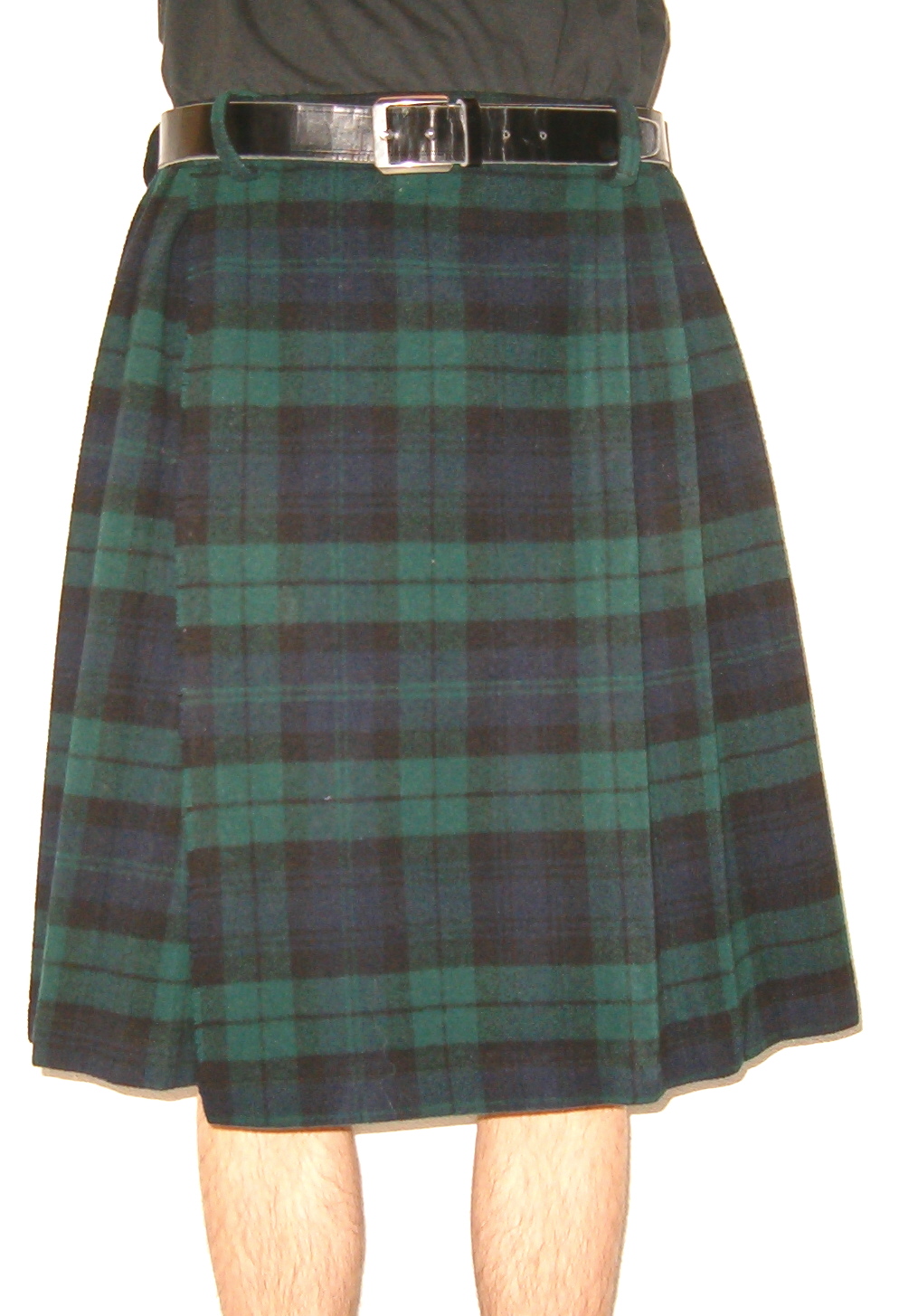
A kilt is a wrap-around skirt reaching the knee, pleated at the sides and back and normally woven in tartan wool. It comes from men's dress in the Scottish Highlands and was first noted in the 16th century; a shorter version appeared in the 1700s. People wear it at ceremonies, Highland games and, increasingly, day to day.
When is Kilt kept?
Kilt is kept on worn at formal occasions, Highland games and competitions, and increasingly as everyday dress, at any time of year.
The kilt is a knee-length wrap garment, usually of pleated tartan wool, that began in the Scottish Highlands and is worn mainly by men. Its upper half could once double as a cloak. Today it appears at formal events, Highland games and sporting fixtures, and also as everyday clothing, and it stands for Scottish, Gaelic and Celtic identity.
What a kilt is
A kilt is a tailored wrap garment that covers the body from the waist to around the middle of the knees. It is fastened with straps and buckles, usually starting at the wearer's left side, passing round the front and back and crossing the front again. The flat overlapping panels at the front are called aprons. The single layer of cloth running round the sides and back is pleated. A pin can be fixed to the free corner of the front apron; it is there to add weight and is not pushed through the cloth beneath. Traditionally the cloth is tartan, and the garment is most often worn by men.
Origins and history
The great kilt, also called the belted plaid or breacan, appears in records from the 16th century. It was a full-length piece whose top half could be draped over a shoulder or pulled up over the head. In the 1720s Thomas Rawlinson, an English Quaker from Lancashire, found the belted plaid awkward to wear. He cut the skirt free and made it a separate garment with the pleats already stitched. Iain MacDonnell, chief of the MacDonnells of Inverness, took up the same work, and men employed in logging, charcoal burning and iron smelting copied their chief. The shorter kilt, the philibeg, then spread quickly among Highlanders and some Lowlanders. There is also a suggestion that a version with unsewn pleats was made in the 1690s.
Tartan and setts
The pattern of a tartan is known as a sett. Tying particular setts to clans and families reaches back perhaps one or two centuries. Systematic naming and recording came in the Victorian period, mostly through weaving firms supplying the trade; before then most patterns were linked to regions rather than clans. A thread count gives the order of colours and their widths. The Wallace tartan, for example, is written K/4 R32 K32 Y/4, where K stands for black, R for red and Y for yellow. Setts are worked across and up the cloth, not on the bias; the exception is cloth adapted for women's skirts.
Cloth and making
Kilts are usually sewn from twill-woven worsted wool, and the twill line gives the cloth its diagonal texture. Cloth is sold by weight, measured in ounces per yard: regimental worsted runs about 18 to 22 ounces, a light worsted about 10 to 11, and 13 and 16 ounces are the common choices. Heavier cloth suits cold weather; lighter cloth is picked for warm days or for dancing. A modern adult kilt takes roughly 6 to 8 yards of single-width cloth, or 3 to 4 yards of double width. Hems are avoided so the garment hangs properly. Kilts worn by Irish pipe bands are cut in a similar way but use plain cloth, most often saffron or green.
Wearing it today
Formal occasions and Highland games are where most people still see a kilt, and it is also worn for other sporting events. In recent years it has come back as informal men's dress, closer to the everyday garment it once was. Casual versions are made in many materials, may close with different fastenings, and can have pockets so the pouch known as a sporran is not needed. Some women wear kilts for sport. Competition rules in Highland dancing and piping set out what competitors may wear; women taking part in the national dances wear the Aboyne dress.
How Kilt is kept
A kilt is wrapped round the waist and held by straps and buckles. It is buckled so that the cloth is neither loose enough to twist round the body nor tight enough to pull into scalloped ridges where it fastens. The hem is meant to sit between roughly an inch above the kneecap and halfway down it. The flat aprons cross at the front; the pleats lie at the sides and back. A pin may be fixed at the free corner of the front apron for weight. What, if anything, is worn underneath is left to the wearer.
When and where
No single date belongs to the kilt. It is worn at formal occasions, Highland games and other sporting fixtures, and at Highland dancing and piping competitions, where the rules of the organisers state what competitors may wear. Because casual kilts now sell as everyday clothing, they can be seen at any time of year.
Scotland is home to the kilt, above all the Highlands, and it stands for Scottish culture and for Gaelic or Celtic heritage more widely. Kilted pipe bands are found in Ireland, wearing plain cloth. Elsewhere in the Celtic world the garment has been taken up in local forms, including the Welsh cilt and the Cornish cilt. It also travels with people of Scottish descent overseas.
What Kilt means
For many wearers the kilt is a sign of Scottish, Gaelic or Celtic identity, and it marks formal and festive occasions. It is also a practical garment with a long working history. The colours and patterns carry less meaning than people often assume: clan tartans were largely a Victorian arrangement, and before that patterns were linked to regions. According to the sources, the shades in a tartan are a matter of the weaver's choice and do not reflect the wearer's rank.


Questions people ask about Kilt
When is Kilt kept?
Kilt is kept on worn at formal occasions, Highland games and competitions, and increasingly as everyday dress, at any time of year.
What is a kilt?
A kilt is a knee-length wrap garment with pleats at the sides and back, usually made from twill-woven worsted wool in a tartan pattern. It began as men's wear in the Scottish Highlands and today appears at ceremonies, Highland games, sporting events and, increasingly, in everyday use.
Where is the kilt worn?
Scotland, especially the Highlands, is its home, and it is bound up with Scottish culture and with Gaelic and Celtic heritage. Kilted pipe bands play in Ireland, and related garments have been adopted in other Celtic nations, including the Welsh cilt and the Cornish cilt. It also travels with Scottish communities abroad.
Is anything worn under a kilt?
That is left to the wearer. A long-running saying claims that a Scot wears nothing beneath it, though the Scottish Tartans Authority has cautioned that going without can be unhygienic and unbecoming in certain settings.
What is a sett?
A sett is the repeating pattern of a tartan, set out in a thread count that lists the colours and their widths. Patterns have been linked to clans and families for perhaps a century or two, and many named tartans were recorded in the Victorian era by commercial weavers.
See also
 ChristmasA festival of Jesus's birth, kept on 25 December with gifts, lights and shared meals
 HalloweenAn annual observance on 31 October marking the eve of All Saints' Day, rooted in Christian tradition and Celtic heritage
 Valentine's DayA Christian feast day and cultural celebration of love kept on February 14 in many countries.
 Good FridayA solemn Christian holy day commemorating the crucifixion and death of Jesus Christ.
Good reading and sources
- Kilt on WikipediaEncyclopedia
- More photos on Wikimedia CommonsPhotos and video
- Wikidata recordOpen data
The facts on this page come from the Wikipedia article "Kilt", written by its contributors and used under the CC BY-SA 4.0 licence, and from its Wikidata record (CC0). EveryParampara rewrote the text in its own words, with AI assistance, and compares every page with the article to make sure no passage is copied. It may be reused under the same CC BY-SA 4.0 licence with a link back.
It may contain mistakes. Traditions differ from one family, village and community to the next, and the people who keep them know them best. If something is wrong, tell us. Last refreshed 2026-10-05.
More from the United Kingdom
All the traditions of the United Kingdom 🇬🇧 United KingdomTartanbreacan
The checked woollen cloth of Scotland, woven from crossing stripes into named patternsDress
🇬🇧 United KingdomTartanbreacan
The checked woollen cloth of Scotland, woven from crossing stripes into named patternsDress
 🇮🇳 India and 4 moreSindoorसिंदूर
A red powder worn in the hair parting by many married Hindu womenDress
🇮🇳 India and 4 moreSindoorसिंदूर
A red powder worn in the hair parting by many married Hindu womenDress
 🇬🇧 United KingdomGuernsey
A traditional seamless wool sweater crafted for seafarers across the British IslesDress
🇮🇹 Rome, Italy and 4 moreChristmas
A festival of Jesus's birth, kept on 25 December with gifts, lights and shared mealsFestival
🇬🇧 United KingdomGuernsey
A traditional seamless wool sweater crafted for seafarers across the British IslesDress
🇮🇹 Rome, Italy and 4 moreChristmas
A festival of Jesus's birth, kept on 25 December with gifts, lights and shared mealsFestival
The same idea elsewhere
All of this kind 🇮🇳 Paithan, IndiaPaithani
A handwoven silk sari from Maharashtra, with a squared border and a peacock palluDress
🇮🇳 Paithan, IndiaPaithani
A handwoven silk sari from Maharashtra, with a squared border and a peacock palluDress
 🇮🇱 Israel and 1 moreTzitzitצִיצִית
Knotted ritual fringes worn on a four-cornered garment, a reminder of the commandmentsDress
🇮🇱 Israel and 1 moreTzitzitצִיצִית
Knotted ritual fringes worn on a four-cornered garment, a reminder of the commandmentsDress
 🇼🇸 Samoa and 1 moreʻIe tōga
Precious woven mats exchanged in Samoan ceremonies to honor family ties and chiefly status.Dress
🇼🇸 Samoa and 1 moreʻIe tōga
Precious woven mats exchanged in Samoan ceremonies to honor family ties and chiefly status.Dress
 🇪🇬 Egypt and 5 moreTraditional tattooing
The ancient custom of marking the skin for protection, healing, status and sacred ritesDress
🇪🇬 Egypt and 5 moreTraditional tattooing
The ancient custom of marking the skin for protection, healing, status and sacred ritesDress