Festivals and celebrationsEuropeChristianPagan and ancient
Krakelingen and Tonnekensbrand
A bread throw and a hilltop bonfire that close the winter in Geraardsbergen
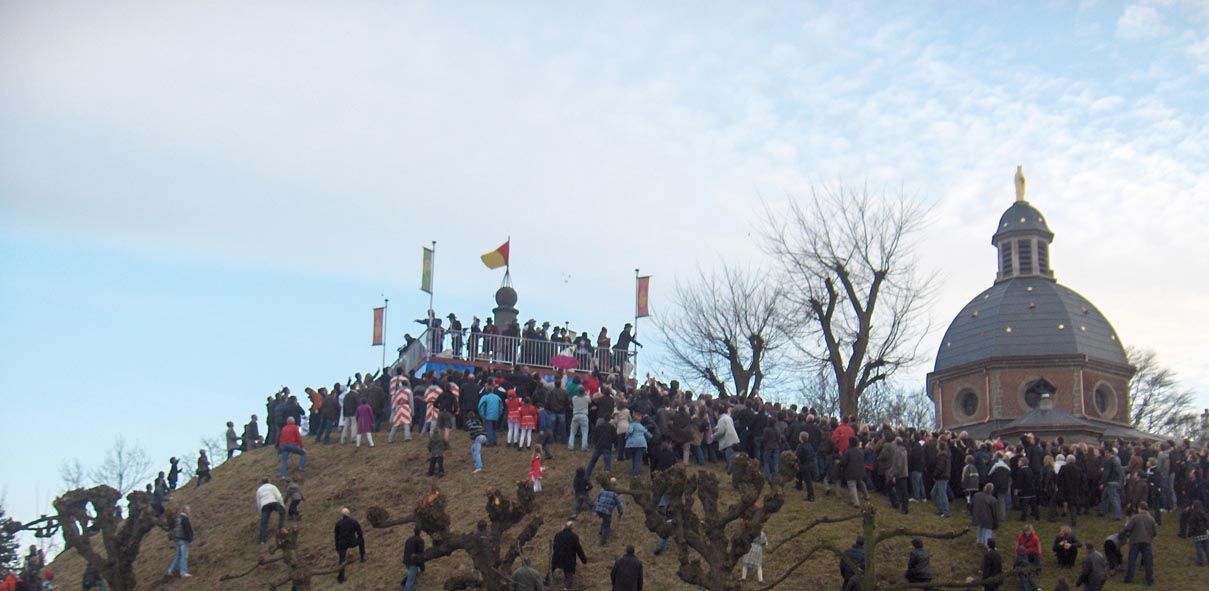
Each year the Belgian town of Geraardsbergen holds a double feast as winter ends: a historical procession through the streets, a throw of ring-shaped breads from the Oudenberg hill, and a bonfire on the same hill at night. The town's accounts mention the fire as early as 1393, and UNESCO listed the custom in 2010.
When is Krakelingen and Tonnekensbrand kept?
Krakelingen and Tonnekensbrand is kept each year on a Sunday in late February, with the fire in the evening.
The town of Geraardsbergen in Belgium keeps a double feast each year as winter runs out. A procession of townspeople in historical dress walks from Hunnegem church to the Oudenberg hill. There, thousands of ring-shaped breads called krakelingen, or mastellen, are thrown to the crowd, and one hides a note that wins a golden jewel. At night a straw figure burns on the hilltop.
Records and listings
The oldest account book of Geraardsbergen that survives, from 1393, already sets out what was spent on the Tonnekensbrand, and the town council was running that fire feast even then. The same pages call it an old custom, and from that date onward both the bread throw and the fire turn up without a break in the town's accounts. Flanders placed the pair on its inventory of intangible cultural heritage in 2009, and UNESCO added them to its representative list in 2010.
The procession
Before the throw, a historical procession leaves the old Romanesque church at Hunnegem at three in the afternoon and finishes on the Oudenberg. It presents roughly twenty-five centuries of the town's past. The dean and the town council wear historical clothing, and about a thousand extras, mostly local people taking part through a school or an association, fill the ranks. Celtic themes and the town's defeat by the army of the count of Flanders under Walter of Enghien stand beside the later stories. Every year one strand of local heritage is given extra attention: ties with Latin America, the work of women in the town, medieval trades, nineteenth-century industries, artists, or the boroughs absorbed in the merger.
Bread thrown from the hill
After the procession, druids, the dean, the council, the bread-basket carriers and thousands of onlookers climb the Oudenberg, which rises 110 metres above the town. The Litany of Our Lady is said in the hilltop chapel while the crowd takes its place below the stage. Before anything is thrown, the dean, the mayor, the aldermen and the councillors have to take wine with a small live fish out of a silver cup about four hundred years old. Then some ten thousand krakelingen fly out over the crowd. One of them holds a note that wins the golden kringle, a jewel shaped like the bread and made each time by a different jeweller from the area. The fair in the town centre follows.
The fire at night
At eight in the evening a straw doll is set alight on the summit of the Oudenberg. The burning figure is meant to drive the cold season off and greet the new spring, and folk dancers perform while it burns. In a few nearby municipalities a smaller fire is lit in answer to the Tonnekensbrand. Torches are handed out to the people watching, and they carry the flame down into Geraardsbergen's Markt, where the fairground rides are turning at full speed.
What it means
Two strands meet in the feast. Christian practice shows in the part played by the dean and in the prayer said on the hill, while older layers, perhaps reaching back to Celtic times, show in the fire, the bread, the live fish and the moment of the year chosen. The ring of the krakeling is modelled on a cult bread and stands for the turning year and for life itself. The fish is read as a sign of new life, and the shared wine as a sign of celebration and brotherhood. The bonfire says farewell to winter and welcomes spring.
How Krakelingen and Tonnekensbrand is kept
On the chosen Sunday a historical procession sets off at three in the afternoon from the Romanesque church at Hunnegem and walks to the Oudenberg, with the dean and the town council in old-style dress and around a thousand volunteers taking part. On the hill, the Litany of Our Lady is recited in the chapel, and the dean, mayor, aldermen and councillors take wine with a small live fish from an old silver cup. Then about ten thousand krakelingen are thrown to the crowd. At eight in the evening a straw doll is set alight, and torches carry the fire down to the Markt.
When and where
Until 1960 the feast followed the first Sunday of Lent. Since then it is set by the civil calendar and lands on a Sunday in late February, eight days ahead of March's first Monday. The bread throw happens in the afternoon, and the bonfire is lit at eight in the evening.
Both parts belong to Geraardsbergen, a town in Belgium, and are held on and around the Oudenberg, the hill that stands above it. The procession crosses the town from the Hunnegem church to the hill, and the evening fire ends at the Markt. A few neighbouring municipalities light smaller fires in reply.
What Krakelingen and Tonnekensbrand means
Christian marks and older ones sit side by side here, the first in the dean's role and the prayer on the hilltop, the second in the fire, the bread, the fish and the choice of season, which may go back to Celtic times. The ring of the krakeling comes from a cult bread and points to the turning year and to life. The fish is taken as a sign of new life, the wine shared from one cup as a sign of celebration and brotherhood. The bonfire marks winter leaving and spring arriving.

Questions people ask about Krakelingen and Tonnekensbrand
When is Krakelingen and Tonnekensbrand kept?
Krakelingen and Tonnekensbrand is kept each year on a Sunday in late February, with the fire in the evening.
What is Krakelingen and Tonnekensbrand?
It is a yearly double feast in Geraardsbergen, Belgium. In the afternoon a historical procession ends on the Oudenberg hill, where ring-shaped breads are thrown to the crowd. In the evening a straw figure is burned on the same hill to mark the end of winter.
Where does it take place?
In Geraardsbergen, a town in Belgium. The procession starts at the Romanesque church of Hunnegem and finishes on the Oudenberg, the hill above the town. The bonfire is lit on the summit, and torches then carry the flame to the Markt.
What is the golden kringle?
One of the thrown breads holds a note. Whoever finds it wins a golden kringle, a piece of jewellery shaped like the bread itself. A different jeweller from the area makes it each year, so no two are alike.
Why does anyone swallow a live fish in wine?
The dean, the mayor, the aldermen and the councillors each swallow a small live fish in a sip of wine from a silver cup. The humanist Joos Schollaert described this in 1599. It is read as a sign of new life and of shared celebration.
See also
 MaypoleA tall wooden pole, garlanded and danced around, raised at May Day, Whitsun or Midsummer
 Carnival of BincheA Belgian pre-Lenten festival known for masked dancers and orange tossing
 CandlemasA Christian feast of candle blessings marking the end of the Christmas season
 BuergbrennenA bonfire festival marking the end of winter on the first Sunday of Lent in Luxembourg
Good reading and sources
- Krakelingen and Tonnekensbrand on WikipediaEncyclopedia
- More photos on Wikimedia CommonsPhotos and video
- Wikidata recordOpen data
The facts on this page come from the Wikipedia article "Krakelingen and Tonnekensbrand", written by its contributors and used under the CC BY-SA 4.0 licence, and from its Wikidata record (CC0). EveryParampara rewrote the text in its own words, with AI assistance, and compares every page with the article to make sure no passage is copied. It may be reused under the same CC BY-SA 4.0 licence with a link back.
It may contain mistakes. Traditions differ from one family, village and community to the next, and the people who keep them know them best. If something is wrong, tell us. Last refreshed 2026-10-05.
More from Belgium
All the traditions of Belgium
🇩🇪 Germany and 5 moreMaypole
A tall wooden pole, garlanded and danced around, raised at May Day, Whitsun or MidsummerFestival
🇧🇪 Binche, BelgiumCarnival of BincheCarnaval de Binche
A Belgian pre-Lenten festival known for masked dancers and orange tossingFestival
 🇺🇸 New Orleans, United States and 5 moreMardi Gras
A festive day of parades and rich foods marking the final celebration before the Christian fasting season of Lent beginsFestival
🇺🇸 New Orleans, United States and 5 moreMardi Gras
A festive day of parades and rich foods marking the final celebration before the Christian fasting season of Lent beginsFestival
 🇭🇷 Dubrovnik, Croatia and 1 moreFestivity of Saint BlaiseFesta Svetog Vlaha
An annual patron saint festival in Dubrovnik with processions, relics and dovesFestival
🇭🇷 Dubrovnik, Croatia and 1 moreFestivity of Saint BlaiseFesta Svetog Vlaha
An annual patron saint festival in Dubrovnik with processions, relics and dovesFestival
The same idea elsewhere
Spring and renewal compared 🇺🇸 United States and 5 moreMother's Day
A worldwide annual celebration dedicated to mothers, maternal bonds and family careHome
🇺🇸 United States and 5 moreMother's Day
A worldwide annual celebration dedicated to mothers, maternal bonds and family careHome
 🇮🇷 Iran and 7 moreNowruzنوروز
The Iranian new year at the March equinox, kept with fire, greenery and picnicsSeasonal
🇮🇷 Iran and 7 moreNowruzنوروز
The Iranian new year at the March equinox, kept with fire, greenery and picnicsSeasonal
 🇮🇱 Jerusalem, IsraelPassoverפסח
A Jewish spring festival celebrating freedom from slavery with ritual mealsSpiritual · Dinner
🇮🇱 Jerusalem, IsraelPassoverפסח
A Jewish spring festival celebrating freedom from slavery with ritual mealsSpiritual · Dinner
 🇮🇳 Mathura, India and 5 moreHoliहोली (Hindi)
A spring festival of colours and bonfires that marks the end of winter and the triumph of good over evil.Festival
🇮🇳 Mathura, India and 5 moreHoliहोली (Hindi)
A spring festival of colours and bonfires that marks the end of winter and the triumph of good over evil.Festival