Music, dance and storytellingEuropeSecular and civic
Latvian Song and Dance Festival
In its own language: Vispārējie latviešu Dziesmu un Deju svētki
A grand gathering of choirs, dancers and folk artists held every five years in Latvia

The Latvian Song and Dance Festival is a nationwide cultural celebration held every five years in Riga, bringing together tens of thousands of amateur singers and dancers. Participants gather from across Latvia and the diaspora to perform traditional folk music, choreographed dances, orchestral works, and mass choral concerts.
When is Latvian Song and Dance Festival kept?
Latvian Song and Dance Festival is kept every five years in July.
The Latvian Song and Dance Festival is one of the largest amateur performance gatherings in the world. Every five years, tens of thousands of singers, folk dancers, and instrumentalists convene in Riga. The event celebrates Latvian cultural identity through massed choral singing, complex group choreography, craft exhibitions, and community parades. It remains a central pillar of social life and collective memory for Latvians at home and across the diaspora.
Choral and dance traditions
Tens of thousands of amateur performers fill the capital for roughly a week of events. The musical core relies heavily on unaccompanied choral harmony, blending ancient folk melodies with classical and modern compositions. Alongside the massed choirs, thousands of folk dancers execute synchronized patterns in large arenas, while wind bands and symphonic orchestras stage open concerts. The celebration also incorporates visual arts, showcasing traditional handicrafts and photography. Outside the formal stages, performers join a grand festive parade through city streets, dressed in regional costumes from across the country.
Origins and endurance
The festival began taking shape during the nineteenth century, drawing inspiration from regional singing events in Europe. A precursor gathering took place at Dikļi in 1864, leading to the first official celebration in Riga in 1873 with just over one thousand choristers. Over subsequent decades, the event became an expression of national identity. Even during foreign occupation, singing remained a vital outlet. In 1985, choristers defied Soviet authorities by demanding to sing The Castle of Light, an anthem about national renewal, conducted by Haralds Mednis. By 1990, restored sovereignty brought the national flag and previously prohibited songs back into the open.
Celebrations beyond borders
Following World War II, displaced Latvians established festival traditions in refugee camps across Germany. As communities resettled, they organized regular gatherings in North America and Australia to keep their heritage alive. These overseas festivals continue today, rotating between cities in Canada and the United States, such as Toronto and locations in Minnesota. Conductors preserved classic repertoires and trained successive generations abroad. When Latvia regained independence, diaspora choirs traveled back to Riga, turning the festival into a reunion of communities separated by decades of political division.
The modern festival
Recent editions have reached historic proportions, drawing nearly half a million spectators and over forty thousand performers. In 2018, the festival marked the centenary of Latvian independence with its largest attendance to date, culminating in an all-night sing-along after the final concert. The 2023 gathering marked the sesquicentennial of the choral festival and seventy-five years of the dance program, introducing choral music in the Livonian language. A separate festival for school youth, established in 1960, runs on its own five-year cycle, ensuring that new generations continue the practice.
How Latvian Song and Dance Festival is kept
Choirs, dance troupes, and orchestras rehearse for years through local competitions before arriving in Riga. During festival week, thousands of participants march in an opening parade through the city. Ensembles perform in parks, arenas, and the Daugava Stadium. The celebration culminates at the Mežaparks open-air amphitheater, where thousands of singers join on a massive tiered stage. Under rotating guest conductors, the grand choir sings folk arrangements, classical pieces, and patriotic anthems, followed by late-night singing where audience members join the performers.
When and where
The festival is held once every five years, usually during July. Occasional special editions take place to commemorate major city or national anniversaries. Preparations and regional qualifying events continue throughout the intervening years.
The main festival takes place across Riga, Latvia, primarily at the Mežaparks Great Bandstand and Daugava Stadium. Satellite celebrations are also held by diaspora communities in Canada, the United States, and Australia.
What Latvian Song and Dance Festival means
For Latvians, the festival represents collective identity, cultural resilience, and national unity. Choral singing has historically served as a peaceful vehicle for cultural preservation during eras of political suppression. Songs like The Castle of Light embody themes of national awakening and renewal, turning mass performances into powerful communal statements.


Questions people ask about Latvian Song and Dance Festival
When is Latvian Song and Dance Festival kept?
Latvian Song and Dance Festival is kept every five years in July.
What is the Latvian Song and Dance Festival?
It is a massive cultural gathering held in Latvia every five years. It brings together tens of thousands of amateur singers, dancers, and musicians to perform traditional and classical Latvian works in open-air concerts and parades.
Where and when does the festival take place?
The main celebration is held in Riga, Latvia, typically during the month of July every five years. Diaspora communities also host rotating overseas editions in North America and Australia.
How many people participate in the celebration?
Around forty thousand amateur performers take part in the main festival events. The closing concert features mass choirs of over sixteen thousand voices singing together, attended by tens of thousands of spectators.
What kinds of performances are included?
The program focuses heavily on unaccompanied a cappella choral singing and choreographed folk dancing. It also features symphonic and wind orchestra concerts, craft and photography exhibits, and popular modern songs.
See also
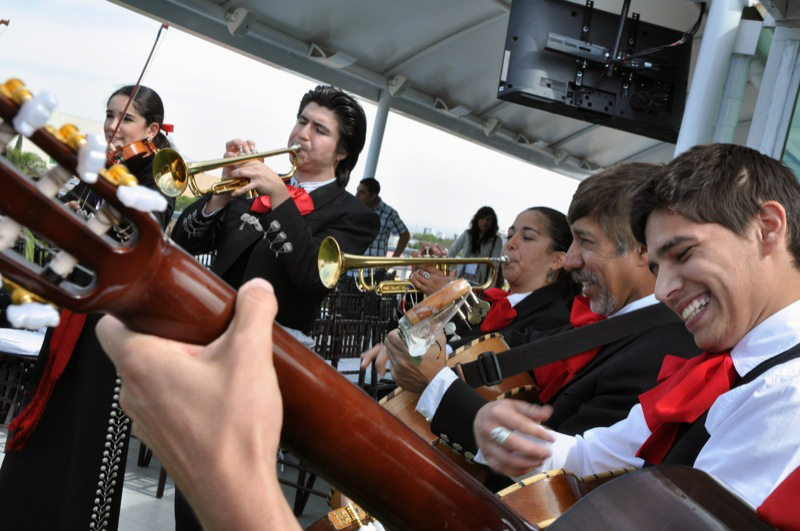 MariachiA Mexican string and trumpet music tradition featuring charro attire and communal singing.
 Royal Edinburgh Military TattooAn annual military music and performance show held on the Esplanade of Edinburgh Castle in August.
 Mummers' playA comic folk drama of staged combat, death, and revival by an eccentric doctor
 ChristmasA festival of Jesus's birth, kept on 25 December with gifts, lights and shared meals
Good reading and sources
- Baltic song and dance celebrationsUNESCO, Heritage listing
- Baltic song and dance celebrationsUNESCO, Article
- Latvian Song and Dance Festival on WikipediaEncyclopedia
- More photos on Wikimedia CommonsPhotos and video
- Wikidata recordOpen data
The facts on this page come from the Wikipedia article "Latvian Song and Dance Festival", written by its contributors and used under the CC BY-SA 4.0 licence, and from its Wikidata record (CC0). EveryParampara rewrote the text in its own words, with AI assistance, and compares every page with the article to make sure no passage is copied. It may be reused under the same CC BY-SA 4.0 licence with a link back.
It may contain mistakes. Traditions differ from one family, village and community to the next, and the people who keep them know them best. If something is wrong, tell us. Last refreshed 2026-10-04.
More from Latvia
All the traditions of Latvia 🇱🇻 LatviaDaina
Short, traditional Latvian folk songs and verses sung across the human life cyclePerformance
🇱🇻 LatviaDaina
Short, traditional Latvian folk songs and verses sung across the human life cyclePerformance
 🇱🇹 Lithuania and 1 moreLithuanian folk songsliaudies dainos
Songs of love, weddings, work and war, sung in unison or in harmony across LithuaniaPerformance
🇱🇻 Riga, LatviaRiga International Short Film Festival 2ANNASRīgas Starptautiskais īsfilmu festivāls 2ANNAS
An annual autumn film competition and screening event held in Riga, LatviaPerformance
🇱🇻 Riga, LatviaRiga Salsa Festival
An annual salsa dance festival in Riga, Latvia, featuring workshops and live performances.Performance
🇱🇹 Lithuania and 1 moreLithuanian folk songsliaudies dainos
Songs of love, weddings, work and war, sung in unison or in harmony across LithuaniaPerformance
🇱🇻 Riga, LatviaRiga International Short Film Festival 2ANNASRīgas Starptautiskais īsfilmu festivāls 2ANNAS
An annual autumn film competition and screening event held in Riga, LatviaPerformance
🇱🇻 Riga, LatviaRiga Salsa Festival
An annual salsa dance festival in Riga, Latvia, featuring workshops and live performances.Performance
The same idea elsewhere
All of this kind 🇵🇭 Philippines and 1 morePangalay
A traditional fingernail dance of the Tausūg and Bajau peoples in the Sulu Archipelago and Sabah.Performance
🇵🇭 Philippines and 1 morePangalay
A traditional fingernail dance of the Tausūg and Bajau peoples in the Sulu Archipelago and Sabah.Performance
 🇮🇳 Jammu, IndiaBhangra
A Punjabi harvest dance, first kept by farmers and now performed worldwidePerformance
🇮🇳 Jammu, IndiaBhangra
A Punjabi harvest dance, first kept by farmers and now performed worldwidePerformance
 🇳🇿 Auckland, New ZealandPoi
A Māori performing art of swinging tethered weights in rhythmical patterns.Performance
🇦🇴 Luanda, Angola and 2 moreKuduro
An energetic Angolan music and dance style born in Luanda that mixes African rhythms with electronic beats.Performance
🇳🇿 Auckland, New ZealandPoi
A Māori performing art of swinging tethered weights in rhythmical patterns.Performance
🇦🇴 Luanda, Angola and 2 moreKuduro
An energetic Angolan music and dance style born in Luanda that mixes African rhythms with electronic beats.Performance