Music, dance and storytellingEuropeChristianSecular and civic
Mummers' play
A comic folk drama of staged combat, death, and revival by an eccentric doctor

Mummers' plays are comic folk dramas performed by amateur troupes who visit pubs, streets, and houses across Britain, Ireland, and beyond. Usually staged around Christmas, Easter, or Plough Monday, each play revolves around a mock battle between rival heroes and a comic doctor who cures the fallen warrior.
When is Mummers' play marked?
Mummers' play is kept as part of Christmas, which is on Friday, 25 December 2026.
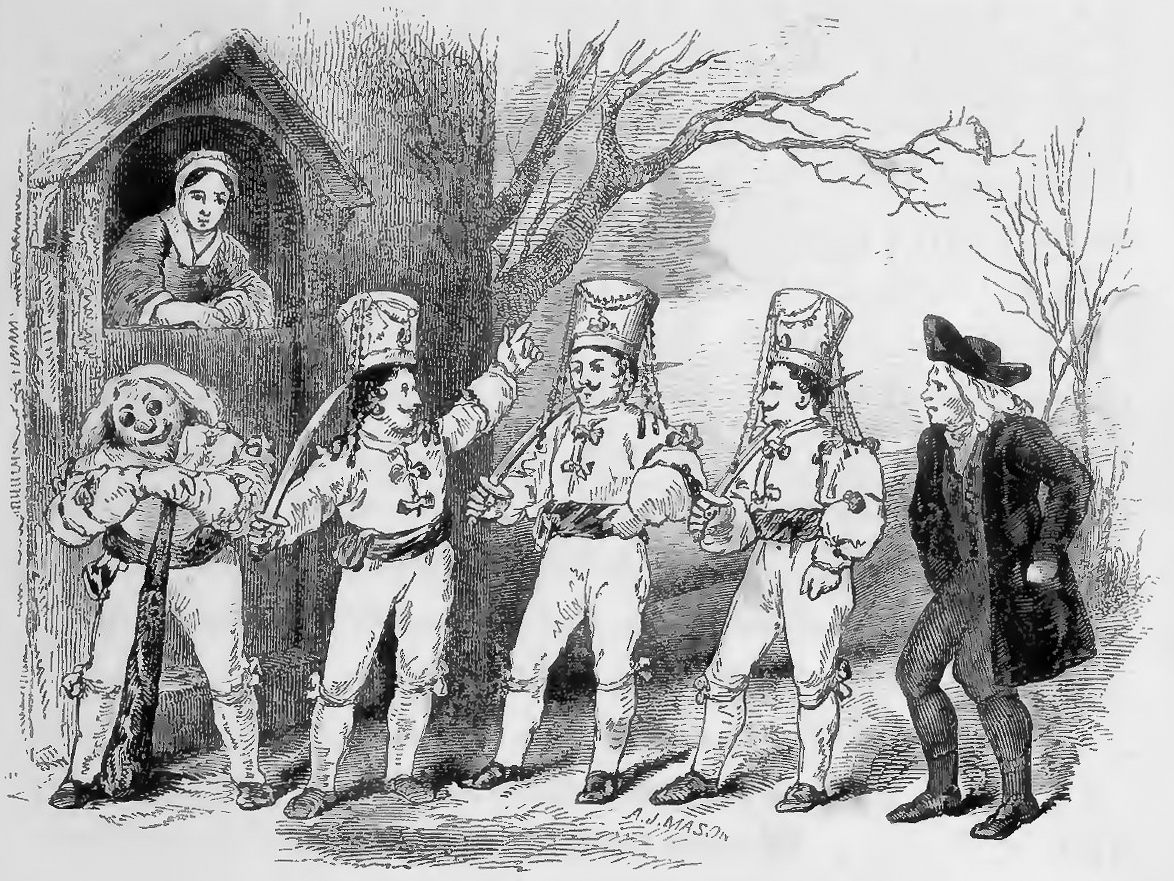
A mummers' play is a traditional comic folk performance staged by wandering groups of amateur actors, historically referred to as mummers or guisers. Rooted in seasonal house-visiting customs across Britain and Ireland, the play follows an absurd storyline: two rival fighters duel, one is slain, and an eccentric doctor revives the fallen warrior with nonsense remedies. Troupes perform in streets, private parlours, and inns, concluding with rhyming appeals for coins.
Core characters and plot
Performers deliver their lines in short rhyming verses, either announcing themselves as they step forward or entering when summoned by a narrator. The plot hinges on a duel between a central champion, frequently Saint George, King George, or Robin Hood, and a formidable opponent such as the Turkish Knight or Slasher. After an exchange of boastful threats, weapons clash and one combatant drops to the ground. A quack doctor is summoned to the scene, bragging of absurd cures before administering an elixir that brings the dead man back to life. Additional figures, such as Father Christmas, Beelzebub, or Little Johnny Jack, join the troupe to deliver jokes and collect contributions from the crowd.
Origins and printed scripts
While masked community visits have occurred since medieval times, script-based folk drama emerged much later. Complete surviving texts date to the mid-eighteenth century, with an early northern script titled Alexander and the King of Egypt published between 1746 and 1769. During the late eighteenth and nineteenth centuries, printed chapbooks helped spread standard scripts across England, Scotland, and Ireland. The tradition reached its greatest popularity in southern England toward the close of the nineteenth century. Most original village teams disbanded around the First World War, but folk dance and music enthusiasts sparked widespread revivals during the mid-twentieth century.
Regional and seasonal forms
Different regions adapted the plays to distinct calendar customs. In eastern English counties, farm workers known as ploughboys staged Plough plays around Plough Monday in January, sometimes pulling a farm plough and demanding gifts from households. Springtime brought Easter peace-egging plays in northern England, while autumn soulers performed around All Souls' Day. Regional characters also altered the action. In Yorkshire and Derbyshire, boys dramatised the Derby Tup with a hobby sheep head, or presented the Old Horse play featuring a snapping horse skull on a pole. In Scotland, plays were often known as Galoshins, while Shetland sword dancers performed calling-on rhymes.
Irish mumming traditions
Ireland developed a distinct mumming tradition, using English-language verses infused with figures from Irish history, such as Brian Boru, Wolfe Tone, and Saint Patrick alongside Oliver Cromwell. The plays encountered church disapproval in the early twentieth century, leading to the 1935 arrest of the Carne Mummers under local dance hall laws. Despite opposition, the custom persisted in places like Wexford, Tyrone, and Fermanagh. In Fingal, near Dublin, performers revived the practice in the 1980s, securing recognition on Ireland's national inventory of intangible heritage. Today, groups like the Armagh Rhymers and annual festivals keep the storytelling tradition active for modern audiences.
How Mummers' play is kept
A troupe of amateur actors gathers in costume and visits local pubs, community halls, or private houses. An opening character calls the performers into the acting space using rhyming verses. Two lead actors engage in a boastful debate followed by a sword fight that ends with one falling dead. A comical doctor enters, humorously describes his medical skills, and revives the fallen warrior with a magic draught. Finally, characters like Beelzebub or Little Johnny Jack step forward to ask the audience for food, drinks, or cash donations, often collected for charitable causes in modern performances.
When and where
Performances occur seasonally throughout the year, with the majority staged during the Christmas and New Year holidays. Depending on regional customs, troupes also perform on Plough Monday in early January, at Easter during pace-egging, or during autumn on Halloween, All Souls' Day, and Bonfire Night.
The plays are staged across England, Scotland, Wales, and Ireland, with strong local lineages in areas like Wexford, Dublin, and Yorkshire. Historical emigration also carried the practice across the Atlantic to communities in Newfoundland, Canada, as well as the Caribbean island of Saint Kitts.
What Mummers' play means
Nineteenth-century folklorists often interpreted the death and resurrection plot as a survival of ancient seasonal fertility rites, though modern researchers treat it simply as comic street theatre. For performers and local communities, the plays represent neighbourly celebration, midwinter camaraderie, and lighthearted fundraising that brings people together across generations.


Days Mummers' play is marked
Questions people ask about Mummers' play
When is Mummers' play marked?
Mummers' play is kept as part of Christmas, which is on Friday, 25 December 2026.
What is a mummers' play?
It is a traditional comic folk drama performed by amateur troupes. The play features rhyming speeches, a sword fight between rival heroes where one is slain, and a comical doctor who revives the dead warrior with a magical potion.
Who are the traditional characters in the drama?
Standard characters include a hero such as Saint George or Robin Hood, an antagonist like the Turkish Knight, and a quack doctor. Additional figures such as Father Christmas, Beelzebub, and Little Johnny Jack often appear to collect money.
Why was mumming historically controversial in some areas?
Masked disguise sometimes drew official concern. London banned disguise plays in 1418, while in early twentieth-century Ireland, church authorities discouraged the practice, resulting in the 1935 arrest of performers under public dance regulations.
See also
 ChristmasA festival of Jesus's birth, kept on 25 December with gifts, lights and shared meals
 HalloweenAn annual observance on 31 October marking the eve of All Saints' Day, rooted in Christian tradition and Celtic heritage
 Mother's DayA worldwide annual celebration dedicated to mothers, maternal bonds and family care
 Christmas treeA decorated evergreen or artificial tree placed indoors to mark the Christmas season.
Good reading and sources
- Encyclopaedia BritannicaArticle
- Your Place And Mine - FermanaghBBC, Article
- Your Place And Mine - FermanaghBBC, Article
- Mummers' play on WikipediaEncyclopedia
- More photos on Wikimedia CommonsPhotos and video
- Wikidata recordOpen data
The facts on this page come from the Wikipedia article "Mummers' play", written by its contributors and used under the CC BY-SA 4.0 licence, and from its Wikidata record (CC0). EveryParampara rewrote the text in its own words, with AI assistance, and compares every page with the article to make sure no passage is copied. It may be reused under the same CC BY-SA 4.0 licence with a link back.
It may contain mistakes. Traditions differ from one family, village and community to the next, and the people who keep them know them best. If something is wrong, tell us. Last refreshed 2026-10-04.
More from the United Kingdom
All the traditions of the United Kingdom 🇬🇧 United Kingdom and 5 moreMorris dance
A rhythmic English folk dance performed in costume with bells, sticks and handkerchiefsPerformance
🇬🇧 United Kingdom and 5 moreMorris dance
A rhythmic English folk dance performed in costume with bells, sticks and handkerchiefsPerformance
 🇬🇧 United Kingdom and 5 moreChristmas carol
Festive songs and hymns sung during the Christmas season and door to doorPerformance
🇬🇧 United Kingdom and 5 moreChristmas carol
Festive songs and hymns sung during the Christmas season and door to doorPerformance
 🇬🇧 United KingdomLong sword dance
A Yorkshire winter sword dance kept by village teams at Christmas and Plough MondayPerformance
🇬🇧 United KingdomLong sword dance
A Yorkshire winter sword dance kept by village teams at Christmas and Plough MondayPerformance
 🇹🇹 Trinidad and Tobago and 3 moreSteelpan
A tuned percussion tradition forged from industrial steel containers in TrinidadPerformance
🇹🇹 Trinidad and Tobago and 3 moreSteelpan
A tuned percussion tradition forged from industrial steel containers in TrinidadPerformance
The same idea elsewhere
Midwinter and the longest night compared 🇮🇷 Yazd, Iran and 1 moreSadehسده
An ancient midwinter festival of fire, light, and the approach of springFestival · Feasts and festival meals
🇮🇷 Yazd, Iran and 1 moreSadehسده
An ancient midwinter festival of fire, light, and the approach of springFestival · Feasts and festival meals
 🇮🇷 Iran and 7 moreNowruzنوروز
The Iranian new year at the March equinox, kept with fire, greenery and picnicsSeasonal
🇮🇷 Iran and 7 moreNowruzنوروز
The Iranian new year at the March equinox, kept with fire, greenery and picnicsSeasonal
 🇮🇳 Mathura, India and 5 moreHoliहोली (Hindi)
A spring festival of colours and bonfires that marks the end of winter and the triumph of good over evil.Festival
🇮🇳 Mathura, India and 5 moreHoliहोली (Hindi)
A spring festival of colours and bonfires that marks the end of winter and the triumph of good over evil.Festival
 🇰🇷 Jeju, South KoreaGut굿
Sacred rites of song, dance, and spirit communion performed by Korean shamansSpiritual
🇰🇷 Jeju, South KoreaGut굿
Sacred rites of song, dance, and spirit communion performed by Korean shamansSpiritual