Games, sport and playEast Asia
Mahjong
In its own language: 麻將
A tile game from China, played by two to four people at a table

Mahjong is a tile game that took shape in China in the nineteenth century and spread around the world from the early twentieth. Two to four people play at one table, drawing and discarding tiles to build sets and a pair, and it is kept today as a household pastime, a tournament sport and a bond in Chinese-speaking communities.
Mahjong is a game of tiles, played by two to four people at a table. It grew out of card games in nineteenth-century China and travelled the world in the early twentieth century. Players take turns picking up and setting down tiles, building sets and a pair in each round. People keep it as a social pastime, a family habit, a tournament sport and a shared bond in Chinese communities.
A game of tiles
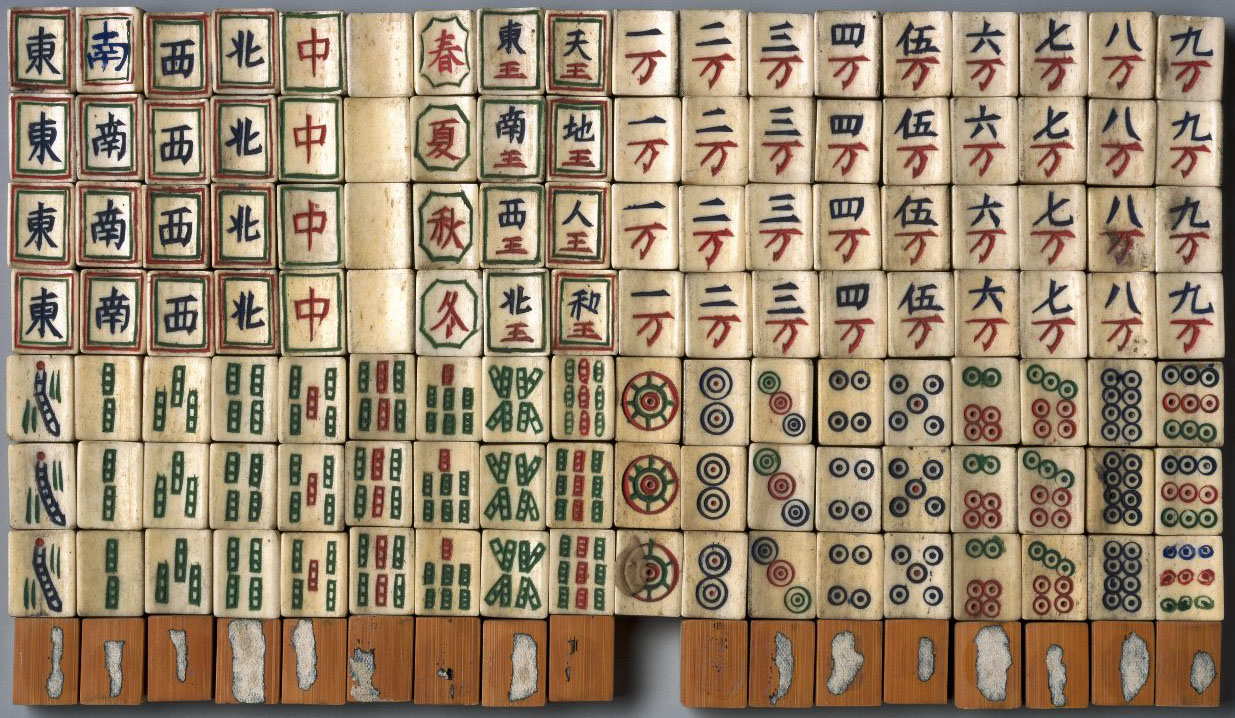
A mahjong set usually holds 144 tiles, marked with Chinese characters and symbols. Some regional versions leave tiles out or add their own. Each player takes a seat at one of four winds: East, South, West or North. A round begins with thirteen tiles in hand, and play moves clockwise from the prevailing wind. On a turn a player picks up a tile and puts one down, and may claim a tile another player has just discarded if the rules allow. The aim is a complete, scoring hand: four sets, called melds, and a pair, known as the eye. Special hands score too.
Origins and history
Where mahjong began is disputed. The writer Yifan Shen, in a guidebook published in 1914, placed its birth in Ningbo about thirty years earlier. The scholar Yaquan Du argued in 1933 that it first spread among fishermen in Guangdong and Fujian before reaching Ningbo traders in the early Guangxu years. Both accounts set it in the late Qing period. Behind it lie card games of the eighteenth and nineteenth centuries played with a stripped money-suit deck. Cards turned into tiles, probably in the middle of the nineteenth century. The oldest surviving sets date from about 1870 and were bought in Fuzhou, Shanghai and Ningbo. After 1949 gambling bans in China reduced play, and the game was barred during the Cultural Revolution.
Rules and variations
The basic order of play is much the same from table to table, but the details are not. Regions and households differ, sometimes widely, over which sets count, which hands may win and how points are awarded, and many add rules of their own. In 1998 the China State Sports Commission issued a standard set, called Chinese Official rules or International Tournament rules, to separate the game from illegal gambling. Those rules rest on patterns, with 81 combinations listed in the rulebook, and they ask players to avoid betting, drinking and smoking. Tournament organisers often group players into teams, presenting mahjong as a sport.
In the West
Western knowledge of mahjong starts with the papers of the British consul F.E.B. Harvey, who served in Ningbo in the 1860s and learned the game from Chen Yumen, an official under the Daoguang Emperor. In 1895 the sinologist William Henry Wilkinson tied the name to cards called ma chioh, or hemp sparrow. By 1910 there were written accounts in several languages. American shops began selling sets in 1920, and Joseph Park Babcock's simplified rulebook of that year fed a craze. The National Mah Jongg League formed in 1937 and brought out the first American rulebook. Alan Millington's 1977 handbook led British players back to the older Chinese classical game.
Today and change
In Japan, mahjong has been called the country's most popular table game, with millions of players and thousands of parlours, and comics, animated shows and arcade machines have grown up around it. Hong Kong films often include games, and the government licenses mahjong schools where older people play for company. Researchers have trained computer programs to play well enough to face strong opponents. One 2007 study and later case reports connect very long sessions with seizures in a small number of players, while studies by doctors in Hong Kong led to mahjong therapy for people with dementia or memory difficulties. In Chinese communities the game is part of everyday life.
How Mahjong is kept
Two to four people sit around a table. Each takes one of the four wind seats, East, South, West or North, and the prevailing wind plays first. Everyone receives thirteen tiles, and turns then pass clockwise. A turn means taking a tile and throwing one away. Anyone who can use a tile another player has just thrown may call for it, if that table's rules allow. A round closes when someone completes a legal, scoring hand. Points gather over several rounds, and play goes on until the agreed total is reached or the players stop.
When and where
Mahjong has no fixed day or season. People play it whenever a table can be gathered, often in the evening. In the United States during the 1920s, mahjong nights became social occasions, with rooms decorated in Chinese style and songs written about the craze.
Mahjong began in China and is still strongest there and in Chinese-speaking communities elsewhere, including Hong Kong. It spread through the Sinosphere, in East and Southeast Asia, during the twentieth century, and Japan now has a large mahjong culture of its own. Western countries took it up in the 1920s and have kept it since, with tournaments, leagues and rulebooks.
What Mahjong means
The tiles carry Chinese characters and symbols, and the four wind seats give every player a direction and a place at the table. For many households the game is a regular way to pass an evening together. Chinese Americans in the 1920s and 1930s used it to build community, and in the 1940s and 1950s Jewish women in American suburbs did the same. It rewards tactics, observation, risk management and luck, and in Chinese-speaking communities it stays a familiar part of ordinary life.



Questions people ask about Mahjong
What is mahjong?
It is a game played with tiles, usually 144 of them, marked with Chinese characters and symbols. Two to four people play at one table. In each round they try to build four sets and a pair, and points gather over several rounds until the game ends.
Where is mahjong played?
It comes from China and spread through East and Southeast Asia and to Western countries from the early twentieth century. It stays strongest in China and other Chinese-speaking communities. Japan has a large mahjong culture, with parlours, comics and arcade machines.
When is it played?
There is no set day or season for it. People play whenever a table of players can gather, often in the evening. In the United States in the 1920s, mahjong nights were social events, with rooms dressed in Chinese style.
Do the rules differ from place to place?
Yes. The turn order, the draw and the discard are broadly shared, but regions and households disagree on which sets count, which hands win and how points are scored. In 1998 China issued international tournament rules built on 81 scoring patterns.
Why is it called mahjong?
The older name was 麻雀, máquè, meaning sparrow, and southern Chinese languages such as Cantonese and Hokkien still use it. People say the clatter of shuffled tiles sounds like sparrows. Mandarin speakers now say 麻將, májiàng. In Thai the game is called sparrow cards.
See also
 Hunting with eaglesThe Central Asian tradition of hunting foxes and hares from horseback with golden eagles.
 KarutaJapanese playing cards from the 16th century, still raced over poems each New Year
 World Eskimo-Indian OlympicsAn annual Arctic gathering of traditional survival games, athletics, and cultural arts
 DreidelA four-sided top spun for small stakes, most often by Jewish families at Hanukkah
Good reading and sources
- Encyclopaedia BritannicaArticle
- BBC NEWS | HealthBBC, Article
- Why mahjong is a global phenomenonNational Geographic, Article
- BBC NEWS | HealthBBC, Article
- Why mahjong is a global phenomenonNational Geographic, Article
- Mahjong on WikipediaEncyclopedia
- More photos on Wikimedia CommonsPhotos and video
- Wikidata recordOpen data
The facts on this page come from the Wikipedia article "Mahjong", written by its contributors and used under the CC BY-SA 4.0 licence, and from its Wikidata record (CC0). EveryParampara rewrote the text in its own words, with AI assistance, and compares every page with the article to make sure no passage is copied. It may be reused under the same CC BY-SA 4.0 licence with a link back.
It may contain mistakes. Traditions differ from one family, village and community to the next, and the people who keep them know them best. If something is wrong, tell us. Last refreshed 2026-10-05.
More from China
All the traditions of China 🇲🇳 Ulaanbaatar, Mongolia and 2 moreMongolian wrestlingBökh
A traditional folk wrestling style of the Mongols, kept as a central part of Naadam festivals across Mongolia and neighbGame
🇲🇳 Ulaanbaatar, Mongolia and 2 moreMongolian wrestlingBökh
A traditional folk wrestling style of the Mongols, kept as a central part of Naadam festivals across Mongolia and neighbGame
 🇨🇳 China and 2 moreCuju蹴鞠
An ancient Chinese kicking game played without hands using a stuffed or air-filled ballGame
🇲🇳 Ölgii, Mongolia and 3 moreHunting with eagles
The Central Asian tradition of hunting foxes and hares from horseback with golden eagles.Game
🇨🇳 China and 2 moreCuju蹴鞠
An ancient Chinese kicking game played without hands using a stuffed or air-filled ballGame
🇲🇳 Ölgii, Mongolia and 3 moreHunting with eagles
The Central Asian tradition of hunting foxes and hares from horseback with golden eagles.Game
 🇨🇳 China and 1 moreXiangqi象棋
A two-player game of armies and cannons, played on the points of a nine-by-ten boardGame
🇨🇳 China and 1 moreXiangqi象棋
A two-player game of armies and cannons, played on the points of a nine-by-ten boardGame
The same idea elsewhere
All of this kind
🇺🇸 Fairbanks, United States and 2 moreWorld Eskimo-Indian Olympics
An annual Arctic gathering of traditional survival games, athletics, and cultural artsGame
 🇲🇽 MexicoRarájipari
A traditional endurance running ball game of the Rarámuri people in northern MexicoGame
🇲🇽 MexicoRarájipari
A traditional endurance running ball game of the Rarámuri people in northern MexicoGame
 🇨🇭 Aproz, Switzerland and 2 moreCombat de Reines
An annual Swiss pushing contest where Hérens cows compete for herd dominanceGame
🇨🇭 Aproz, Switzerland and 2 moreCombat de Reines
An annual Swiss pushing contest where Hérens cows compete for herd dominanceGame
 🇸🇪 Mora, SwedenVasaloppet
A 90 km cross-country ski race from Sälen to Mora, run every March since 1922Game
🇸🇪 Mora, SwedenVasaloppet
A 90 km cross-country ski race from Sälen to Mora, run every March since 1922Game