Games, sport and playEast Asia
Xiangqi
In its own language: 象棋
A two-player game of armies and cannons, played on the points of a nine-by-ten board

Xiangqi is a board game for two players, kept across China and in Chinese communities abroad, and a familiar pastime in Vietnam, where it is called cờ tướng. Each side has sixteen pieces on a grid of nine lines by ten, and the aim is to trap the opposing general.
When is Xiangqi kept?
Xiangqi is kept at any time of year, with no set date.
Xiangqi is a board game for two players, long played in China and known in English as Chinese chess. Each side has sixteen flat pieces that sit on the crossing points of a ruled board, and the game ends when one general is trapped. It belongs to the same family as Western chess, shogi and janggi, and is also a familiar pastime in Vietnam.
Board and pieces
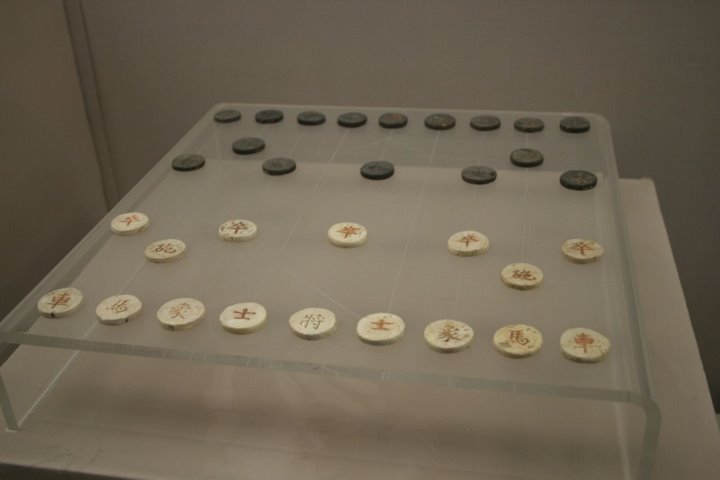
A xiangqi board is a grid nine lines across and ten lines down. Pieces rest on the crossings, not inside the squares, as in the game of Go. Across the middle, between the fifth and sixth lines, runs the river, written with the words Chu river and Han frontier in memory of an old war. Each side also has a palace, a square of nine points at the back of its half. Every army has sixteen round disks, each carved or printed with the character for its rank. Red and black are the usual colours. Sets are often plastic now, though wood, bone, horn, ivory and jade are all used, and the oldest piece known, a chariot, is kept in the Three Gorges Museum.
Origins and history
象棋 is usually read as elephant chess. 象 means elephant, and 棋 is the word for chess or board games, which also appears in the names of weiqi and fangqi. H. J. R. Murray noted that 象 can also mean ivory, a carved figure, or a heavenly sign, and proposed readings such as the Ivory Game and the Astronomical Game. He judged the Figure Game the most likely, because early sets used figures instead of pieces marked with names. Play in the form known today goes back at least to the Southern Song dynasty. Which side opens has changed over the centuries and from region to region.
How a game is played
Players take turns moving one piece from the point it stands on to another point. A piece may not pass over an occupied point, except for the cannon, which captures only by jumping a single piece along its line. Capturing means landing on a point held by the enemy and taking that piece off the board. The aim is to trap the opposing general so that it cannot escape. Red normally opens, at least in tournaments today. Three features shape the play: the generals may not face each other down an open file, the palace keeps generals and advisors near home, and the river lets soldiers step sideways once they cross it while keeping elephants on their own side.
Around the world
Xiangqi is played throughout China and in Chinese communities abroad. Vietnam is its other home, where it is called cờ tướng, the general's chess, a name that sets it apart from Western chess, cờ vua or the king's chess. It shares a family with shogi, janggi, chaturanga, Indian chess and Western chess. An informal game may take twenty minutes or run for hours, and a blitz game is over within ten. Boards were once sheets of ruled paper, thrown away after one use, though wood and plastic are common now.
How Xiangqi is kept
Two people sit down facing each other with the pieces in their starting positions. Red moves first. On each turn a player shifts one piece to a new point, and if that point holds an enemy piece, that piece is removed. Nothing may pass through an occupied point, apart from the cannon in the act of capturing. Play goes on until one general is trapped with no way out, which ends the game.
When and where
There is no fixed day or season for the game. It is played whenever two people sit down together, at home, in parks, in clubs or in tournaments. An informal game can run from about twenty minutes to several hours; a blitz game ends inside ten minutes.
Its strongest home is China, and it follows Chinese communities to other countries. Vietnam keeps it too, as a familiar pastime under the name cờ tướng. Outside those places, players mostly meet it as Chinese chess.
What Xiangqi means
The board sets two armies against each other, and everything in the game points to the safety of the general. Losing the general loses the game, so advisors, elephants and soldiers are arranged to shield it. The palace and the river give the struggle a shape that players read at a glance. Even the name of the general carries history: Chinese rulers once objected to royal titles appearing on game pieces, so the piece was called a general rather than a king.


Questions people ask about Xiangqi
When is Xiangqi kept?
Xiangqi is kept at any time of year, with no set date.
What is xiangqi?
It is a board game for two people, played on a grid of nine lines by ten. Each player commands sixteen pieces, and the winner is the one who traps the enemy general. In English it is usually called Chinese chess.
Where is it played?
Above all in China, and wherever Chinese communities have settled. Vietnam is another home for the game, where it goes by the name cờ tướng, or general's chess. It belongs to the same family as shogi, janggi and Western chess.
How does it differ from Western chess?
Pieces stand on the crossings of the lines rather than in the squares. There are cannons, which capture only by jumping over another piece, and the two generals are forbidden from facing each other along an open line. A river and two palaces limit where some pieces may go.
What pieces does each side have?
Sixteen in all: one general, two advisors, two elephants or ministers, two horses, two chariots, two cannons and five soldiers. The two armies are told apart by the colour of the ink on the pieces, usually red against black.
What does the name mean?
象棋 is often translated as elephant chess: 象 means elephant and 棋 is the general word for chess and board games, also seen in the names of weiqi and fangqi. Scholars have suggested other readings, including the figure game.
See also
 CujuAn ancient Chinese kicking game played without hands using a stuffed or air-filled ball
 Mongolian wrestlingA traditional folk wrestling style of the Mongols, kept as a central part of Naadam festivals across Mongolia and neighb
 Hunting with eaglesThe Central Asian tradition of hunting foxes and hares from horseback with golden eagles.
 Water lanternSmall lamps floated on water to honour the dead and ask for good fortune
Good reading and sources
- Xiangqi on WikipediaEncyclopedia
- More photos on Wikimedia CommonsPhotos and video
- Wikidata recordOpen data
The facts on this page come from the Wikipedia article "Xiangqi", written by its contributors and used under the CC BY-SA 4.0 licence, and from its Wikidata record (CC0). EveryParampara rewrote the text in its own words, with AI assistance, and compares every page with the article to make sure no passage is copied. It may be reused under the same CC BY-SA 4.0 licence with a link back.
It may contain mistakes. Traditions differ from one family, village and community to the next, and the people who keep them know them best. If something is wrong, tell us. Last refreshed 2026-10-05.
More from China
All the traditions of China
🇨🇳 China and 2 moreCuju蹴鞠
An ancient Chinese kicking game played without hands using a stuffed or air-filled ballGame
🇲🇳 Ulaanbaatar, Mongolia and 2 moreMongolian wrestlingBökh
A traditional folk wrestling style of the Mongols, kept as a central part of Naadam festivals across Mongolia and neighbGame
🇲🇳 Ölgii, Mongolia and 3 moreHunting with eagles
The Central Asian tradition of hunting foxes and hares from horseback with golden eagles.Game
 🇨🇳 Ningbo, China and 2 moreMahjong麻將
A tile game from China, played by two to four people at a tableGame
🇨🇳 Ningbo, China and 2 moreMahjong麻將
A tile game from China, played by two to four people at a tableGame
The same idea elsewhere
All of this kind 🇺🇸 Fairbanks, United States and 2 moreWorld Eskimo-Indian Olympics
An annual Arctic gathering of traditional survival games, athletics, and cultural artsGame
🇺🇸 Fairbanks, United States and 2 moreWorld Eskimo-Indian Olympics
An annual Arctic gathering of traditional survival games, athletics, and cultural artsGame
 🇲🇽 MexicoRarájipari
A traditional endurance running ball game of the Rarámuri people in northern MexicoGame
🇲🇽 MexicoRarájipari
A traditional endurance running ball game of the Rarámuri people in northern MexicoGame
 🇨🇭 Aproz, Switzerland and 2 moreCombat de Reines
An annual Swiss pushing contest where Hérens cows compete for herd dominanceGame
🇨🇭 Aproz, Switzerland and 2 moreCombat de Reines
An annual Swiss pushing contest where Hérens cows compete for herd dominanceGame
 🇸🇪 Mora, SwedenVasaloppet
A 90 km cross-country ski race from Sälen to Mora, run every March since 1922Game
🇸🇪 Mora, SwedenVasaloppet
A 90 km cross-country ski race from Sälen to Mora, run every March since 1922Game