Spiritual and religiousSoutheast AsiaChristian
Mass of the Lord's Supper
An evening liturgy marking the start of the Easter Triduum and recalling Jesus' final meal with his followers.

This service is held on the evening of Maundy Thursday to begin the Easter Triduum. It focuses on the Last Supper, the establishment of the priesthood, and the commandment of love. Christian denominations including Catholic, Lutheran, Anglican, and Methodist churches observe this rite.
When is Mass of the Lord's Supper kept?
Mass of the Lord's Supper is kept on evening of Maundy Thursday.
The Mass of the Lord's Supper is a central Christian liturgy celebrated on the evening of Maundy Thursday. It serves as the opening event for the Easter Triduum, the three-day period leading to Easter Sunday. The service recalls the final meal Jesus shared with his disciples before his arrest. This gathering emphasizes the institution of the Eucharist, the creation of the ministerial priesthood, and the call for brotherly love. Various Christian traditions, including Catholic, Lutheran, Anglican, and Methodist communities, maintain this observance.
Origins and history
The practice began in late fourth-century Jerusalem, where believers honored the Passion events at their original locations. Rome later adopted similar customs, initially focusing on reconciling penitents before Easter. By the seventh century, Roman celebrations included specific masses for the Lord's Supper and reconciliation. Over time, these merged into a single evening service. Pope Pius V restricted evening masses in the sixteenth century, moving the celebration to morning. Pope Pius XII restored the evening timing in the mid-twentieth century. The foot-washing ritual was also formalized during this historical evolution.
Liturgical structure
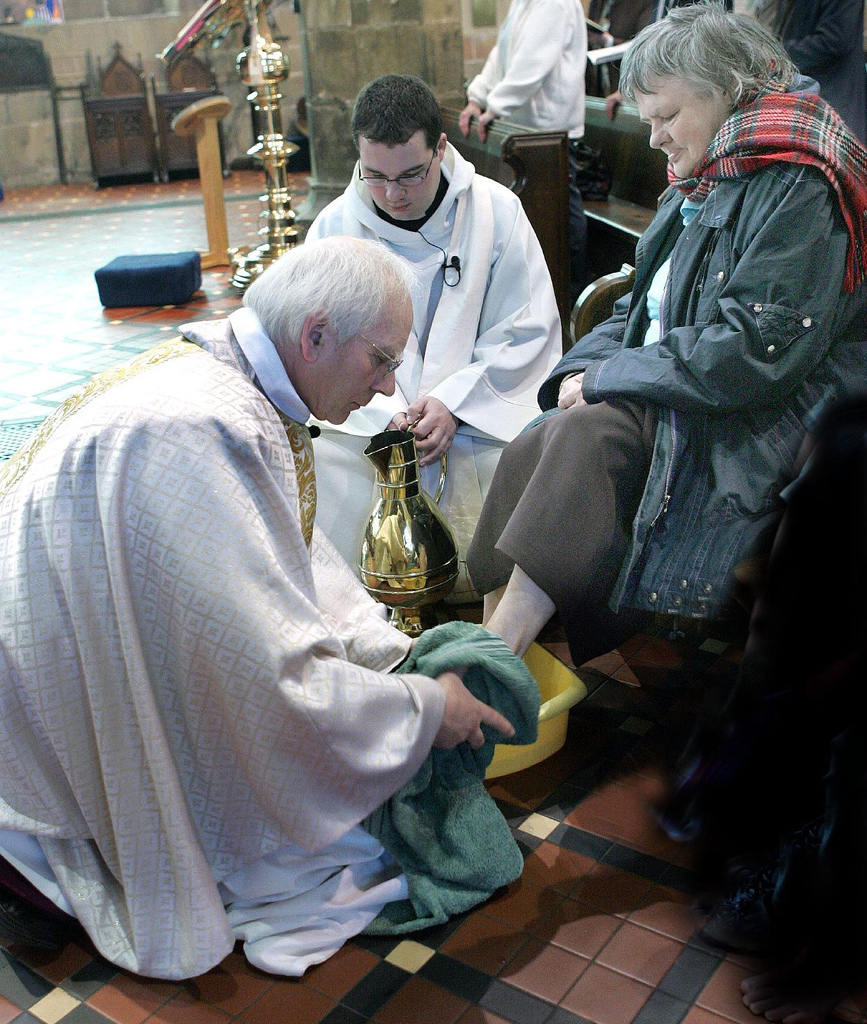
The service starts with an empty tabernacle. Readings include Exodus describing the Passover, Psalm 115, Corinthians recounting the Last Supper, and John detailing the foot washing. A homily explains the core themes. The priest then washes the feet of several participants, usually twelve. The Nicene Creed is omitted. Special prayers recall the Last Supper. Consecrated hosts are prepared for Good Friday. These hosts are not stored in the main tabernacle but are processed to an altar of repose. Bells remain silent after the Gloria until the Easter Vigil.
Altar stripping
Churches traditionally remove decorations to prepare for Good Friday. Altars are often draped in black paraments. Flowers and candles are taken away. Images may be veiled in black or purple. In some traditions, the altar is left bare to symbolize the cross's humiliation. This act occurs at the conclusion of the liturgy. The practice varies slightly among denominations. Lutherans leave the altar bare until Easter. Anglicans remove all linens and appointments. Catholics historically performed this with specific psalms, though modern rites simplify the process.
Byzantine tradition
Eastern Orthodox and Byzantine Catholic churches celebrate The Mystical Supper. This service often occurs earlier in the day. It combines Vespers with the Divine Liturgy. Readings focus on Moses, Job, and Isaiah. The Gospel includes accounts of the Last Supper and foot washing. A unique hymn replaces standard communion verses. The Washing of the Feet is frequently performed afterward. Priests wash the feet of congregation members. The service concludes with prayers and hymns inviting the faithful to partake in Christ's hospitality.
How Mass of the Lord's Supper is kept
The priest leads the congregation through scripture readings and a homily. He then washes the feet of selected individuals, typically twelve people representing the apostles. After the main prayer, consecrated bread is processed to a side altar. Bells are silenced. Churches strip altars of decorations. Some communities visit multiple churches to pray at each altar of repose.
When and where
It falls on the evening of Maundy Thursday. This date follows Holy Week and precedes Good Friday. The timing marks the beginning of the Easter Triduum.
The custom originated in Jerusalem. It spread to Rome and other Christian centers. Today it is observed globally by various Christian denominations. The Philippines is noted for its specific devotional practices related to this service.
What Mass of the Lord's Supper means
The service highlights the institution of the Eucharist and the priesthood. It emphasizes Jesus' commandment of brotherly love demonstrated through foot washing. Stripping the altars symbolizes the desolation of the cross. The transfer of the Eucharist to the altar of repose represents Jesus' retreat before his passion.


Questions people ask about Mass of the Lord's Supper
When is Mass of the Lord's Supper kept?
Mass of the Lord's Supper is kept on evening of Maundy Thursday.
What is the Mass of the Lord's Supper?
It is a Christian liturgy held on Maundy Thursday evening. It begins the Easter Triduum and commemorates Jesus' final meal with his disciples. The service focuses on the Eucharist, priesthood, and love.
Who celebrates this mass?
Catholic, Lutheran, Anglican, and Methodist churches observe this rite. Eastern Orthodox and Byzantine Catholic Christians hold a similar service called The Mystical Supper.
Why are bells silenced?
Church bells are rung during the Gloria but then silenced until the Easter Vigil. This reflects the somber mood of Holy Week and the anticipation of the Resurrection.
See also
 Yom KippurThe holiest day in Judaism, dedicated to fasting, prayer and atonement
 Rosh HashanahThe Jewish New Year marked by shofar horn blasts, prayer and sweet foods
 MuharramThe sacred opening month of the Islamic year, observed through remembrance and fasting
 TashlikhA Jewish new year rite of casting sins into flowing water, kept by the waterside
Good reading and sources
- Mass of the Lord's Supper on WikipediaEncyclopedia
- More photos on Wikimedia CommonsPhotos and video
- Wikidata recordOpen data
The facts on this page come from the Wikipedia article "Mass of the Lord's Supper", written by its contributors and used under the CC BY-SA 4.0 licence, and from its Wikidata record (CC0). EveryParampara rewrote the text in its own words, with AI assistance, and compares every page with the article to make sure no passage is copied. It may be reused under the same CC BY-SA 4.0 licence with a link back.
It may contain mistakes. Traditions differ from one family, village and community to the next, and the people who keep them know them best. If something is wrong, tell us. Last refreshed 2026-10-07.
More from the Philippines
All the traditions of the Philippines 🇦🇺 Australia and 5 moreGood Friday
A solemn Christian holy day commemorating the crucifixion and death of Jesus Christ.Spiritual · Fasting and breaking the fast
🇦🇺 Australia and 5 moreGood Friday
A solemn Christian holy day commemorating the crucifixion and death of Jesus Christ.Spiritual · Fasting and breaking the fast
 🇵🇭 Philippines and 5 moreHoly WeekἉγία καὶ Μεγάλη Ἑβδομάς
The solemn seven days leading to Easter, recalling the final week and Passion of JesusSpiritual · Fasting and breaking the fast
🇵🇭 Philippines and 5 moreHoly WeekἉγία καὶ Μεγάλη Ἑβδομάς
The solemn seven days leading to Easter, recalling the final week and Passion of JesusSpiritual · Fasting and breaking the fast
 🇹🇭 Thailand and 7 moreSpirit house
A small roofed shrine on a pillar, kept in homes and villages across Southeast Asia to honour protective spirits.Spiritual
🇹🇭 Thailand and 7 moreSpirit house
A small roofed shrine on a pillar, kept in homes and villages across Southeast Asia to honour protective spirits.Spiritual
 🇵🇭 Manila, Philippines and 5 moreNovena
A nine-day Christian prayer tradition for petitions, feasts, or mourning.Spiritual
🇵🇭 Manila, Philippines and 5 moreNovena
A nine-day Christian prayer tradition for petitions, feasts, or mourning.Spiritual
The same idea elsewhere
New Year compared 🇮🇳 Ayodhya, India and 7 moreDiwaliदीपावली (Dīpāvalī)
A five-day festival of lights celebrated across India and its diaspora to mark the victory of light over darkness.Festival · Feasts and festival meals
🇮🇳 Ayodhya, India and 7 moreDiwaliदीपावली (Dīpāvalī)
A five-day festival of lights celebrated across India and its diaspora to mark the victory of light over darkness.Festival · Feasts and festival meals
 🇮🇷 Iran and 7 moreNowruzنوروز
The Iranian new year at the March equinox, kept with fire, greenery and picnicsSeasonal
🇮🇷 Iran and 7 moreNowruzنوروز
The Iranian new year at the March equinox, kept with fire, greenery and picnicsSeasonal
 🇮🇱 Jerusalem, Israel and 1 moreHanukkahחֲנֻכָּה
An eight-day Jewish festival marking the rededication of the Second Temple in Jerusalem and the miracle of a single day'Festival
🇮🇱 Jerusalem, Israel and 1 moreHanukkahחֲנֻכָּה
An eight-day Jewish festival marking the rededication of the Second Temple in Jerusalem and the miracle of a single day'Festival
 🇪🇬 Egypt and 5 moreMawlidمولد (Mawlid)
An annual festival marking the birth of the Prophet Muhammad, marked by poetry, processions and feasts.Festival · Feasts and festival meals
🇪🇬 Egypt and 5 moreMawlidمولد (Mawlid)
An annual festival marking the birth of the Prophet Muhammad, marked by poetry, processions and feasts.Festival · Feasts and festival meals