Dress and adornmentSoutheast Asia
Mo hom
In its own language: หม้อห้อม
A northern Thai shirt and cloth, dyed deep blue-black with the hom plant

Mo hom is a fabric and shirt from northern Thailand, dyed a dark blue-black with the hom plant. The largest centre of traditional weaving and dyeing is at Baan Thung Hong in Phrae Province, and the shirt spread nationwide after a 1953 banquet in Chiang Mai.
Mo hom is a cloth from northern Thailand and the shirt cut from it, dyed a deep blue-black with the hom plant. In Lan Na speech the name describes that colour, not the garment itself. Production centres on Phrae Province, and after a banquet in Chiang Mai in 1953 the shirt grew popular across Thailand.
What it is
Mo hom is both a dyed cotton fabric and the garment made from it. The shirt usually comes in dark blue or black. The neck opening is a simple circle, the sleeves stop above the elbow, and there is no collar. In the past each household made its own cloth, while most of what is sold now is produced in factories. The colour is the point of the name: people in Lan Na country call this deep navy shade mo hom, so the fabric and the shirt share one word.
Origins and history
Dyeing in dark navy tones in Phrae Province is traced to families who moved there from Chiang Saen, Xishuangbanna and Laos from Thonburi times onward. They carried a way of colouring cloth that used three plants: kram, hom and homkriea. The white cotton shirt men wore in Lan Na before this was called a Hadook. Mo hom shirts reached a wider public in 1953, after Kriengsri Nimmanhemin held a banquet in Chiang Mai for Sanya Thammasak and the American consul, with the shirt named as the dress for the evening.
Dyeing and weaving
Making the colour takes two stages. Leaves and stems of the hom plant, Baphicacanthus cusia, are left in rainwater for three days, which gives a green liquid. Older plant material stays in the water as fresh bundles are added, and the brew turns navy. After filtering, slaked lime goes in. A second liquid is drawn from ash and rainwater. The two are combined, more lime is added, and the result is the dye bath. Cotton is wetted, dried, then dipped again and again, five or six times, until the shade is right. Cloth was once woven at home on a local loom called a kee.
Words and meaning
Two readings of the name circulate. One takes mo as 'pot' and hom as the indigo plant, giving 'dye in the pot'. The other treats mo as the colour black or navy and hom as the plant that yields it, so the phrase simply names the shade. The mix-up comes from tone and pace in Lan Na speech, where the word is said as the colour. Either way, the cloth carries the identity of the north, and the 1953 banquet made it a shirt for public occasions.
How Mo hom is kept
Dyeing and weaving were once household work, with families collecting old cotton bolls, drying and cleaning them, spinning the fibre and weaving the cloth on a kee, a local loom. The dye came from the hom plant, sometimes alongside kram and homkriea. Today most mo hom fabric is made in factories, while the traditional method survives around Baan Thung Hong in Phrae Province, the largest centre for it in Thailand. Wearing the shirt spread from the north after the 1953 banquet, and it is now worn widely across Thailand.
When and where
Mo hom belongs to northern Thailand. Its traditional production is concentrated at Baan Thung Hong in Mueang Phrae District, Phrae Province, the biggest such centre in the country. The craft's roots lie with people who came from Chiang Saen, Xishuangbanna and Laos, and after 1953 the shirt became popular throughout Thailand. Cloth is sold in and around Phrae and at traditional markets elsewhere in the country.
What Mo hom means
The deep navy of mo hom is not a decoration added afterwards; it is the whole point of the cloth, and the plant that gives it, hom, is part of its name. For people in the north the shirt marks local identity and skill in dyeing, a craft carried down in families. When a Chiang Mai banquet named mo hom as its dress in 1953, the shirt moved from local wear into wider Thai life.
Questions people ask about Mo hom
What is mo hom?
It is a cotton cloth from northern Thailand and the shirt made from it, dyed a dark blue-black using the hom plant. In Lan Na speech the name refers to that colour. The shirt has a plain round neckline, sleeves that stop above the elbow and no collar.
Where does mo hom come from?
Its heart is Phrae Province in northern Thailand, where Baan Thung Hong is the largest centre of traditional production. The dyeing craft is linked to people who moved from Chiang Saen, Xishuangbanna and Laos from Thonburi times onward.
How is the dark colour made?
Leaves and stems of the hom plant sit in rainwater for three days, then older material stays while fresh bundles go in until the liquid turns navy. Slaked lime and a liquid made from ash and rainwater are added, and the cotton is dipped five or six times.
When did mo hom shirts become popular?
In 1953, when Kriengsri Nimmanhemin held a banquet in Chiang Mai for Sanya Thammasak and the American consul and set the mo hom shirt as the dress for the evening. From then on the shirt spread throughout Thailand.
What did men wear before mo hom?
A white cotton shirt called a Hadook, described as the older men's shirt of Lan Na. Mo hom was not the original northern men's garment; it came later, and its name speaks of a colour rather than of the thing worn.
See also
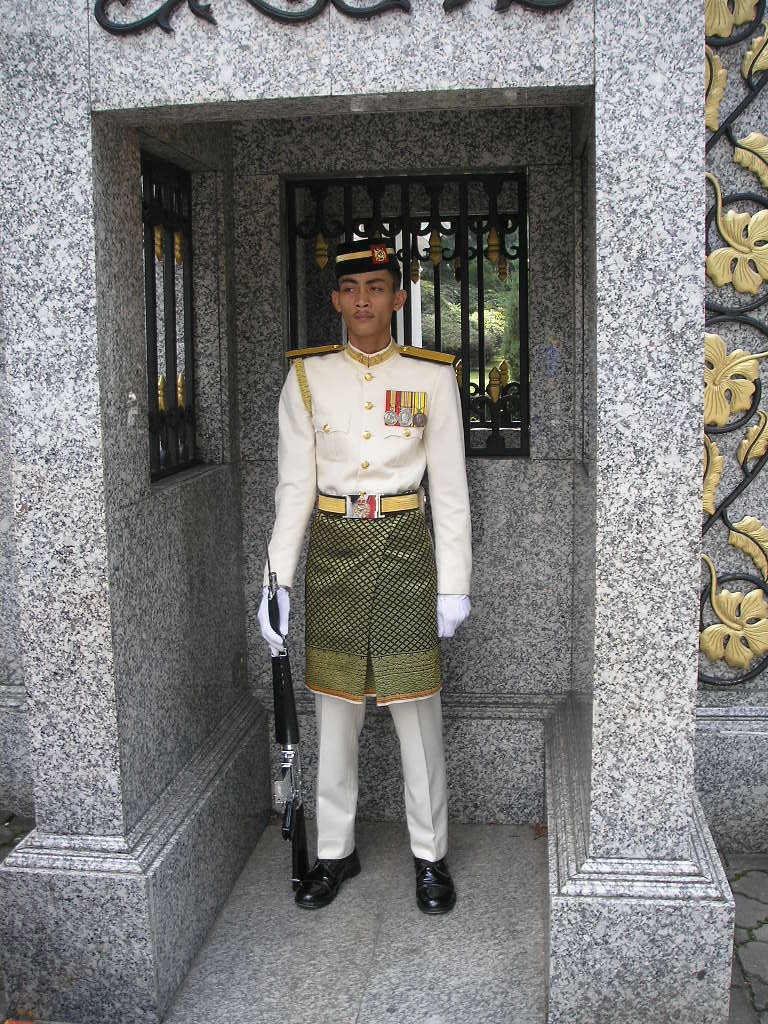 SampingA traditional Malay waist cloth worn over festive attire in Southeast Asia
 Baju MelayuThe long-sleeved Malay man's shirt and trousers, formal national dress in Malaysia and Brunei
 LongyiA tube of cloth worn from waist to feet in Myanmar, folded shut with no knot
 SampotA length of cloth wrapped at the waist, the everyday and ceremonial dress of Cambodia
Good reading and sources
- Mo hom on WikipediaEncyclopedia
- More photos on Wikimedia CommonsPhotos and video
- Wikidata recordOpen data
The facts on this page come from the Wikipedia article "Mo hom", written by its contributors and used under the CC BY-SA 4.0 licence, and from its Wikidata record (CC0). EveryParampara rewrote the text in its own words, with AI assistance, and compares every page with the article to make sure no passage is copied. It may be reused under the same CC BY-SA 4.0 licence with a link back.
It may contain mistakes. Traditions differ from one family, village and community to the next, and the people who keep them know them best. If something is wrong, tell us. Last refreshed 2026-10-11.
More from Thailand
All the traditions of Thailand
🇰🇭 Cambodia and 2 moreSampotសំពត់
A length of cloth wrapped at the waist, the everyday and ceremonial dress of CambodiaDress
🇲🇲 Myanmar and 1 moreLongyiလုံချည်
A tube of cloth worn from waist to feet in Myanmar, folded shut with no knotDress
 🇮🇩 Yogyakarta, Indonesia and 4 moreKebayaꦏꦼꦧꦪ
A front-opening blouse and wrapped cloth, worn by women across Southeast AsiaDress
🇲🇾 Malacca, Malaysia and 5 moreBaju Melayuباجو ملايو
The long-sleeved Malay man's shirt and trousers, formal national dress in Malaysia and BruneiDress
🇮🇩 Yogyakarta, Indonesia and 4 moreKebayaꦏꦼꦧꦪ
A front-opening blouse and wrapped cloth, worn by women across Southeast AsiaDress
🇲🇾 Malacca, Malaysia and 5 moreBaju Melayuباجو ملايو
The long-sleeved Malay man's shirt and trousers, formal national dress in Malaysia and BruneiDress
The same idea elsewhere
All of this kind 🇮🇳 Paithan, IndiaPaithani
A handwoven silk sari from Maharashtra, with a squared border and a peacock palluDress
🇮🇳 Paithan, IndiaPaithani
A handwoven silk sari from Maharashtra, with a squared border and a peacock palluDress
 🇳🇴 Norway and 3 moreGákti
A traditional coat worn by the Sámi people across northern Scandinavia and Russia, signaling origin and status through cDress
🇳🇴 Norway and 3 moreGákti
A traditional coat worn by the Sámi people across northern Scandinavia and Russia, signaling origin and status through cDress
 🇼🇸 Samoa and 1 moreʻIe tōga
Precious woven mats exchanged in Samoan ceremonies to honor family ties and chiefly status.Dress
🇼🇸 Samoa and 1 moreʻIe tōga
Precious woven mats exchanged in Samoan ceremonies to honor family ties and chiefly status.Dress
 🇮🇱 Israel and 1 moreTzitzitצִיצִית
Knotted ritual fringes worn on a four-cornered garment, a reminder of the commandmentsDress
🇮🇱 Israel and 1 moreTzitzitצִיצִית
Knotted ritual fringes worn on a four-cornered garment, a reminder of the commandmentsDress