Spiritual and religiousSouth AsiaMuslim
Night of Power
In its own language: ليلة القدر
The night Muslims believe the Quran first came down, sought in Ramadan's last ten nights

Laylat al-Qadr is a night Muslims keep in memory of the first revelation of the Quran to Muhammad. It belongs to Ramadan's closing ten nights, most likely an odd one, and is marked with night prayer, reading, supplication, charity and retreat in a mosque.
When is Night of Power marked?
Night of Power is kept as part of Ramadan, which runs from 8 February to 9 March 2027.
Laylat al-Qadr is a night Muslims hold in memory of the first revelation of the Quran to Muhammad. It falls in Ramadan, in the month's final ten nights, and believers look for it there. Good done on this night is believed to outweigh a thousand months of prayer. Mosques stay busy until dawn, and people pray, read, give and ask forgiveness.
What it is
Laylat al-Qadr is one of the holy nights of the Muslim year. Muslims hold that the Quran came down from heaven into the world on it, and that this was the first time Muhammad received words brought by the angel Gabriel. A surah of the Quran, al-Qadr, is named for the night and tells of its greatness. The night is said to return each year, carrying mercy and blessing. It is counted among the five Kandil nights, the nights of light kept by many Muslims.
Names and meanings
The Arabic word qadr can mean measure, limit, worth or destiny, and with another pronunciation it means power. Each sense has been offered as a reason for the name. One explanation is that God settles every person's lot for the year on this night. Another holds that anyone who stays awake in prayer, reading or repentance reaches a higher state. A third is that the night is simply grand and precious. Persian speakers know it as Shab-e Qadr. Arabic also calls it the Night of Greatness and the Night of Honour.
The first revelation
Muslims link this night to the start of the Quran's coming to Muhammad. Some scholars speak of two sendings: an immediate one at the cave of Hira, dated to 610 CE on the first Laylat al-Qadr, and a gradual one spread over the twenty-three years that followed, in Meccan and Medinan portions. The Quran's word anzal, meaning to send down, is read by some as pointing to the first of these, a reading linked to Allamah Tabatabai. Others say the whole book was handed to Gabriel in the lowest heaven on this night, then given to Muhammad piece by piece. The earliest verses are said to be the first five of Surat al-Alaq.
Keeping the night
Those who keep the night stay awake and worship. Ordinary practices include tahajjud, the late night prayer, reading the Quran, dua or personal supplication, and dhikr, the repeated remembrance of God. Many seek forgiveness and give sadaqah, free charity to the poor. Some enter i'tikaf, staying in a mosque for Ramadan's closing ten days, praying and fasting and holding back from marital relations. In Muslim communities, mosques are lit with candles for the occasion, taraweeh prayers are held, often twenty rakats, and people share the meal that ends the day's fast.
Dates and differences
The Quran gives no date. One hadith, a report of Muhammad's words and deeds, says God told him the exact night in a dream, and that he forgot it when two men quarrelled in front of him. Sunni Muslims look for it among the odd nights of Ramadan's closing ten: the twenty-first, twenty-third, twenty-fifth, twenty-seventh or twenty-ninth, and the twenty-seventh is widely favoured. Sahih Muslim carries a report traced to Ubayy ibn Ka'b naming that night. Shi'a Muslims give weight to the nineteenth, the twenty-first and especially the twenty-third, the night Ali was struck while praying in the Great Mosque of Kufa. Another account places the writing of destinies on the nineteenth, their settling on the twenty-first, and their confirmation on the twenty-third.
How Night of Power is kept
Muslims, Sunni and Shi'a, keep this night inside the closing ten nights of Ramadan. Because an Islamic day runs from sunset to the next dawn, people stay up after the evening prayer and pray until first light. The usual acts are night prayer, Quran reading, supplication, remembrance of God, asking forgiveness and giving charity. Some remain in the mosque for the whole ten days in retreat. In Shi'a communities, long collective prayers are held in mosques, shrines and homes, some holding copies of the Quran above their heads, food is given out at dawn, and Ali is mourned.
When and where
The night comes once a year, in Ramadan's last ten days, and no date is fixed. Sunni Muslims favour the odd nights, especially the twenty-seventh. Shi'a Muslims stress the nineteenth, twenty-first and twenty-third. Because Ramadan follows a lunar calendar, the night shifts through the solar year. It begins at sunset and lasts until the following dawn.
It is kept wherever Muslims live, in the Arab world and across the wider Muslim world, and among Muslim communities elsewhere. The night is observed at home and in the mosque, and for Shi'a Muslims also at shrines, meeting halls and family homes. Kufa, where Ali was struck, holds a particular place in Shi'a memory of these nights.
What Night of Power means
For those who keep it, the night carries a mercy and a weight found nowhere else in the year. Acts of worship and of giving done within it are believed to be multiplied, so that a single night of devotion outweighs a thousand months. Angels are said to come down, and peace to rest over the earth until first light. The destiny of the coming year is described as being set then, which is why people ask forgiveness and make their requests with particular care.


Days Night of Power is marked
Questions people ask about Night of Power
When is Night of Power marked?
Night of Power is kept as part of Ramadan, which runs from 8 February to 9 March 2027.
What is the Night of Power?
It is a night in Ramadan when Muslims remember the first coming down of the Quran to Muhammad. They believe it returns every year, and that worship offered in it is worth more than worship spread over a thousand months.
Where is it kept?
Wherever Muslims live. Mosques are the main setting, with prayer through the night, and families also keep it at home. Shi'a Muslims gather at shrines and meeting halls as well. In some places mosques are lit with candles for the occasion.
What do people do on the night?
They stay awake and pray, read the Quran, make supplication, repeat the remembrance of God, ask forgiveness and give charity. Some spend the closing ten days of Ramadan in retreat inside a mosque, fasting by day and praying by night.
Why is it called the Night of Power?
The Arabic word qadr can mean measure, worth, destiny or power. Some explain the name by the belief that destinies are set that night, others by the night's greatness, and others by the standing a person reaches by staying awake in prayer.
See also
 Eid al-FitrThe feast that ends Ramadan, opened with morning prayers, sweets and visits home
 Krishna JanmashtamiA Hindu festival celebrating the birth of Krishna with fasting, singing and night vigils
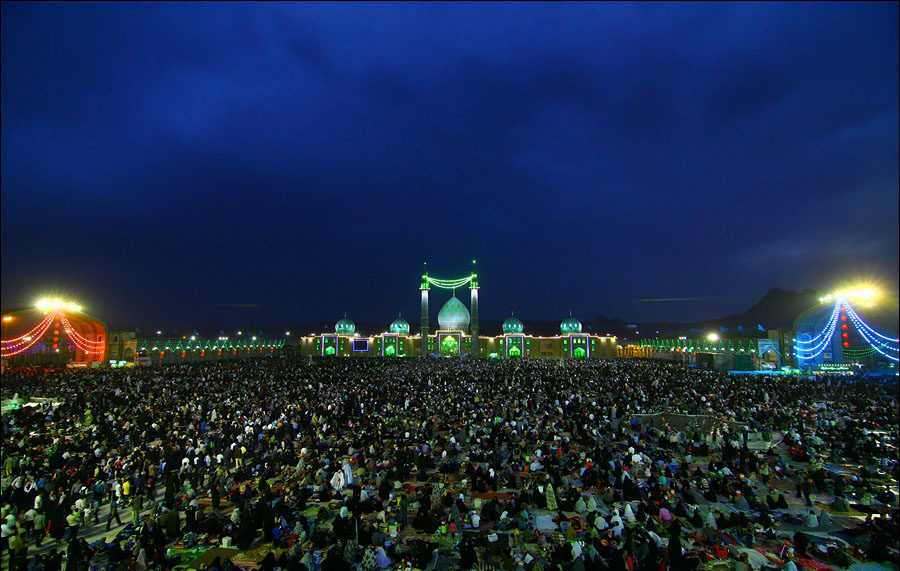 Mid-Sha'banAn Islamic night of prayer, remembrance, and seeking divine forgiveness.
 Sharad PurnimaA Hindu autumn full moon festival of night vigils, moonlit sweets and sacred dances
Good reading and sources
- Night of Power on WikipediaEncyclopedia
- More photos on Wikimedia CommonsPhotos and video
- Wikidata recordOpen data
The facts on this page come from the Wikipedia article "Night of Power", written by its contributors and used under the CC BY-SA 4.0 licence, and from its Wikidata record (CC0). EveryParampara rewrote the text in its own words, with AI assistance, and compares every page with the article to make sure no passage is copied. It may be reused under the same CC BY-SA 4.0 licence with a link back.
It may contain mistakes. Traditions differ from one family, village and community to the next, and the people who keep them know them best. If something is wrong, tell us. Last refreshed 2026-10-05.
More from Bangladesh
All the traditions of Bangladesh
🇮🇳 Mathura, India and 4 moreKrishna Janmashtamiकृष्णजन्माष्टमी
A Hindu festival celebrating the birth of Krishna with fasting, singing and night vigilsSpiritual
🇮🇷 Iran and 5 moreMid-Sha'banنصف شعبان
An Islamic night of prayer, remembrance, and seeking divine forgiveness.Spiritual
🇮🇳 India and 2 moreSharad Purnima
A Hindu autumn full moon festival of night vigils, moonlit sweets and sacred dancesSpiritual · Feasts and festival meals
 🇮🇳 Vrindavan, India and 2 moreGovardhan Puja
A Hindu festival of piled vegetarian foods and sculpted earth, honouring KrishnaSpiritual · Feasts and festival meals
🇮🇳 Vrindavan, India and 2 moreGovardhan Puja
A Hindu festival of piled vegetarian foods and sculpted earth, honouring KrishnaSpiritual · Feasts and festival meals
The same idea elsewhere
Fasting and feasting compared 🇮🇪 Ireland and 5 moreHalloween
An annual observance on 31 October marking the eve of All Saints' Day, rooted in Christian tradition and Celtic heritageFestival · Sweets given and shared
🇹🇷 Turkey and 5 moreEid al-Fitrعيد الفطر
The feast that ends Ramadan, opened with morning prayers, sweets and visits homeFestival · Feasts and festival meals
🇮🇪 Ireland and 5 moreHalloween
An annual observance on 31 October marking the eve of All Saints' Day, rooted in Christian tradition and Celtic heritageFestival · Sweets given and shared
🇹🇷 Turkey and 5 moreEid al-Fitrعيد الفطر
The feast that ends Ramadan, opened with morning prayers, sweets and visits homeFestival · Feasts and festival meals
 🇦🇺 Australia and 5 moreGood Friday
A solemn Christian holy day commemorating the crucifixion and death of Jesus Christ.Spiritual · Fasting and breaking the fast
🇦🇺 Australia and 5 moreGood Friday
A solemn Christian holy day commemorating the crucifixion and death of Jesus Christ.Spiritual · Fasting and breaking the fast
 🇵🇭 Philippines and 5 moreHoly WeekἉγία καὶ Μεγάλη Ἑβδομάς
The solemn seven days leading to Easter, recalling the final week and Passion of JesusSpiritual · Fasting and breaking the fast
🇵🇭 Philippines and 5 moreHoly WeekἉγία καὶ Μεγάλη Ἑβδομάς
The solemn seven days leading to Easter, recalling the final week and Passion of JesusSpiritual · Fasting and breaking the fast