Palekh miniature
In its own language: Палехская миниатюра
Tiny tempera paintings on lacquered papier-mâché, made in the Russian town of Palekh

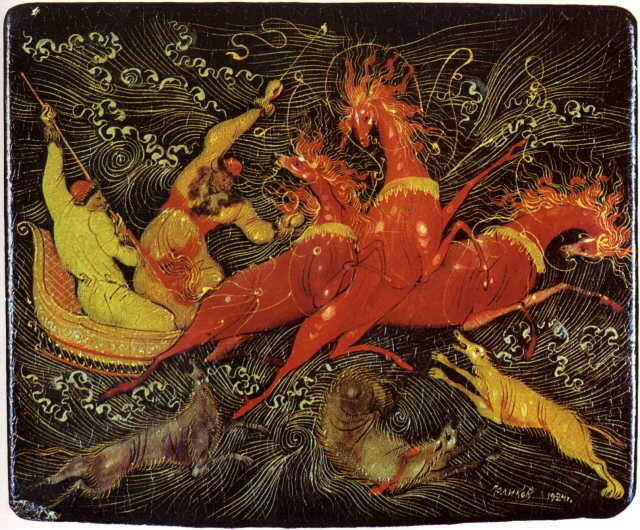
Palekh miniature is a Russian folk craft of painting tiny pictures in tempera on lacquered papier-mâché objects, among them small boxes, cigarette cases and cases for powder. It began in 1923 in Palekh, a town in Ivanovo Oblast, where icon painters turned to fairy tales and folklore after the 1917 revolution put their religious work in danger.
In the Russian town of Palekh, painters make very small pictures in tempera on objects coated with lacquer, most often boxes, cigarette cases and powder cases formed from papier-mâché. The craft began in 1923, when the town's icon painters faced the loss of their old work and chose to keep their skills by painting fairy tales and folklore instead of religious images.
A painted folk craft
Palekh miniature is a Russian folk handicraft, a kind of very small painting. The artist works in tempera, a paint, and puts the picture on an object that has already been varnished. Those objects are made of papier-mâché, paper pulp formed and hardened into shape. Most are small and meant to be held: boxes with lids, cigarette cases and cases for powder. The painted surface is no bigger than a palm, yet it can carry a whole scene. Fine brushes and a patient hand are needed, and the finished article is a useful thing that is also a picture.
Out of icon painting
Palekh is a town in the Palekhsky District of Ivanovo Oblast, Russia. Icons are painted religious images, and Palekh had a long history of making them. After the Bolshevik revolution of 1917, that work was threatened. Rather than lose the skill, the town's painters looked for something else to do with it. In 1923 the first Palekh lacquer art appeared. Fedoskino lacquer art served as their model. Tempera stayed their paint, and gilding stayed part of the work. What changed was the subject.
Tales and folklore
The early boxes did not show religious figures. Their painters chose fairy tales and folklore scenes instead. Folklore means the stories, beliefs and customs that pass down among ordinary people, and fairy tales are familiar wonder stories. So a lid might hold a moment from a tale rather than a face from a church. That choice gave the craft its own character and set it apart from the icon painting that came before. Work of this kind from Palekh also appeared on Soviet postage stamps, which carried the town's art far past Ivanovo Oblast.
How Palekh miniature is kept
Making a Palekh miniature is the work of painters in Palekh, the town where the craft started in 1923 and where it is still kept. The base, a papier-mâché article, receives a varnished surface. The painter then sets a small tempera picture on it, and gilding, a method the town's icon painters already used, may form part of the design. The subjects are fairy tales and folklore scenes rather than religious imagery. Objects made in this way include boxes, cigarette cases and cases for powder, each carrying a hand-painted picture.
When and where
Palekh miniature has no fixed date in the year. It is a craft rather than a festival, and it is made in every season. What the sources give instead is a beginning: the craft first appeared in 1923, in the years after the Bolshevik revolution of 1917 put the town's icon painting at risk.
Palekh, in the Palekhsky District of Ivanovo Oblast, is the home of the craft, and Russia is the country it belongs to. The town is where the icon painting that fed the new work had long been practised, and where the first lacquer pieces appeared in 1923. The new painters took their lead from Fedoskino lacquer art.
What Palekh miniature means
For the painters of Palekh the craft was a way of holding on to a skill. Their icon work was threatened after 1917, and they could have let it go. Instead they kept the paints and the gilding they knew and gave them new subjects. The result is an art tied to one small town, made by hand and marked by the place it comes from.


Questions people ask about Palekh miniature
What exactly is a Palekh miniature?
It is a small painting in tempera on a lacquered papier-mâché object. The objects are things people handle: little boxes, cigarette cases and cases for powder. Palekh miniature is described as a Russian folk handicraft, and the painting is done by hand.
Where did it come from?
From Palekh, a town in the Palekhsky District of Ivanovo Oblast, Russia. The town had a long tradition of icon painting, and the new craft grew out of that work rather than starting from nothing.
When did the craft begin?
In 1923. The town's icon painters saw their religious work threatened by the Bolshevik revolution of 1917, and within a few years the first Palekh lacquer art had appeared.
What do the pictures show?
The first boxes showed fairy tales and folklore scenes, not religious imagery. That choice set the direction for later work. The painters kept their tempera paint and their gilding, and changed what they painted.
Is it still made today?
The sources describe Palekh miniature as a Russian folk handicraft, with Palekh as its home. Work from the town also appeared on Soviet postage stamps, which spread its name beyond Ivanovo Oblast.
See also
 Dog sleddingAn Arctic tradition of navigating snow and ice behind working dog teams
 Dymkovo toysPainted clay people, animals and whistles, shaped by women in Dymkovo near Kirov
 KhokhlomaRussian folk painting of red, black and gold flowers and berries on wooden tableware
 OvooA stone cairn on a peak or pass, circled by travellers and honoured in sky worship
Good reading and sources
- Palekh miniature on WikipediaEncyclopedia
- More photos on Wikimedia CommonsPhotos and video
- Wikidata recordOpen data
The facts on this page come from the Wikipedia article "Palekh miniature", written by its contributors and used under the CC BY-SA 4.0 licence, and from its Wikidata record (CC0). EveryParampara rewrote the text in its own words, with AI assistance, and compares every page with the article to make sure no passage is copied. It may be reused under the same CC BY-SA 4.0 licence with a link back.
It may contain mistakes. Traditions differ from one family, village and community to the next, and the people who keep them know them best. If something is wrong, tell us. Last refreshed 2026-10-05.
More from Russia
All the traditions of Russia
🇬🇱 Greenland and 3 moreDog sledding
An Arctic tradition of navigating snow and ice behind working dog teamsCraft
🇷🇺 Dymkovo, RussiaDymkovo toysДымковская игрушка
Painted clay people, animals and whistles, shaped by women in Dymkovo near KirovCraft
🇷🇺 Khokhloma, RussiaKhokhlomaхохлома
Russian folk painting of red, black and gold flowers and berries on wooden tablewareCraft
 🇺🇦 Ukraine and 7 moreEgg decorating
Decorating eggs with dye, wax and carving, kept at Easter, Nowruz and springCraft
🇺🇦 Ukraine and 7 moreEgg decorating
Decorating eggs with dye, wax and carving, kept at Easter, Nowruz and springCraft
The same idea elsewhere
All of this kind 🇮🇷 Shiraz, Iran and 1 moreKhatamخاتم
A Persian inlay craft that builds geometric patterns from thousands of tiny cut piecesCraft
🇮🇷 Shiraz, Iran and 1 moreKhatamخاتم
A Persian inlay craft that builds geometric patterns from thousands of tiny cut piecesCraft
 🇺🇸 United States and 1 moreDreamcatcherᐊᓴᐱᑫᔒᓐᐦ (asabikeshiinh)
A hand-woven hoop from Anishinaabe tradition, hung above a cradle to protect a childCraft
🇺🇸 United States and 1 moreDreamcatcherᐊᓴᐱᑫᔒᓐᐦ (asabikeshiinh)
A hand-woven hoop from Anishinaabe tradition, hung above a cradle to protect a childCraft
 🇦🇺 AustraliaBark painting
Ochre pictures on flattened tree bark, an Aboriginal art form of northern AustraliaCraft
🇦🇺 AustraliaBark painting
Ochre pictures on flattened tree bark, an Aboriginal art form of northern AustraliaCraft
 🇯🇵 Tokyo, Japan and 1 moreBonsai盆栽
A Japanese craft of keeping small trees in shallow pots, shaped for contemplationCraft
🇯🇵 Tokyo, Japan and 1 moreBonsai盆栽
A Japanese craft of keeping small trees in shallow pots, shaped for contemplationCraft