Crafts and makingEuropeChristian
Khokhloma
In its own language: хохлома
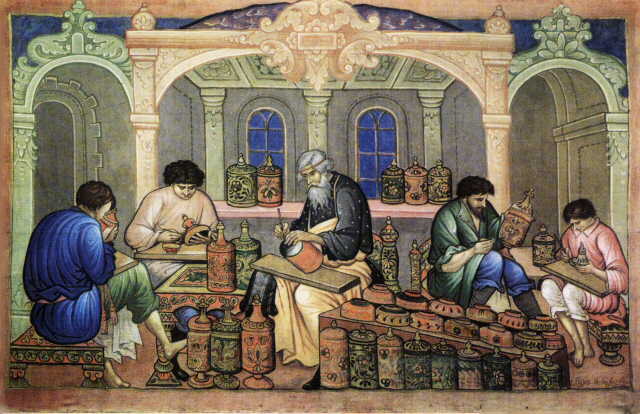
Russian folk painting of red, black and gold flowers and berries on wooden tableware

Khokhloma is a Russian style of painting on wooden household goods, named after a village in the Volga region where it appeared in the later 1600s. Red, black and gold flowers, grasses and berries cover bowls, spoons, saltcellars, breadboxes and furniture made today at workshops in Semyonov and near the village of Khokhloma.
Khokhloma is a Russian folk painting style for wooden household objects, from bowls and spoons to furniture and souvenirs. Its curving lines carry small flowers, berries, grasses and leaves, painted in red and black over a surface that looks like gold. The gold is not real gold but a trick of oil, metal powder and heat. Craftspeople in the Volga region have kept the style since the later 1600s.
What it is
Khokhloma means wooden household things painted with flowing, curving lines. Small flowers, berries, grasses and leaf shapes fill the surface, in red and black on a gold-like ground. The Firebird, a bird from Russian fairy tales, is the best known subject and often takes the centre of a piece. Painters use two main methods. In the superficial technique, red and black go over the goldish layer. In the background technique, a goldish silhouette stands out against a coloured ground. The finish makes light tableware and furniture look heavier, almost like metal.
Origins and history
The style takes its name from the village of Khokhloma, which stands in Koverninsky District, Nizhny Novgorod Oblast, in the Volga region. The style appeared there in the later 1600s. The earliest written record of painted dishes from the area is a letter of 1659, in which a boyar named Morozov asked his bailiff for painted dishes and wine bowls. Local people already knew how to work soft woods. The craft owes its start to Old Believers who fled persecution and took refuge in the local forests. Some of them were icon painters, and they taught local craftsmen to give wood a golden colour without real gold.
How it is made
The wood is first coated with drying oil. Powdered aluminium is then rubbed on, and other metals were used in the past. This layer gives the piece its silver base. The painter works over it with heat resistant oil paints, usually in red and black, building up the flowers, grasses and berries. The piece is then varnished and put into a kiln. Heating turns the varnish a yellow gold colour, so the finished work looks as if it were gilded, though no gold is used. The same look makes a plain wooden spoon or bowl appear heavy and metallic.
Saltcellars and breadboxes
Two wooden items matter in the story of Khokhloma. Saltcellars and breadboxes were important household items in Russian hospitality. Many saltcellars were carved as ducks, with a sliding lid fitted over the duck's back and wings. Breadboxes were shaped as ovals, which left a wide flat surface for painting. Firebirds, fish and other animals sometimes appear as the main subject on these pieces. Khokhloma paint was used on them, but it was not the only style painted on saltcellars and breadboxes. Woodwork in this region ran from small household goods to carvings on the gables and gates of peasant cottages.
Today and change
Early on, the style found buyers in the East, and pieces were made for markets in India and Persia. A Paris exhibition in the late 1800s introduced the style to Western audiences. Then came a long decline: factories and cheap goods, rising timber costs and competition cut folk art production in the late 19th and early 20th centuries. Under the Soviet Union the craft was revived. Craftsmen joined artels in the 1920s and early 1930s, and familiar designs were developed further. In the 1960s the state built a factory called Khokhloma Painter beside the village, and the Khokhloma Painting association in the town of Semyonov, the two main centres. A museum opened at the Semyonov factory in 1972, and in 2008 a museum and cultural centre called Golden Khokhloma opened.
How Khokhloma is kept
Craftspeople take a wooden bowl, spoon, box or piece of furniture and coat it with drying oil. Powdered aluminium goes on next, then heat resistant paints in red and black or, in the background method, a goldish design over colour. The piece is varnished and fired in a kiln, which turns the varnish gold. Today the work is done in workshops at Semyonov and near the village of Khokhloma, in two large centres that make tableware, spoons, furniture and souvenirs.
When and where
Khokhloma belongs to the Volga region of Russia, and above all to Koverninsky District in Nizhny Novgorod Oblast, where the village of Khokhloma sits. The style is named after that village. Its strongest homes today are the town of Semyonov and the area around the village, where the two main production centres stand.
What Khokhloma means
The gold in Khokhloma is the point of it. The surface looks gilded, but no real gold is used. Old Believer icon painters brought the trick of giving wood a golden colour, and the finish still makes plain tableware look like metal. The painted motifs are small flowers, berries, grasses and leaves, worked in flowing curving lines. The Firebird, a bird from Russian fairy tales, is a favourite main subject, and it brings that world of story onto a spoon or a bowl.



Questions people ask about Khokhloma
What is Khokhloma?
It is a Russian style of painting on wooden household objects, known for small flowers, berries, grasses and leaves in red and black on a gold-like ground. The most famous subject is the Firebird from Russian fairy tales. It is used on bowls, spoons, saltcellars, breadboxes, furniture and souvenirs.
Where does it come from?
It is named after the village of Khokhloma, in Koverninsky District, Nizhny Novgorod Oblast, in the Volga region of Russia. The style appeared there in the second half of the 17th century. Its main workshops today are the town of Semyonov and the area around the village.
Is the gold real?
No. Powdered aluminium, and other metals in the past, give the wood a silver base. The piece is painted, varnished and heated in a kiln. The heat turns the varnish a yellow gold colour, so the work looks gilded without any gold being used.
Who kept the craft alive?
Old Believers who fled persecution and settled in the local forests are credited with its start. Some were icon painters, and they taught local craftsmen to paint wood a golden colour without real gold. Later, craftsmen joined artels in the 1920s and 1930s, and the Soviet state built the two factories that still lead production.
Where can it be seen?
A Khokhloma museum opened in the Semyonov factory in 1972. It holds unusual pieces, including a spoon about 2 metres 67 centimetres long and a bowl about one and a half metres across. In 2008 a museum and cultural centre called Golden Khokhloma opened its doors.
See also
 Dog sleddingAn Arctic tradition of navigating snow and ice behind working dog teams
 DreidelA four-sided top spun for small stakes, most often by Jewish families at Hanukkah
 OvooA stone cairn on a peak or pass, circled by travellers and honoured in sky worship
 Holy FireA fire ceremony in Jerusalem each year, kept by Orthodox Christians before Easter
Good reading and sources
- Khokhloma on WikipediaEncyclopedia
- More photos on Wikimedia CommonsPhotos and video
- Wikidata recordOpen data
The facts on this page come from the Wikipedia article "Khokhloma", written by its contributors and used under the CC BY-SA 4.0 licence, and from its Wikidata record (CC0). EveryParampara rewrote the text in its own words, with AI assistance, and compares every page with the article to make sure no passage is copied. It may be reused under the same CC BY-SA 4.0 licence with a link back.
It may contain mistakes. Traditions differ from one family, village and community to the next, and the people who keep them know them best. If something is wrong, tell us. Last refreshed 2026-10-05.
More from Russia
All the traditions of Russia
🇬🇱 Greenland and 3 moreDog sledding
An Arctic tradition of navigating snow and ice behind working dog teamsCraft
 🇷🇺 Palekh, RussiaPalekh miniatureПалехская миниатюра
Tiny tempera paintings on lacquered papier-mâché, made in the Russian town of PalekhCraft
🇷🇺 Palekh, RussiaPalekh miniatureПалехская миниатюра
Tiny tempera paintings on lacquered papier-mâché, made in the Russian town of PalekhCraft
 🇷🇺 Dymkovo, RussiaDymkovo toysДымковская игрушка
Painted clay people, animals and whistles, shaped by women in Dymkovo near KirovCraft
🇷🇺 Dymkovo, RussiaDymkovo toysДымковская игрушка
Painted clay people, animals and whistles, shaped by women in Dymkovo near KirovCraft
 🇺🇦 Ukraine and 7 moreEgg decorating
Decorating eggs with dye, wax and carving, kept at Easter, Nowruz and springCraft
🇺🇦 Ukraine and 7 moreEgg decorating
Decorating eggs with dye, wax and carving, kept at Easter, Nowruz and springCraft
The same idea elsewhere
All of this kind 🇮🇷 Shiraz, Iran and 1 moreKhatamخاتم
A Persian inlay craft that builds geometric patterns from thousands of tiny cut piecesCraft
🇮🇷 Shiraz, Iran and 1 moreKhatamخاتم
A Persian inlay craft that builds geometric patterns from thousands of tiny cut piecesCraft
 🇺🇸 United States and 1 moreDreamcatcherᐊᓴᐱᑫᔒᓐᐦ (asabikeshiinh)
A hand-woven hoop from Anishinaabe tradition, hung above a cradle to protect a childCraft
🇺🇸 United States and 1 moreDreamcatcherᐊᓴᐱᑫᔒᓐᐦ (asabikeshiinh)
A hand-woven hoop from Anishinaabe tradition, hung above a cradle to protect a childCraft
 🇦🇺 AustraliaBark painting
Ochre pictures on flattened tree bark, an Aboriginal art form of northern AustraliaCraft
🇦🇺 AustraliaBark painting
Ochre pictures on flattened tree bark, an Aboriginal art form of northern AustraliaCraft
 🇯🇵 Tokyo, Japan and 1 moreBonsai盆栽
A Japanese craft of keeping small trees in shallow pots, shaped for contemplationCraft
🇯🇵 Tokyo, Japan and 1 moreBonsai盆栽
A Japanese craft of keeping small trees in shallow pots, shaped for contemplationCraft