Dress and adornmentEuropeChristian
Phelonion
In its own language: φαιλόνιον (phailónia), Фело́нь (Felón')
A large outer vestment worn by Eastern Christian clergy during worship services.
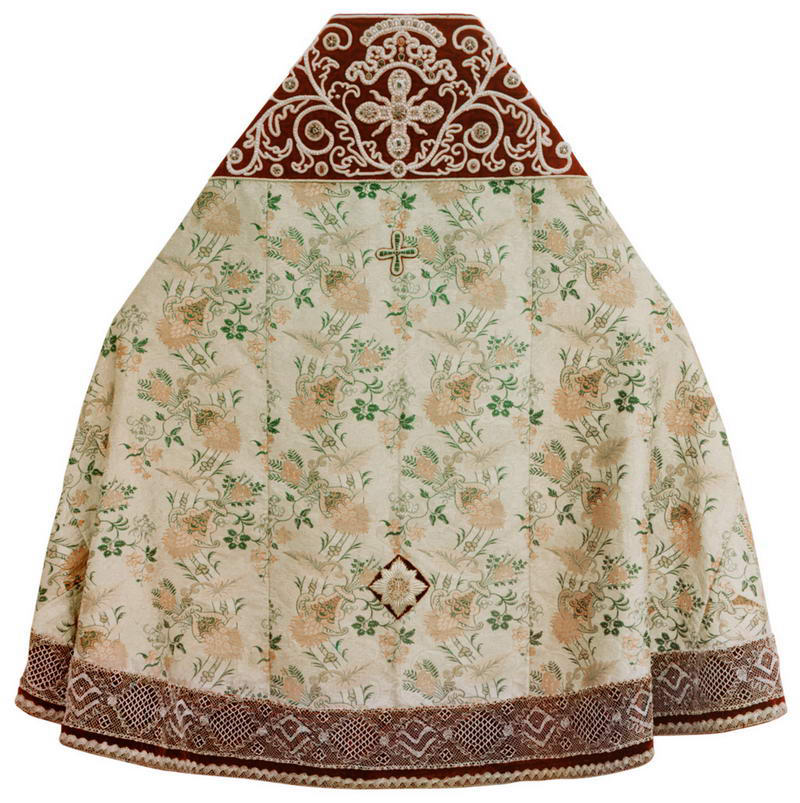
The phelonion is a voluminous liturgical robe worn by priests and bishops in Byzantine Christian churches. Derived from ancient Roman cloaks, it transformed into a folded garment that frees the arms for prayer. Communities across Greece, Russia, and the Middle East continue to use this attire to mark sacred duties.
When is Phelonion kept?
Phelonion is kept at major liturgical functions and the Divine Liturgy.
The phelonion serves as the primary outer vestment for clergy in Eastern Christian worship. Shaped like a wide cloak with a head opening, it drapes over the body to cover all undergarments. This garment allows freedom of movement while honoring the solemnity of the service.
Origins and evolution
The phelonion began as a simple Roman cloak called a paenula. Early versions were round ponchos with a hole for the head. By the sixth century, clergy wore these wool or silk garments. Over time, the shape changed to allow better arm movement. People folded the fabric above the elbows. Around the fifteenth century, the front was cut away from the waist down. This modification helped priests gesture during prayers. The longer front remained common in Russia until recently. Mosaics in Ravenna and Porec show early forms.
Styles and variations
Two main styles exist today. The Greek version fits over the shoulders and is common in Greece and the Balkans. The Russian style features a tall, stiff collar that covers the back of the head. Some Oriental churches use versions that open widely at the neck. These resemble Western copes. Readers in Old Believer churches may wear a small shortened version. Bishops sometimes wear the phelonion instead of heavier robes when serving as priests.
Rank and authority
Bishops once wore the same plain robes as priests. Later, a special garment called the polystavrion developed for high-ranking leaders. This version features woven or embroidered crosses. Only patriarchs and certain exarchs could wear it initially. Rules about who could wear it shifted over centuries. Eventually, the right extended to more bishops. The polystavrion marked authority before being replaced by the sakkos in some areas. Letters from patriarchs enforced these dress codes strictly.
How Phelonion is kept
Priests and bishops wear the phelonion over inner robes during services. They choose a style based on their regional tradition, such as the shoulder-fitting Greek cut or the high-collared Russian version. Bishops may wear special cross-patterned versions to show authority. The garment is put on before starting the liturgy.
When and where
During major liturgical functions, including the Divine Liturgy.
Used throughout Eastern Christian regions, including Greece, Russia, the Balkans, and parts of the Middle East.
What Phelonion means
Represents the priestly office and authority. Special versions with many crosses indicate higher rank among bishops.

Questions people ask about Phelonion
When is Phelonion kept?
Phelonion is kept at major liturgical functions and the Divine Liturgy.
What is the phelonion?
It is a large outer vestment worn by priests and bishops in Eastern Christian churches during worship. It covers the body and signifies the wearer's role in the liturgy.
How does the Russian style differ?
Russian phelonia have a high, stiffened collar covering the back of the head. Greek styles fit loosely over the shoulders without a tall collar.
What is the polystavrion?
It is a special phelonion decorated with multiple crosses. Bishops and patriarchs wear it to display their higher rank and authority within the church hierarchy.
See also
 Vyshyvanka DayAn annual day for wearing traditional Ukrainian embroidered shirts across the world
 RushnykA sacred embroidered cloth used in East Slavic rituals, weddings and daily life.
 Traditional tattooingThe ancient custom of marking the skin for protection, healing, status and sacred rites
 GáktiA traditional coat worn by the Sámi people across northern Scandinavia and Russia, signaling origin and status through c
Good reading and sources
- Phelonion on WikipediaEncyclopedia
- More photos on Wikimedia CommonsPhotos and video
- Wikidata recordOpen data
The facts on this page come from the Wikipedia article "Phelonion", written by its contributors and used under the CC BY-SA 4.0 licence, and from its Wikidata record (CC0). EveryParampara rewrote the text in its own words, with AI assistance, and compares every page with the article to make sure no passage is copied. It may be reused under the same CC BY-SA 4.0 licence with a link back.
It may contain mistakes. Traditions differ from one family, village and community to the next, and the people who keep them know them best. If something is wrong, tell us. Last refreshed 2026-10-13.
More from Greece
All the traditions of Greece 🇬🇷 GreeceKausiaκαυσία
A flat hat of ancient Macedonia, worn by kings and later as sun cover in RomeDress
🇬🇷 GreeceKausiaκαυσία
A flat hat of ancient Macedonia, worn by kings and later as sun cover in RomeDress
 🇬🇷 GreeceTablionταβλίον
An embroidered panel on the ceremonial mantle of Byzantine courtiers.Dress
🇬🇷 GreecePeronaiπερόνη (perónē)
A long straight pin that fastened Greek clothing, and a weapon in Greek legendDress
🇬🇷 GreeceTablionταβλίον
An embroidered panel on the ceremonial mantle of Byzantine courtiers.Dress
🇬🇷 GreecePeronaiπερόνη (perónē)
A long straight pin that fastened Greek clothing, and a weapon in Greek legendDress
 🇬🇷 Sparta, GreeceChitonχιτών
A draped tunic of wool or linen worn across ancient Greece and RomeDress
🇬🇷 Sparta, GreeceChitonχιτών
A draped tunic of wool or linen worn across ancient Greece and RomeDress
The same idea elsewhere
All of this kind 🇮🇱 Israel and 1 moreTzitzitצִיצִית
Knotted ritual fringes worn on a four-cornered garment, a reminder of the commandmentsDress
🇪🇬 Egypt and 5 moreTraditional tattooing
The ancient custom of marking the skin for protection, healing, status and sacred ritesDress
🇮🇱 Israel and 1 moreTzitzitצִיצִית
Knotted ritual fringes worn on a four-cornered garment, a reminder of the commandmentsDress
🇪🇬 Egypt and 5 moreTraditional tattooing
The ancient custom of marking the skin for protection, healing, status and sacred ritesDress
 🇼🇸 Samoa and 1 moreʻIe tōga
Precious woven mats exchanged in Samoan ceremonies to honor family ties and chiefly status.Dress
🇼🇸 Samoa and 1 moreʻIe tōga
Precious woven mats exchanged in Samoan ceremonies to honor family ties and chiefly status.Dress
 🇱🇸 LesothoMokorotlo
A conical straw hat that serves as the national symbol of Lesotho and a key element of Basotho traditional dress.Dress
🇱🇸 LesothoMokorotlo
A conical straw hat that serves as the national symbol of Lesotho and a key element of Basotho traditional dress.Dress