Seasons, harvest and the calendarSouth AsiaHindu
Pongal
Three or four days of boiling rice, garlanded cattle and thanks to the sun
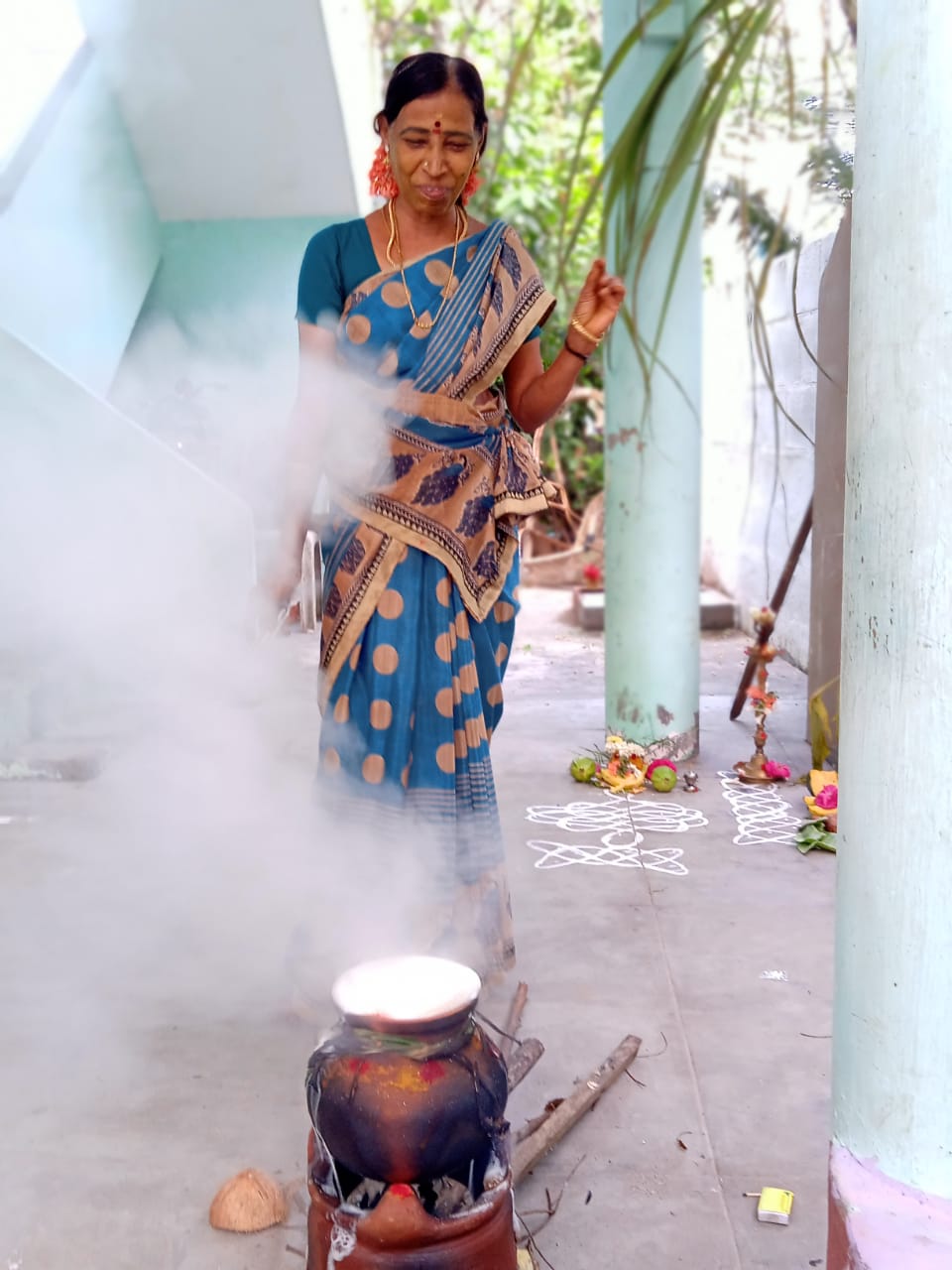
Pongal is a Tamil harvest festival that runs for three or four days, kept mostly by Tamil Hindus in India, Sri Lanka and around the world. It opens on the last day of the Tamil month Margazhi and centres on Thai Pongal, when rice boiled with milk and jaggery spills over the pot in thanks to the sun god Surya.
When is Pongal in 2027?
Pongal 2027 runs from 14 to 17 January 2027. Other years: 2028, 15 to 18 January 2028.
Pongal is a harvest festival kept by Tamils across three or four days, from the close of the Tamil month Margazhi into Thai. Households cook rice with milk and jaggery outdoors, thank the sun god Surya, and honour the cattle that work the land. It is also called Tamizhar thirunal, the festival of the Tamils.
Origins and history
Pongal gives thanks to Surya, to the natural world, and to the animals and workers who feed everyone. A grant of land for the yearly rites is recorded in an inscription dated to the reign of Kulottunga I, a Chola king who ruled from 1070 to 1122 CE. That inscription belongs to the Veeraraghava Swamy Temple. An older Shaiva devotional poem, the Tiruvempavai of Manikkavacakar, from the ninth century, mentions the celebration. Temple records from the Chola and Vijayanagara periods describe dishes much like today's pongal, differing in seasonings and in the amounts used.
Kolam and decoration
Houses are cleaned, painted and dressed for guests before the festival begins. Kolam patterns are drawn on the ground, most often in rice flour and sometimes with natural or bought colour powders: designs built from straight lines, curves and loops, set around a grid of dots. Banana and mango leaves and flowers hang at the entrance. The cooking pot is put out in the sun, garlanded with leaves or flowers and sometimes tied with a piece of turmeric root. New clothes are worn on the main day. Sweets, fruit and a little money are given to children.
Gatherings and games
Temples and cultural centres hold fairs called Pongal mela, where pottery, handicrafts, sarees and jewellery are sold, and where the festival dish is cooked as a ritual. Community sport is part of the days too: Uri Adithal, in which a blindfolded player swings at a mud pot hanging out of reach, the board game Pallanguzhi, and Kabbadi. Larger towns stage group dance and music. In some districts people run Jallikattu, where a bull is released among a crowd and participants try to seize its hump and hold on. Elsewhere, images of temple deities are carried in wooden chariots with dance-dramas. On Mattu Pongal, women and girls feed pongal to crows and pray for their brothers.
Food and offering
The dish called pongal gives the festival its name and holds the centre of the day. Newly harvested rice is boiled with cow's milk and raw cane sugar, often with coconut, ghee, cardamom, raisins and cashews. It is cooked in a clay pot, outdoors in daylight, in a courtyard or porch, so that the pot sits under the open sky. When the rice swells and spills over the rim, those watching blow a conch or shout "Pongalo Pongal". A first serving goes to Surya and Ganesha, sometimes a share is set before the cows, and then the family and guests eat. Temples and villages run free kitchens staffed by volunteers.
Today and change
Pongal is often described as a social festival now, since many households mark it without temple ritual. Tamil Nadu keeps three or four days; cities and families outside South Asia often keep one or two. Karnataka has a similar run of days with its own dish, ellu. Sri Lankan Tamils keep two days, centred on Thai Pongal, and cook pukkai, a dish of red rice, mung beans and milk, on the first. Communities abroad organise a shared Pongal, and near Thiruvananthapuram the Attukal temple holds Attukal Pongala in February or March, with Kathakali, music and processions.
How Pongal is kept
Bhogi comes first, on the last day of Margazhi: old belongings are cleared out and burned, houses are cleaned and painted, and prayers are said to Indra for good rain. Thai Pongal follows on the first of Thai. Families wear new clothes, cook the pongal dish outdoors and offer it to Surya before eating together. On Mattu Pongal the cattle are washed, their horns painted and garlanded, and they are fed sweets and thanked. Kaanum Pongal, where it is kept, is for visiting elders and holding family reunions, with gifts for the young.
When and where
It starts on the last day of the Tamil month Margazhi and runs into the first days of Thai. Thai Pongal usually falls on 14 or 15 January. The Tamil calendar sets the dates. In 2025 the days ran from 13 to 16 January. In cities and outside South Asia, many families keep only one or two of them.
Pongal belongs to Tamil Nadu and to Tamil communities in other parts of South India. In Sri Lanka it is one of the main Tamil festivals. Families in Malaysia, Singapore, Mauritius, South Africa and elsewhere in the diaspora keep it too. In Kerala, Tamil households observe it, and five districts there, Idukki, Palakkad, Pathanamthitta, Thiruvananthapuram and Wayanad, mark it as a public holiday.
What Pongal means
The cooking carries the meaning. Rice from the new harvest, milk and jaggery turn into food that is offered to the gods first and then shared, a shift from field to table that stands for the year's plenty. When the pot boils over, people read it as a blessing, and greet it with the shout Pongalo Pongal. The days thank Surya for the light that ripens the crops, and give open thanks to the cattle and the workers behind every harvest.
On the table
Flavours: Cardamom


Pongal dates: 2027, 2028
| Year | Pongal date |
|---|---|
| 2027 | 14 to 17 January 2027 |
| 2028 | 15 to 18 January 2028 |
Questions people ask about Pongal
When is Pongal in 2027?
Pongal 2027 runs from 14 to 17 January 2027. Other years: 2028, 15 to 18 January 2028.
What is Pongal?
A Tamil harvest festival lasting three or four days, kept by Tamil Hindus and other Tamils in India, Sri Lanka and around the world. It thanks the sun god Surya for the harvest and honours cattle, and it takes its name from the rice dish cooked for it.
Where is it celebrated?
Mainly in Tamil Nadu and among Tamil communities in other parts of South India. Sri Lankan Tamils keep it over two days. Tamil families in Malaysia, Singapore, Mauritius, South Africa, Britain, Canada, the United States and the Gulf also celebrate it.
Why are cattle decorated during Pongal?
The third day, Mattu Pongal, belongs to cattle, which the festival regards as a source of wealth: they give milk and manure and work the fields. They are bathed, their horns polished and painted, garlanded, led in procession and fed sweets.
Is Pongal only a religious festival?
No. It began as a Hindu observance with prayers to Surya, and many people now call it a social festival, since present-day celebrations are not always tied to temple ritual. Tamils of several religions keep it.
See also
 Advent wreathAn evergreen ring of candles lit week by week in the lead-up to Christmas
 LosarThe Tibetan Buddhist New Year festival of renewal, offerings, and family feasts
 UgadiA South Indian New Year feast celebrating life with sweet, sour, and bitter tastes
 LohriA northern Indian midwinter festival of evening bonfires, folk songs and harvest foods
Good reading and sources
- Encyclopaedia BritannicaArticle
- Pongal 2025: When is Pongal? Know date, history, significance and all about 4 days of the festivalHindustan Times, Article
- Pongal 2025: When is Pongal? Know date, history, significance and all about 4 days of the festivalHindustan Times, Article
- Pongal (festival) on WikipediaEncyclopedia
- More photos on Wikimedia CommonsPhotos and video
- Wikidata recordOpen data
The facts on this page come from the Wikipedia article "Pongal (festival)", written by its contributors and used under the CC BY-SA 4.0 licence, and from its Wikidata record (CC0). EveryParampara rewrote the text in its own words, with AI assistance, and compares every page with the article to make sure no passage is copied. It may be reused under the same CC BY-SA 4.0 licence with a link back.
It may contain mistakes. Traditions differ from one family, village and community to the next, and the people who keep them know them best. If something is wrong, tell us. Last refreshed 2026-10-09.
More from India
All the traditions of India
🇧🇹 Bhutan and 4 moreLosarལོ་གསར་
The Tibetan Buddhist New Year festival of renewal, offerings, and family feastsSeasonal · Feasts and festival meals
🇮🇳 India and 1 moreUgadiఉగాది
A South Indian New Year feast celebrating life with sweet, sour, and bitter tastesSeasonal
🇮🇳 India and 1 moreLohri
A northern Indian midwinter festival of evening bonfires, folk songs and harvest foodsSeasonal
 🇮🇳 IndiaVishuവിഷു
The Malayali new year, kept on 14 or 15 April with an auspicious first sightingSeasonal · Feasts and festival meals
🇮🇳 IndiaVishuവിഷു
The Malayali new year, kept on 14 or 15 April with an auspicious first sightingSeasonal · Feasts and festival meals
The same idea elsewhere
Harvest and thanksgiving compared 🇵🇪 Cusco, Peru and 4 moreIntiinti (Quechua)
The Inca sun deity, honoured with temples, offerings and the June festival Inti RaymiSpiritual
🇵🇪 Cusco, Peru and 4 moreIntiinti (Quechua)
The Inca sun deity, honoured with temples, offerings and the June festival Inti RaymiSpiritual
 🇬🇧 United Kingdom and 5 moreChristmas carol
Festive songs and hymns sung during the Christmas season and door to doorPerformance
🇬🇧 United Kingdom and 5 moreChristmas carol
Festive songs and hymns sung during the Christmas season and door to doorPerformance
 🇸🇪 Gävle, Sweden and 1 moreYule goatJulbocken
A straw goat of northern Christmas, once a harvest spirit, now a tree ornamentFestival
🇸🇪 Gävle, Sweden and 1 moreYule goatJulbocken
A straw goat of northern Christmas, once a harvest spirit, now a tree ornamentFestival
 🇬🇪 Tbilisi, GeorgiaChichilakiჩიჩილაკი
A shaved hazelnut branch crafted as a Georgian Christmas tree and burned at EpiphanyFestival
🇬🇪 Tbilisi, GeorgiaChichilakiჩიჩილაკი
A shaved hazelnut branch crafted as a Georgian Christmas tree and burned at EpiphanyFestival