Life-cycle ritesSouth AsiaBuddhist
Poruwa ceremony
A Sinhalese wedding rite held on a decorated wooden platform called a Poruwa

The Poruwa ceremony is the traditional wedding rite of the Sinhalese people of Sri Lanka. It takes place on a decorated wooden platform called a Poruwa, where the bride and groom, with both families, perform a set order of rituals, including the exchange of betel leaves, the tying of fingers with gold thread and a Buddhist blessing.
When is Poruwa ceremony kept?
Poruwa ceremony is kept on the wedding day, as the main rite of a Sinhalese marriage.
The Poruwa ceremony is how many Sinhalese couples in Sri Lanka marry. It is held on a Poruwa, a decorated wooden platform, and joins bride and groom through a set order of small rituals. Their families take part throughout, and a Buddhist chant blesses the marriage. The rite appears to be older than Buddhism on the island, and couples still keep it today.
What it is
A Poruwa ceremony is a Sinhalese wedding. It is not held in a hall or a temple but on a Poruwa, a wooden platform decorated for the day. The bride and her people gather on the left of the platform, and the groom and his people on the right. Both families have parts to play, and many of the small acts are done by relatives rather than by the couple alone. Betel leaves, gold, water, white cloth, milk rice and a coconut all appear in turn. The whole ceremony is a sequence, and each step carries a meaning the families understand.
The wooden platform
Everything happens on the Poruwa. It is a traditional wooden platform, decorated for the wedding, and the couple step onto it leading with the right foot. Right and left matter here: the groom's side takes the right, the bride's side the left. The platform is the stage for the whole rite, from the first greeting to the last act. When the newly married pair step down from it, a member of the groom's family breaks a fresh coconut. After that the Poruwa has done its work.
Betel leaves and gold
Betel leaves run through the ceremony. The officiant offers them to the couple, who accept and give them back to be laid on the Poruwa. Later the groom's brother brings a tray holding seven sheaves, each with a coin tucked inside. The groom holds the tray while the bride lifts one leaf at a time and lets it fall, and then he does the same. Gold marks the union too: the groom's brother passes a necklace to the groom, who fastens it on the bride, and a maternal uncle ties the pair's little fingers with one gold thread. Then water is poured over their fingers, and six girls chant a Buddhist blessing, the Jayamangala Gatha.
History and change
The Poruwa ceremony appears to have been kept in Sri Lanka before Buddhism arrived in the 3rd century BC. It counted as a valid custom for a registered marriage until the British brought in registration of marriages by law in 1870. What is done today draws on both up country and low country customs of the island. The frame of the rite is old, but the details have shifted with the times and with the regions families come from.
How Poruwa ceremony is kept
Both families gather: the groom's people on the right of the Poruwa, the bride's on the left. The couple step up with the right foot first and greet each other with palms together. The officiant gives them betel leaves, and they return them. The bride's father places her right hand in the groom's. A tray of seven betel sheaves, each with a coin, is brought by the groom's brother, and the couple drop the leaves one by one. A gold necklace goes on the bride. A maternal uncle ties their little fingers with gold thread and pours water. Six girls chant. White cloth passes to the bride's mother. Milk rice is fed, then a coconut is broken.
When and where
A Poruwa ceremony is held on the wedding day, as the main rite of a Sinhalese marriage. It has no fixed place in the year, and the family settles the date. For a long stretch of history it could also stand as a registered marriage, until the British brought in marriage registration by law in 1870.
It belongs to Sri Lanka and to Sinhalese families there, and it is strongest among them on the island. The ceremony is performed wherever the wedding is held, on a Poruwa built or decorated for the occasion, with the groom's relatives to the right and the bride's to the left.
What Poruwa ceremony means
The acts carry meanings the families read as they happen. The father placing his daughter's hand in the groom's stands for handing her over. The single gold thread around their little fingers, and the water poured over it, stand for unity. Gold given to the bride marks the bond. The white cloth is the groom's thanks to his mother-in-law. The Buddhist chant asks a blessing on the pair. Milk rice is shared, and the broken coconut marks the end of the rite as they step down.
Questions people ask about Poruwa ceremony
When is Poruwa ceremony kept?
Poruwa ceremony is kept on the wedding day, as the main rite of a Sinhalese marriage.
What is a Poruwa ceremony?
It is the traditional wedding ceremony of the Sinhalese people of Sri Lanka. It is held on a Poruwa, a decorated wooden platform, and consists of a set order of rituals performed by the bride, the groom and their families, with a Buddhist blessing at its centre.
Who takes part?
The bride and groom, and both families. The officiant presents betel leaves, the bride's father hands her over, the groom's brother brings the betel tray and the necklace, a maternal uncle ties the gold thread, six girls chant, and the bride's mother offers milk rice.
Where is it held?
On the Poruwa, a wooden platform decorated for the wedding. The groom's relatives stand to the right of it and the bride's to the left. The couple step onto it leading with the right foot and step down at the end, when a coconut is broken.
Is it a religious ceremony?
It is a Sinhalese custom, and it appears to be older than Buddhism in Sri Lanka, where it existed before the 3rd century BC. A Buddhist chant, the Jayamangala Gatha, is part of it, and the rite today draws on both up country and low country customs.
See also
 PandalTemporary decorated pavilions and arches built for festivals and gatherings
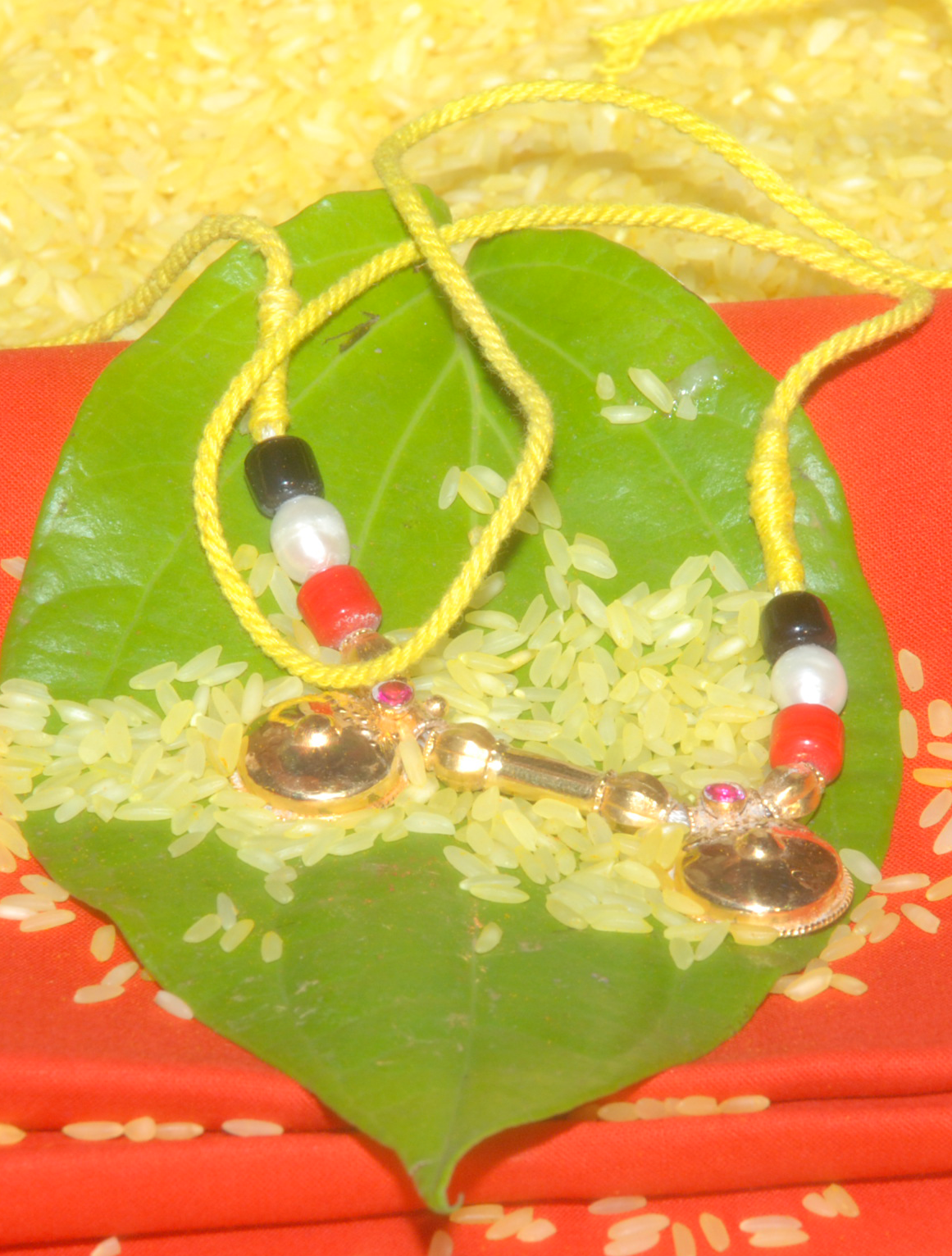 MangalasutraA necklace tied by the groom at a wedding, worn through married life
 SherwaniA long buttoned coat for men, worn at weddings and state occasions in South AsiaKwanjulaA formal marriage introduction ritual of the Baganda people in Uganda, where families meet to exchange gifts and seek bl
Good reading and sources
The facts on this page come from the Wikipedia article "Poruwa ceremony", written by its contributors and used under the CC BY-SA 4.0 licence, and from its Wikidata record (CC0). EveryParampara rewrote the text in its own words, with AI assistance, and compares every page with the article to make sure no passage is copied. It may be reused under the same CC BY-SA 4.0 licence with a link back.
It may contain mistakes. Traditions differ from one family, village and community to the next, and the people who keep them know them best. If something is wrong, tell us. Last refreshed 2026-10-05.
More from Sri Lanka
All the traditions of Sri Lanka
🇮🇳 Lucknow, India and 3 moreSherwani
A long buttoned coat for men, worn at weddings and state occasions in South AsiaDress
🇮🇳 India and 2 moreMangalasutraमङ्गलसूत्रम् (maṅgalasūtram)
A necklace tied by the groom at a wedding, worn through married lifeDress
 🇱🇰 Sri LankaKiribathකිරිබත්
Rice cooked in coconut milk, the dish of Sinhalese New Year and family beginningsTable custom · Breakfast
🇮🇳 India and 2 morePandal
Temporary decorated pavilions and arches built for festivals and gatheringsFestival
🇱🇰 Sri LankaKiribathකිරිබත්
Rice cooked in coconut milk, the dish of Sinhalese New Year and family beginningsTable custom · Breakfast
🇮🇳 India and 2 morePandal
Temporary decorated pavilions and arches built for festivals and gatheringsFestival
The same idea elsewhere
Weddings compared 🇼🇸 Samoa and 1 moreʻIe tōga
Precious woven mats exchanged in Samoan ceremonies to honor family ties and chiefly status.Dress
🇼🇸 Samoa and 1 moreʻIe tōga
Precious woven mats exchanged in Samoan ceremonies to honor family ties and chiefly status.Dress
 🇹🇱 Timor-LesteUma Lulik
Sacred ancestral clan houses and ritual shrines in East TimorSpiritual
🇹🇱 Timor-LesteUma Lulik
Sacred ancestral clan houses and ritual shrines in East TimorSpiritual
 🇮🇩 Indonesia and 2 moreKenduri
A communal prayer meal and gathering shared across Indonesia, Malaysia and BruneiSpiritual · Feasts and festival meals
🇺🇬 UgandaKwanjula
A formal marriage introduction ritual of the Baganda people in Uganda, where families meet to exchange gifts and seek blRite of passage
🇮🇩 Indonesia and 2 moreKenduri
A communal prayer meal and gathering shared across Indonesia, Malaysia and BruneiSpiritual · Feasts and festival meals
🇺🇬 UgandaKwanjula
A formal marriage introduction ritual of the Baganda people in Uganda, where families meet to exchange gifts and seek blRite of passage