Royal, civic and national ceremonyEuropeSecular and civic
Republic Day
In its own language: Tag der Republik
The former national holiday marking the founding of East Germany each October

Republic Day was the national holiday of East Germany, observed annually on 7 October from 1949 to 1989. The state commemorated its founding date with public folk festivals, official honours, concerts, and prominent military displays in East Berlin.
When is Republic Day kept?
Republic Day is kept on annually on 7 October from 1949 to 1989.
Republic Day was an annual civic holiday observed across East Germany every 7 October between 1949 and 1989. Created to commemorate the establishment of the German Democratic Republic in the Soviet Occupation Zone, the event served as a major state celebration. Over four decades, the government marked the anniversary with prestigious civilian awards, public fairs, mass concerts, and formal armed forces reviews along the streets of East Berlin.
Origins and development
East Germany was established on 7 October 1949, following the creation of West Germany earlier that year. Governed by the Socialist Unity Party, the new republic began marking its founding date immediately, holding its first large-scale milestone celebrations in 1959 for its tenth anniversary. Every five years, postal authorities issued commemorative stamps to honor the state's birthday. During the 1970s, the holiday shifted towards a broader public gathering with the character of a community folk festival. New civic landmarks were also tied to the date, including the Palace of the Republic, which opened its doors during the holiday in 1976.
Military parades and music
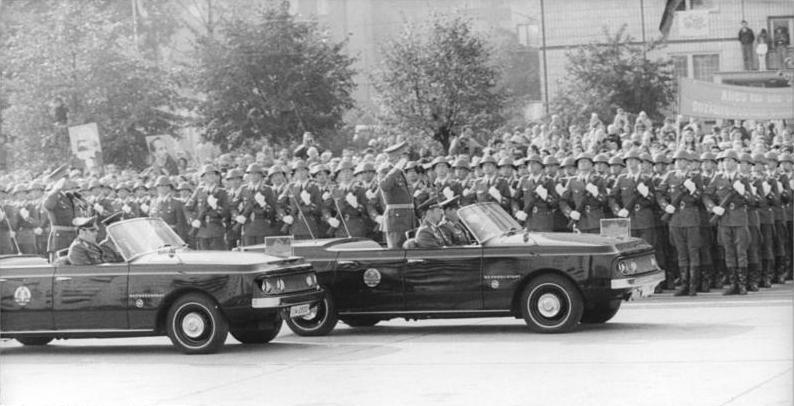
From 1959 until 1989, a central military parade took place along Karl-Marx-Allee in East Berlin between Alexanderplatz and Strausberger Platz. Commanded for many years by Colonel General Horst Stechbarth, the review involved ground columns, mobile units, naval reviews, and massed military bands. The ceremony began with fanfares, inspection by the Minister of Defence, and the national anthem, Auferstanden aus Ruinen. These armed demonstrations in Berlin prompted recurrent diplomatic protests from the Western Powers due to the city's shared Four Powers status. Notable major parades occurred during the twenty-fifth, thirtieth, and fortieth anniversaries.
The evening Grand Tattoo
In the evening, the military presented the Großer Zapfenstreich, an adapted German ceremonial tattoo. Introduced in 1962 and formalized in 1981, this performance revised traditional Prussian routines to include Soviet pieces, torchlight processions, and socialist labor anthems. The assembly featured the Central Band of the National People's Army, timpanists, specialized fanfare players, a corps of drums, and ceremonial guards from the Friedrich Engels unit. Sailors from the Volksmarine and designated color guards marched alongside torchbearers to conclude the state holiday.
Public unrest and transition
Although designed as an expression of unity, the holiday also saw open dissent. On Republic Day in 1977, violent confrontations broke out at Alexanderplatz in East Berlin between local youth and the People's Police. Demonstrators chanted peace slogans and anti-state phrases, leading to multiple arrests and trials. The state held its final military parade on 7 October 1989 for its fortieth anniversary. Following political changes, national commemoration shifted to 3 October under a new united German calendar.
How Republic Day is kept
Morning commemorations featured a ceremonial military procession in East Berlin along Karl-Marx-Allee, where the Minister of Defence inspected troops alongside the parade commander before reviewing leaders on the grandstand. Across the nation, citizens attended concerts, folk gatherings, and fireworks, while the state conferred the National Award of the GDR upon selected individuals. Festivities concluded at nightfall with the Großer Zapfenstreich, a torchlit military tattoo blending fanfare music, working-class anthems, and guard formations.
When and where
Republic Day was observed on 7 October each year from 1949 through 1989. The date was fixed to match the calendar day on which the German Democratic Republic was formally established in 1949.
Celebrations occurred across the German Democratic Republic, with major events centered in East Berlin. Karl-Marx-Allee hosted the primary armed forces parade, while Alexanderplatz served as a central public gathering spot.
What Republic Day means
The observance served to legitimize the sovereignty and socialist identity of East Germany after the postwar partition. Through state honours, patriotic marches, and revised historic ceremonies like the torchlit tattoo, the government used the occasion to foster national pride, showcase defence capabilities, and project stability to both domestic and international audiences.


Questions people ask about Republic Day
When is Republic Day kept?
Republic Day is kept on annually on 7 October from 1949 to 1989.
What was Republic Day in East Germany?
Republic Day was the annual state holiday celebrating the founding of the German Democratic Republic. Observed from 1949 to 1989, it featured public festivals, civilian honours, concerts, and major armed forces parades.
What was the Großer Zapfenstreich on Republic Day?
The Großer Zapfenstreich was a traditional evening military ceremony adapted to include torchlight marches, socialist working-class songs, Soviet musical pieces, and massed fanfare bands.
Why did the military parades cause international tension?
Western Allied powers submitted official diplomatic protests regarding the parades because staging armed military displays in Berlin conflicted with the city's agreed Four Powers postwar status.
See also
 Olympic torch relayThe ceremonial journey of the flame from Olympia to each host city of the Olympic Games
 German Unity DayGermany's national day, marking reunification on 3 October 1990
 Victory in Europe DayThe day Nazi Germany's surrender was accepted, marking the end of the war in EuropeLGBTQ History MonthAn annual month of education and remembrance celebrating queer lives and civil rights
Good reading and sources
- Republic Day (East Germany) on WikipediaEncyclopedia
- More photos on Wikimedia CommonsPhotos and video
- Wikidata recordOpen data
The facts on this page come from the Wikipedia article "Republic Day (East Germany)", written by its contributors and used under the CC BY-SA 4.0 licence, and from its Wikidata record (CC0). EveryParampara rewrote the text in its own words, with AI assistance, and compares every page with the article to make sure no passage is copied. It may be reused under the same CC BY-SA 4.0 licence with a link back.
It may contain mistakes. Traditions differ from one family, village and community to the next, and the people who keep them know them best. If something is wrong, tell us. Last refreshed 2026-10-06.
More from Germany
All the traditions of Germany
🇬🇷 Olympia, Greece and 1 moreOlympic torch relay
The ceremonial journey of the flame from Olympia to each host city of the Olympic GamesCeremony
 🇬🇷 Olympia, Greece and 5 moreOlympic flame
A flame kindled in Greece, carried by torch to light the cauldron of each GamesCeremony
🇬🇷 Olympia, Greece and 5 moreOlympic flame
A flame kindled in Greece, carried by torch to light the cauldron of each GamesCeremony
 🇰🇵 Pyongyang, North Korea and 4 moreMass games
Disciplined, large-scale gymnastic spectacles celebrating unity and national prideCeremony
🇫🇷 France and 5 moreVictory in Europe Day8 mai 1945
The day Nazi Germany's surrender was accepted, marking the end of the war in EuropeCeremony
🇰🇵 Pyongyang, North Korea and 4 moreMass games
Disciplined, large-scale gymnastic spectacles celebrating unity and national prideCeremony
🇫🇷 France and 5 moreVictory in Europe Day8 mai 1945
The day Nazi Germany's surrender was accepted, marking the end of the war in EuropeCeremony
The same idea elsewhere
All of this kind 🇺🇸 Philadelphia, United States and 1 moreIndependence Day
The United States' national day of parades, barbecues and fireworks, kept each July 4Ceremony
🇺🇸 Philadelphia, United States and 1 moreIndependence Day
The United States' national day of parades, barbecues and fireworks, kept each July 4Ceremony
 🇺🇸 Washington, United StatesState of the Union address
The US president's yearly report to Congress and the nation, given in the House chamberCeremony
🇺🇸 Washington, United StatesState of the Union address
The US president's yearly report to Congress and the nation, given in the House chamberCeremony
 🇮🇳 Kolkata, IndiaJana Gana Mana
India's national anthem, from a Bengali hymn of 1911, sung at civic occasionsCeremony
🇮🇳 Kolkata, IndiaJana Gana Mana
India's national anthem, from a Bengali hymn of 1911, sung at civic occasionsCeremony
 🇺🇸 United StatesTalking stick
A carved staff that shows who may speak at a Northwest Coast gatheringCeremony
🇺🇸 United StatesTalking stick
A carved staff that shows who may speak at a Northwest Coast gatheringCeremony