Customs of food and drinkSoutheast Asia
Rijsttafel
Many small dishes around rice: a colonial-era banquet still served in the Netherlands

An Indonesian banquet of rice with many small side dishes, developed by the Dutch in colonial times from the hidang style of nasi padang in West Sumatra. Still eaten in the Netherlands, Belgium and South Africa, it has almost gone from Indonesian restaurants.
When is Rijsttafel kept?
Rijsttafel is kept at banquets and restaurant meals, in colonial days as a midday meal on Sundays.
Rijsttafel is a Dutch name, meaning rice table, for a feast built around rice and dozens of small dishes. It grew out of the way food is set out in Padang, West Sumatra, and was reshaped by Dutch colonists in the East Indies. Diners meet it today mostly in the Netherlands, at long, ceremonial meals rather than everyday suppers.
What it is
A rijsttafel is a meal rather than a single dish. Rice arrives in more than one style, and around it come many small bowls: meat, fish, vegetables, pickles, nuts, fruit and fried items, sometimes forty or more. Diners take a little from each. The aim is contrast. Flavours, colours and degrees of heat sit side by side, and so do textures, crisp, chewy, slippery or soft, things Asian cooks weigh heavily and writers on Western food rarely discuss. The Dutch phrase means rice table, and in the Netherlands and other places shaped by Dutch rule the meal is still called by that name.
Colonial history
The format began as a colonial showpiece. Dutch hosts in the East Indies wanted one sitting to hold dishes from across the archipelago, and they wanted visitors to feel the reach of the empire they governed. Cooks drew on the cooking of more than three hundred communities: sateh, tempeh and serundeng from Java, gado-gado and sayur lodeh from Batavia and the Preanger, rendang and gulai from Minangkabau country in Sumatra, plus everyday favourites such as nasi goreng, soto ayam and kroepoek. Chinese and European cooking joined in too, with babi ketjap, loempia, bami and beef smoor. Its grandest versions were the rice tables of two colonial hotels, the Savoy Homann in Bandung and the Hotel des Indes in Batavia, where as many as sixty dishes could be set out.
The ceremonial table
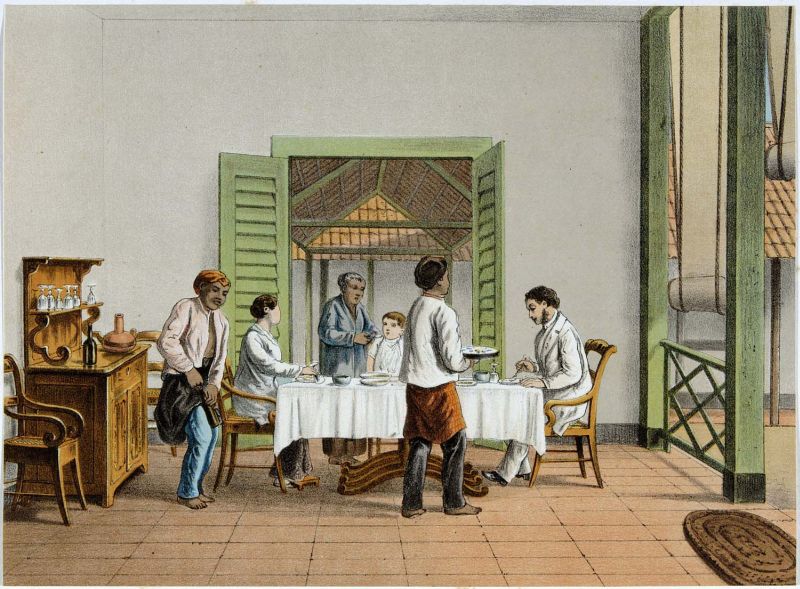
A colonial rijsttafel was staged rather than simply placed on the table. Waitresses in sarongs, or lines of servants, carried the food out on platters. The rice came first, mounded into a cone on a wide dish in the middle of the table. Bowls of meat, vegetables and condiments were then arranged around it, as many as forty of them. Guests reached for whatever they wanted and ate for a long time. A few restaurants in Indonesia still keep the old touch of giving every dish its own waitress.
Today and change
After Indonesia won independence in 1945, the rice table left with people who were moving: former colonials, exiled Indonesians and Indo-Europeans, many of whom settled in the Netherlands. There it stayed largely a meal of Dutch families with colonial roots. Nationalist feeling in Indonesia turned away from what was seen as a colonial custom, and the format faded at home, surviving in a handful of fine-dining rooms, mostly in Jakarta. From about 1990 interest in Southeast Asian food grew, and Indonesian restaurants multiplied in the Netherlands. Garuda Indonesia added a rijsttafel to its Executive Class service in July 2011.
How Rijsttafel is kept
Guests sit down to rice and a spread of small dishes, often laid across more than one table. In the colonial version everything arrived on platters: rice first, heaped into a cone on a central dish, then bowls of meat, fish, vegetables and condiments set around it, sometimes forty or sixty of them. Diners take small portions of whatever they like, mixing flavours and textures, and the meal runs long. Now it is mostly a restaurant and banquet affair, ordered as a set spread for a group.
When and where
Rijsttafel has no fixed festival date. It is a banquet and restaurant meal, served when a host wants to mark an occasion or a group wants to eat widely from Indonesian cooking. In colonial times the showpiece versions were midday meals on Sundays. Garuda Indonesia has offered one in its Executive Class cabin since July 2011.
Its roots lie in Indonesia, where the Padang way of setting out food gave it its shape, but the rice table is now far more common in the Netherlands. It also reached Belgium and South Africa, and other places with a Dutch colonial past such as parts of the West Indies. In Indonesia it survives in a few upscale restaurants, mainly in Jakarta.
What Rijsttafel means
For the Dutch in the East Indies the rice table was a display of reach and plenty: one sitting that gathered cooking from many regions and put the size of the colonial empire on the table. For the families who carried it to the Netherlands it became a familiar, celebratory way to eat, tied to memories of the Indies. For Indonesians it can read differently, as a colonial-era custom their national story set aside. Its meaning now rests with whoever is at the table.
On the table
Flavours: Chilli


Questions people ask about Rijsttafel
When is Rijsttafel kept?
Rijsttafel is kept at banquets and restaurant meals, in colonial days as a midday meal on Sundays.
What is a rijsttafel?
It is a large Indonesian meal built around rice with many small side dishes, often dozens of them, served together so that one sitting holds a wide range of food. The Dutch shaped this form in colonial times from the hidang way of presenting nasi padang.
Where does it come from?
The dishes are Indonesian, but the format is colonial. Dutch colonists in the East Indies adapted it from hidang, the way nasi padang is set out in the Padang region of West Sumatra, and used it to show guests how much cooking their colony held.
Is it still eaten in Indonesia?
Seldom. Most Indonesian meals put rice with only one to three other dishes, so a spread of forty counts as extravagant and costly. A few upscale restaurants, mostly in Jakarta, still serve it in the old ceremonial way. Nasi padang and nasi campur are the closest everyday equivalents.
Why is it called a rice table?
The name is Dutch and means rice table, which describes the layout: rice in the middle and small bowls arranged around it. Where Dutch influence reached, that Dutch name is the one in use rather than an Indonesian term.
See also
 KopitiamA neighbourhood coffee shop where Southeast Asians share meals, drinks and news
 IftarThe sunset meal that breaks the Ramadan fast, eaten with family and community
 KenduriA communal prayer meal and gathering shared across Indonesia, Malaysia and Brunei
 HandshakeA brief clasp of hands to greet, part or seal a deal, with local rules on how it is done
Good reading and sources
- Rijsttafel on WikipediaEncyclopedia
- More photos on Wikimedia CommonsPhotos and video
- Wikidata recordOpen data
The facts on this page come from the Wikipedia article "Rijsttafel", written by its contributors and used under the CC BY-SA 4.0 licence, and from its Wikidata record (CC0). EveryParampara rewrote the text in its own words, with AI assistance, and compares every page with the article to make sure no passage is copied. It may be reused under the same CC BY-SA 4.0 licence with a link back.
It may contain mistakes. Traditions differ from one family, village and community to the next, and the people who keep them know them best. If something is wrong, tell us. Last refreshed 2026-10-05.
More from Indonesia
All the traditions of Indonesia
🇲🇾 Malaysia and 4 moreKopitiam
A neighbourhood coffee shop where Southeast Asians share meals, drinks and newsTable custom · Breakfast
🇮🇷 Mashhad, Iran and 7 moreIftarإفطار
The sunset meal that breaks the Ramadan fast, eaten with family and communityTable custom · Fasting and breaking the fast
 🇮🇩 Bali, IndonesiaTumpengꦠꦸꦩ꧀ꦥꦼꦁ (Javanese); ᬢᬸᬫ᭄ᬧᭂᬂ (Balinese)
A tall cone of rice ringed with side dishes, central to Javanese ceremonies and partiesTable custom · Feasts and festival meals
🇮🇩 Bali, IndonesiaTumpengꦠꦸꦩ꧀ꦥꦼꦁ (Javanese); ᬢᬸᬫ᭄ᬧᭂᬂ (Balinese)
A tall cone of rice ringed with side dishes, central to Javanese ceremonies and partiesTable custom · Feasts and festival meals
 🇧🇩 Dhaka, Bangladesh and 5 moreSuhurسحور
The pre-dawn meal Muslims eat before a day of fasting in RamadanTable custom · Breakfast
🇧🇩 Dhaka, Bangladesh and 5 moreSuhurسحور
The pre-dawn meal Muslims eat before a day of fasting in RamadanTable custom · Breakfast
The same idea elsewhere
Hospitality and welcome compared 🇹🇷 Turkey and 5 moreEid al-Fitrعيد الفطر
The feast that ends Ramadan, opened with morning prayers, sweets and visits homeFestival · Feasts and festival meals
🇧🇩 Bangladesh and 3 moreAs-salamu alaykumسَلَامٌ عَلَيْكُمْ
A traditional Arabic greeting of peace exchanged in daily life and prayerEtiquette
🇹🇷 Turkey and 5 moreEid al-Fitrعيد الفطر
The feast that ends Ramadan, opened with morning prayers, sweets and visits homeFestival · Feasts and festival meals
🇧🇩 Bangladesh and 3 moreAs-salamu alaykumسَلَامٌ عَلَيْكُمْ
A traditional Arabic greeting of peace exchanged in daily life and prayerEtiquette
 🇮🇱 Jerusalem, IsraelSukkotסוכות
A seven-day autumn Jewish festival of temporary booths, harvest prayers and hospitalitySpiritual
🇮🇱 Jerusalem, IsraelSukkotסוכות
A seven-day autumn Jewish festival of temporary booths, harvest prayers and hospitalitySpiritual
 🇮🇱 Jerusalem, Israel and 1 morePurimפּוּרִים
A lively Jewish festival of storytelling, shared food, masks and charityFestival · Feasts and festival meals
🇮🇱 Jerusalem, Israel and 1 morePurimפּוּרִים
A lively Jewish festival of storytelling, shared food, masks and charityFestival · Feasts and festival meals