Customs of food and drinkMiddle EastMuslim
Iftar
In its own language: إفطار
The sunset meal that breaks the Ramadan fast, eaten with family and community

Iftar is the meal that ends a day of fasting in Ramadan, eaten at sunset when the Maghrib call to prayer sounds. Muslims keep it across the world, and it goes back to the Prophet Muhammad, who broke his fast with food and water in the 7th century. Mosques and families gather to share it.
When is Iftar marked?
Iftar is kept as part of Ramadan, which runs from 8 February to 9 March 2027.
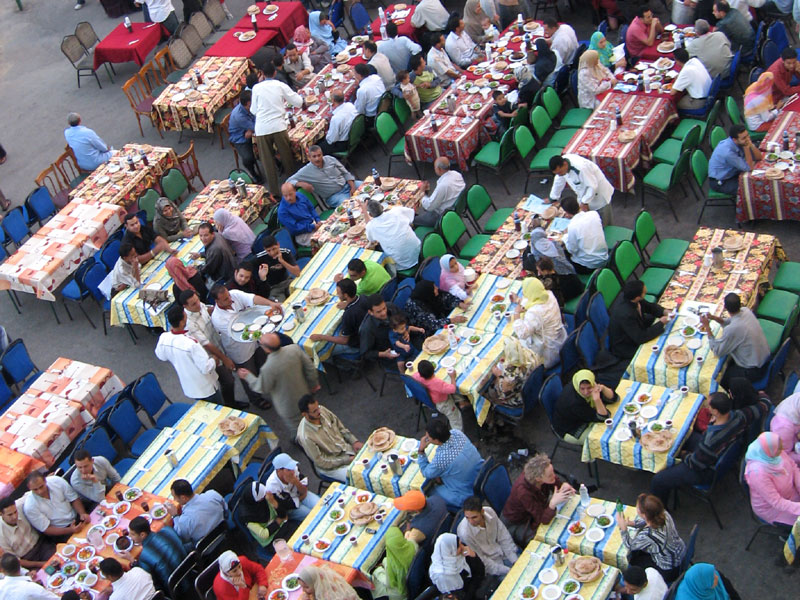
Iftar is the evening meal that ends a day of fasting in Ramadan. Muslims eat it at sunset, when the call to the Maghrib prayer is heard. Families gather, mosques set out long tables, and neighbours share what they have. The fast begins again before dawn, after suhur, the meal taken in the dark. Iftar holds hunger satisfied and gratitude offered together.
What it is
During Ramadan the day turns around two meals. Suhur comes before dawn; from then until sunset nothing is eaten or drunk, and iftar is what ends that stretch. Most tables open with dates and water, a habit taken from the Prophet Muhammad, though nobody is obliged to follow it, and three dates are common. Many people say a short dua as they eat, giving thanks that thirst has passed. Feeding another person at iftar counts as sadaqah, charity, and Muslims believe the Prophet practised it and that it earns great reward.
Origins and history
The custom reaches back to the Prophet Muhammad, who broke his fast in 7th-century Arabia with food and water. Muslims have copied that example ever since. In the Islamic Golden Age, wealthy patrons hosted large meals during Ramadan to encourage charity and to hold the community together, and the practice travelled with Muslim populations into many countries. The shrine of Imam Reza in Mashhad has provided iftar for 332 years, one of the biggest such meals anywhere. In 2023 UNESCO recognised the meal as intangible cultural heritage.
Around the world
Names and customs change with the map. In Brunei the meal is sungkai, taken at a village mosque where residents cook a buffet; a drum called the beduk announces it, and in Bandar Seri Begawan cannons are fired across the business district. Indonesians call it buka puasa, queue at Ramadan food stalls and listen for the same drum. Malaysians say berbuka puasa, buy from street markets called Bazaar Ramadhan, and return after Taraweeh for a light supper, moreh. Maldivians call it roadha villun, and mosques there hand out dates and juice. In Nigeria, Hausa speakers say buda-baki and Yoruba speakers isinu.
Food and drink
What reaches the table depends on the region. Afghans begin with shorwa and steamed dumplings, then rice with carrots and raisins. In Bangladesh fried snacks such as piyaju and beguni are eaten before the sweets, with borhani or sherbet to drink. Indonesians buy kolak, cendol and iced fruit drinks from the streets. Iranians take a small plate first, tea with zulbia, then a full Persian dinner. Haleem fills the tables of Hyderabad, while Kerala and Tamil Nadu serve a rice porridge called nonbu kanji, cooked for hours with meat and vegetables. In Morocco, harira and chebakia are the usual pair.
Today and change
Outside the home, iftar has become a public occasion. Hotels and restaurants in Malaysia and the Maldives sell special iftar packages, and big Pakistani cities advertise iftar deals on restaurant boards. Mosques and charities keep the older side of the custom alive by feeding anyone who turns up, and Indonesian families sometimes invite groups of orphans to eat with them. Muslims hold that providing someone else's iftar brings reward, which is why so much of it is given away. Even in places strained by poverty or conflict, the meal stays a point of thanks and contact.
How Iftar is kept
Preparations may start three hours before sunset, at home and at roadside stalls. When the Maghrib call sounds, in some places after a drum, siren or cannon, the fast ends. Dates and water are taken first, then snacks and drinks, then the larger dishes. Families, neighbours and guests eat together, and mosques or charities set out food for those who come alone. Maghrib prayer follows the first bites, with eating often continuing afterwards. Later many return to the mosque for Isha and Taraweeh, and in Malaysia a light supper, moreh, is served in the grounds.
When and where
Iftar is kept every evening of Ramadan, the ninth month of the Islamic lunar calendar. The fast is closed at sunset, at the time of the Maghrib call to prayer. The daily cycle then begins again before dawn with suhur, so the pattern of fasting by day and eating after dark repeats through the whole month.
It is kept wherever Muslims live: Indonesia, Malaysia, Brunei, Bangladesh, India, Pakistan, Afghanistan, Iran, Turkey, the Maldives, Morocco and Nigeria among many others. Communal meals at mosques are common, and the shrine of Imam Reza in Mashhad seats around 12,000 people each night of Ramadan.
What Iftar means
Iftar closes a day of obedience and opens a shared table. Muslims read the meal as gratitude, reflection and connection: the hunger is real, and so is the company. Feeding someone else is understood as sadaqah, charity, and the Prophet Muhammad is said to have fed others in this way. The table also binds people together, since family, neighbour and stranger eat from the same spread. A short dua at the first dates gives thanks that thirst has gone and the reward is assured.
On the table
Flavours: Chilli


Days Iftar is marked
Questions people ask about Iftar
When is Iftar marked?
Iftar is kept as part of Ramadan, which runs from 8 February to 9 March 2027.
What is iftar?
It is the evening meal that ends a day of fasting in Ramadan. Muslims eat it at sunset, when the Maghrib call to prayer is heard. Dates and water usually come first, then the main dishes, with Maghrib prayer often said before the meal continues.
Do you have to eat three dates?
No. Three dates are the customary opening, following the example of the Prophet Muhammad, but the sources stress that this is not required. Ending the fast with water, or with anything else available, is equally accepted.
Can a visitor join an iftar at a mosque?
In many places, yes. Mosques and Muslim organisations host communal meals that are open to those who come, and in Brunei a village or regional mosque cooks a buffet for everyone attending the evening prayers before sungkai.
Is iftar a big feast or a simple meal?
It varies. Some households take dates, water and soup and little more. Others sit down to a long spread. Pakistan and India tend to serve a heavy meal, while in Iran only a small selection is eaten first, with a full Persian dinner later.
See also
 SamovarA heated urn that brews tea for a slow, sociable pour, from Russia to Iran and Kashmir
 KopitiamA neighbourhood coffee shop where Southeast Asians share meals, drinks and news
 Caffè sospesoAn anonymous gift of a paid cup of coffee for a stranger in need
 Armudu tea glassA pear-shaped glass used in Azerbaijan to serve and drink black tea.
Good reading and sources
- Encyclopaedia BritannicaArticle
- Iftar/Eftari/Iftar/Iftor and its socio-cultural traditionsUNESCO, Heritage listing
- 5 questions everyone asks about RamadanAl Jazeera, Article
- Chawkbazar: The original iftar market in DhakaThe Daily Star, Article
- Iftar/Eftari/Iftar/Iftor and its socio-cultural traditionsUNESCO, Article
- 5 questions everyone asks about RamadanAl Jazeera, Article
- Chawkbazar: The original iftar market in DhakaThe Daily Star, Article
- Iftar on WikipediaEncyclopedia
- More photos on Wikimedia CommonsPhotos and video
- Wikidata recordOpen data
The facts on this page come from the Wikipedia article "Iftar", written by its contributors and used under the CC BY-SA 4.0 licence, and from its Wikidata record (CC0). EveryParampara rewrote the text in its own words, with AI assistance, and compares every page with the article to make sure no passage is copied. It may be reused under the same CC BY-SA 4.0 licence with a link back.
It may contain mistakes. Traditions differ from one family, village and community to the next, and the people who keep them know them best. If something is wrong, tell us. Last refreshed 2026-10-05.
More from Iran
All the traditions of Iran
🇷🇺 Tula, Russia and 3 moreSamovarсамовар
A heated urn that brews tea for a slow, sociable pour, from Russia to Iran and KashmirTable custom · Tea, coffee and drinking ceremonies
 🇮🇷 Ashtian, Iran and 5 moreSamanuسمنو
A sweet sprouted-wheat paste stirred through the night for NowruzTable custom · Sweets given and shared
🇮🇷 Ashtian, Iran and 5 moreSamanuسمنو
A sweet sprouted-wheat paste stirred through the night for NowruzTable custom · Sweets given and shared
 🇮🇱 Jerusalem, Israel and 1 morePurimפּוּרִים
A lively Jewish festival of storytelling, shared food, masks and charityFestival · Feasts and festival meals
🇮🇱 Jerusalem, Israel and 1 morePurimפּוּרִים
A lively Jewish festival of storytelling, shared food, masks and charityFestival · Feasts and festival meals
 🇮🇱 Jerusalem, Israel and 5 moreTisha B'Avתשעה באב
A solemn fast day in July or August to mourn the destruction of the Jerusalem Temples and other Jewish tragedies.Spiritual · Fasting and breaking the fast
🇮🇱 Jerusalem, Israel and 5 moreTisha B'Avתשעה באב
A solemn fast day in July or August to mourn the destruction of the Jerusalem Temples and other Jewish tragedies.Spiritual · Fasting and breaking the fast
The same idea elsewhere
Fasting and feasting compared 🇧🇪 Belgium and 5 moreSaint Nicholas Day
The feast day of Saint Nicholas, kept in Advent with gifts, shoes and church servicesSpiritual
🇧🇪 Belgium and 5 moreSaint Nicholas Day
The feast day of Saint Nicholas, kept in Advent with gifts, shoes and church servicesSpiritual
 🇷🇸 SerbiaSlavaСлава
An annual Serbian family feast honouring their patron saint with blessed bread and wineSpiritual · Feasts and festival meals
🇷🇸 SerbiaSlavaСлава
An annual Serbian family feast honouring their patron saint with blessed bread and wineSpiritual · Feasts and festival meals
 🇲🇦 Morocco and 4 moreMimounaמִימוּנָה
A Maghrebi Jewish celebration marking the end of Passover with sweets and open doorsFestival · Dinner
🇲🇦 Morocco and 4 moreMimounaמִימוּנָה
A Maghrebi Jewish celebration marking the end of Passover with sweets and open doorsFestival · Dinner
 🇮🇩 Indonesia and 4 moreLebaranHari Raya Lebaran
Indonesia's festive season of homecoming, seeking forgiveness and shared feastsFestival · Breakfast
🇮🇩 Indonesia and 4 moreLebaranHari Raya Lebaran
Indonesia's festive season of homecoming, seeking forgiveness and shared feastsFestival · Breakfast