Spiritual and religiousSouth AsiaHindu
Sanjhi
Autumn devotion honoring a mother goddess and sacred floor art of Radha and Krishna
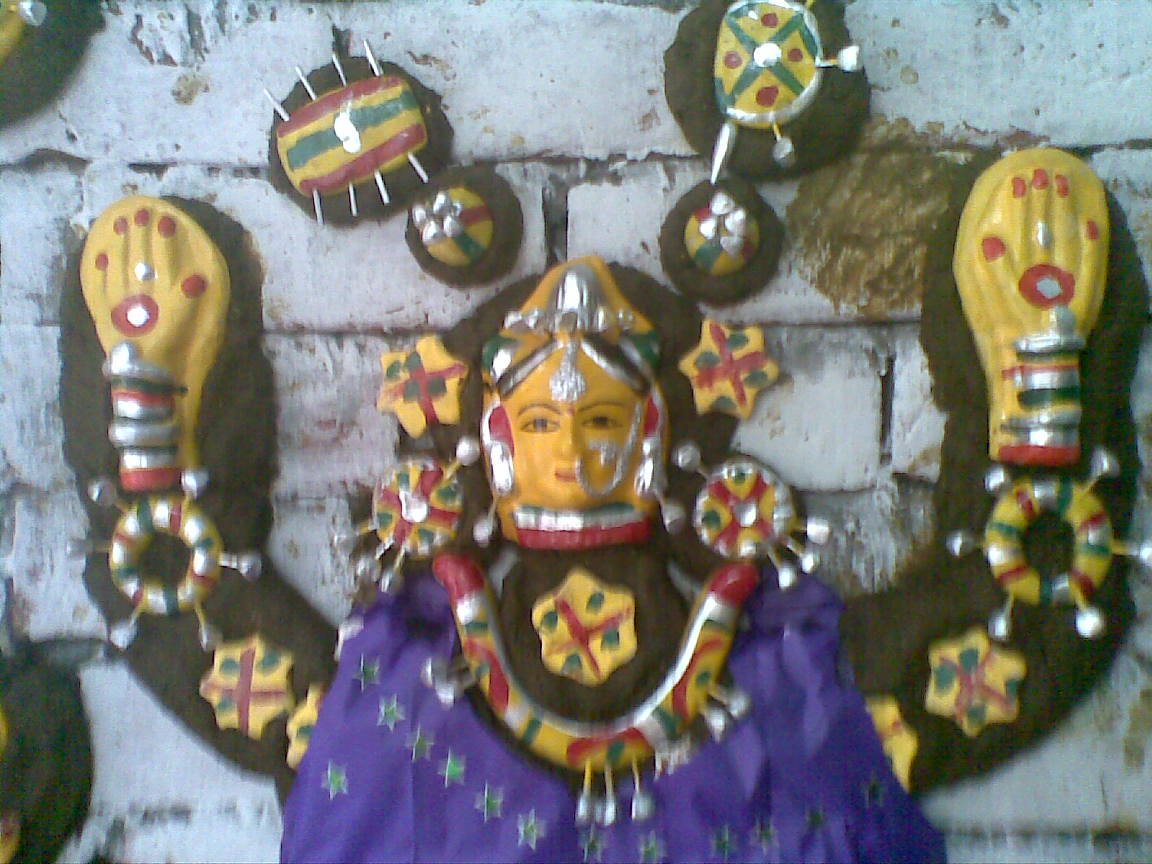
Sanjhi is an Indian devotional observance held during Navratri by women and girls, who craft clay images of a mother goddess on domestic walls. In Vraja temples, priests create intricate geometric powder designs that celebrate Radha and Krishna before immersing festival images on Dussehra.
When is Sanjhi marked?
Sanjhi is kept as part of Navratri, which runs from 11 to 19 October 2026.
Sanjhi is an autumn observance celebrated across northern India during the nine days of Navratri. Households prepare clay images of the mother goddess on their walls, gathering to sing hymns and seek blessings for marriage or personal wishes. Alongside domestic rituals, a related temple tradition in the Vraja region uses colorful dry powders to form intricate sacred patterns celebrating the divine play of Radha and Krishna.
Creating the domestic image
Householders shape the goddess on home walls using mud, forming her face along with celestial motifs. They paint these figures with varied shades. Neighborhood potters provide clay body components such as limbs and faces adorned with jewellery and weaponry. How elaborate these decorative elements are depends on a family's financial resources. The installation takes place at the start of Navratri, serving as a focal point for household prayer and wish-making.
Rituals and neighborhood gatherings
Throughout the nine festival days, women gather daily to chant devotional songs and perform ritual light offerings, usually guided by an elder woman. Unmarried girls join the circle to seek the deity's favor in finding good husbands, presenting food and prayers each day. Men often participate in the rituals after completing their daily work. Families use the occasion to petition for fulfilled wishes, known as mannat. On Dussehra, after singing kirtan, participants carry the clay image to water for its final ritual immersion.
Sacred art of Vraja
In the Vraja region, the practice took a distinct theological form centered on Radha and Krishna. Vaishnava tradition relates that Radha first made these images to summon Krishna, while folk accounts describe Krishna crafting a twilight flower portrait to comfort Radha. Although village customs historically relied on cow dung and blossoms, Vaishnava temples adopted the craft during the fifteenth and sixteenth centuries. Trained Brahman priests create intricate diagrams using dry pigments over an eight-sided mud base that represents a lotus. At the center lies the seat of the divine pair, surrounded by intersecting lines spreading across eight directions. Chanting sacred songs before this floor art forms the core of temple devotion.
How Sanjhi is kept
On the opening day of Navratri, families mold mud into images of the mother goddess upon household walls, adding clay limbs and ornaments made by potters. Each evening, neighbourhood women assemble to sing devotional hymns and perform aarti guided by an older woman. Young girls offer daily food and prayers, while men may join after finishing work. On Dussehra, kirtan is sung and the goddess image is submerged in water.
When and where
The observance begins on the opening day of the nine-day Navratri festival, also known as Durga Puja. Daily prayers continue throughout this period until the festival concludes with ritual immersion on the day of Dussehra.
Domestic celebrations take place across northern India, including homes in Delhi, Haryana, Punjab, and Uttar Pradesh. A specialised temple art tradition is also practiced in the sacred region of Vraja.
What Sanjhi means
Crafting the domestic image lets families seek fulfilled prayers, termed mannat, and ask for auspicious marriages for their daughters. In the temple setting, the art reflects the divine love of Radha and Krishna, with the eight-sided lotus base representing divinity radiating from the center outward to all cardinal directions.


Days Sanjhi is marked
Questions people ask about Sanjhi
When is Sanjhi marked?
Sanjhi is kept as part of Navratri, which runs from 11 to 19 October 2026.
What is Sanjhi?
It is a devotional observance where families mold clay icons of a mother goddess on walls and sing daily hymns, alongside a temple tradition of geometric powder art dedicated to Radha and Krishna.
Where is Sanjhi practiced?
Domestic customs are kept across northern India, including Punjab, Haryana, Delhi, and Uttar Pradesh. The temple art form is centered in the Vraja area.
Why do young girls take part in the rituals?
Young girls present daily prayers and food offerings to the mother goddess, asking for her blessings in finding suitable husbands and securing good marriages.
See also
 Rama NavamiA Hindu spring festival marking the birth of Rama with prayer, fasting and processions
 LohriA northern Indian midwinter festival of evening bonfires, folk songs and harvest foods
 GangaurA North Indian spring festival honouring Shiva and Gauri with clay idols and processionsSitalsasthiA festival in western Odisha re-enacting the divine wedding of Shiva and Parvati
Good reading and sources
- Artist couple from UP bring Sanchi art to UdupiDeccan Herald, Article
- Artist couple from UP bring Sanchi art to UdupiDeccan Herald, Article
The facts on this page come from the Wikipedia article "Sanjhi", written by its contributors and used under the CC BY-SA 4.0 licence, and from its Wikidata record (CC0). EveryParampara rewrote the text in its own words, with AI assistance, and compares every page with the article to make sure no passage is copied. It may be reused under the same CC BY-SA 4.0 licence with a link back.
It may contain mistakes. Traditions differ from one family, village and community to the next, and the people who keep them know them best. If something is wrong, tell us. Last refreshed 2026-10-04.
More from India
All the traditions of India 🇮🇳 India and 1 moreAkhand Pathਅਖੰਡ ਪਾਠ
The unbroken, continuous reading of the entire Sikh scripture over two daysSpiritual
🇮🇳 India and 1 moreAkhand Pathਅਖੰਡ ਪਾਠ
The unbroken, continuous reading of the entire Sikh scripture over two daysSpiritual
 🇮🇳 IndiaTulasi Vivahaतुलसी विवाह (Tulasī Vivāha)
A ritual wedding of the tulasi plant to Vishnu, kept in homes and temples across IndiaSpiritual
🇮🇳 IndiaTulasi Vivahaतुलसी विवाह (Tulasī Vivāha)
A ritual wedding of the tulasi plant to Vishnu, kept in homes and temples across IndiaSpiritual
 🇮🇳 Kanchipuram, IndiaPanguni UthiramPaṅkuṉi Uttiram
A Tamil Hindu festival celebrating divine weddings and the virtues of married lifeSpiritual
🇮🇳 Kanchipuram, IndiaPanguni UthiramPaṅkuṉi Uttiram
A Tamil Hindu festival celebrating divine weddings and the virtues of married lifeSpiritual
 🇮🇱 Safed, Israel and 5 moreHakafotהַקָּפוֹת
Circling the synagogue platform with the Torah scrolls, at Sukkot and Simchat TorahSpiritual
🇮🇱 Safed, Israel and 5 moreHakafotהַקָּפוֹת
Circling the synagogue platform with the Torah scrolls, at Sukkot and Simchat TorahSpiritual
The same idea elsewhere
Weddings compared 🇼🇸 Samoa and 1 moreʻIe tōga
Precious woven mats exchanged in Samoan ceremonies to honor family ties and chiefly status.Dress
🇼🇸 Samoa and 1 moreʻIe tōga
Precious woven mats exchanged in Samoan ceremonies to honor family ties and chiefly status.Dress
 🇮🇩 Indonesia and 2 moreKenduri
A communal prayer meal and gathering shared across Indonesia, Malaysia and BruneiSpiritual · Feasts and festival meals
🇮🇩 Indonesia and 2 moreKenduri
A communal prayer meal and gathering shared across Indonesia, Malaysia and BruneiSpiritual · Feasts and festival meals
 🇹🇱 Timor-LesteUma Lulik
Sacred ancestral clan houses and ritual shrines in East TimorSpiritual
🇺🇬 UgandaKwanjula
A formal marriage introduction ritual of the Baganda people in Uganda, where families meet to exchange gifts and seek blRite of passage
🇹🇱 Timor-LesteUma Lulik
Sacred ancestral clan houses and ritual shrines in East TimorSpiritual
🇺🇬 UgandaKwanjula
A formal marriage introduction ritual of the Baganda people in Uganda, where families meet to exchange gifts and seek blRite of passage