Spiritual and religiousSouth AsiaHindu
Tulasi Vivaha
In its own language: तुलसी विवाह (Tulasī Vivāha)
A ritual wedding of the tulasi plant to Vishnu, kept in homes and temples across India

Hindus stage a symbolic wedding for the tulasi plant, seen as Lakshmi, and a stone or amla branch that stands for Vishnu. It is kept in India between Prabodhini Ekadashi and the full moon in Kartika, and it marks the close of the rains and the start of the wedding season.
When is Tulasi Vivaha kept?
Tulasi Vivaha is kept on one day between Prabodhini Ekadashi and the Kartika full moon, usually in October or November.
Every year, in homes and temples across India, a tulasi plant is married to Vishnu. The plant is dressed as a bride called Lakshmi; the groom is a shaligrama stone or a branch of amla. The ceremony closes the rainy season and opens the months when Hindu families hold weddings. Its date shifts by region, falling somewhere between Prabodhini Ekadashi and the Kartika full moon.
What it is
Tulasi Vivaha is a Hindu rite in which a tulasi plant, the sacred basil grown in courtyards, is wedded to Vishnu. The plant stands for Lakshmi, his consort. For the groom, families use a shaligrama stone, a fossil ammonite held sacred, or a branch of the amla tree. Where no stone is used, a household may keep a metal figure or printed portrait of Vishnu, Krishna or Balarama. The union is a ritual one, performed with the steps of a human wedding. It carries two meanings at once: a divine marriage and a point in the year, since it closes the monsoon and opens the season for marriages.
Tales of Vrinda
The Skanda, Padma and Shiva Puranas tell of Vrinda, faithful wife of the asura Jalandhara. Her devotion made him unbeatable, even by the gods. Hearing of Parvati's beauty, Jalandhara demanded that Shiva surrender her, and war followed. Parvati prayed that Vrinda be deceived as she had been. Vishnu came in the form of Vrinda's husband and broke her chastity, and only then could Shiva defeat Jalandhara. Vrinda cursed Vishnu that he too would be parted from his wife, then took her own life. In one version she is reborn as the tulasi plant and becomes a goddess.
Other tellings
Not every account agrees. A minor legend says Lakshmi killed a demon on this day and stayed on earth as the tulasi plant. A Vaishnava telling links Tulasi to the churning of the cosmic ocean: when Dhanvantari rose holding amrita, the elixir of immortality, Vishnu wept for joy, and the first tear fell into the amrita and became Tulasi, whom he married. Another story says Vishnu had promised Vrinda he would wed her in her next life, and did so on Prabodhini Ekadashi; the rite remembers that marriage. The Puranas add that Dhatri, Malati and Tulasi grew from seeds and went with Vishnu to Vaikuntha.
The ceremony at home
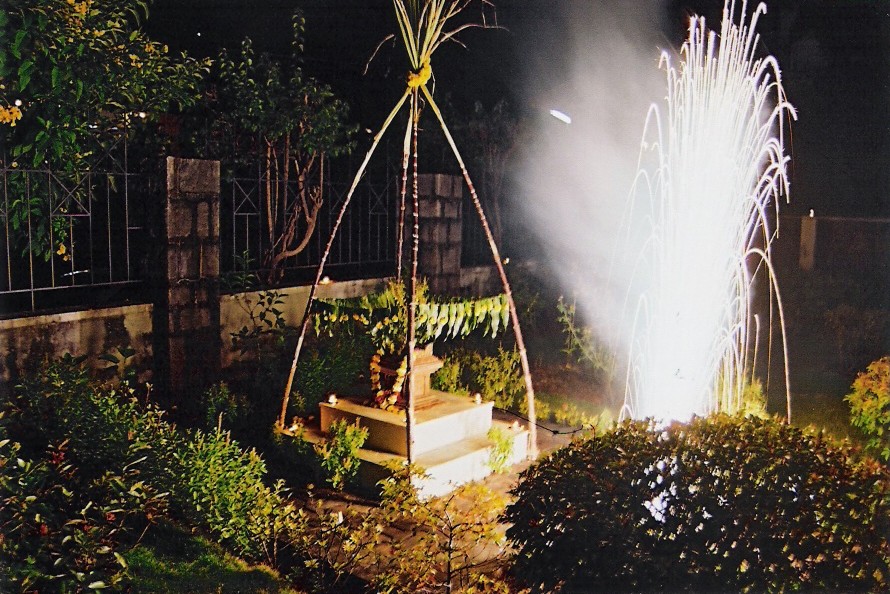
The setting matters as much as the words. Where a tulasi grows in the middle of a courtyard, a canopy is raised around it; the plant usually stands in a brick planter known as a Tulasi Vrindavana. The bride is bathed and dressed in a sari with earrings and necklaces, and a paper face with a bindi and nose ring is sometimes fixed on. The groom's image is bathed and wrapped in a dhoti, and both are then garlanded. A cotton thread binds them. Many people hold that Vrinda's spirit rests in the plant overnight and departs at dawn.
Across the regions
Practices differ from state to state. At Prabhu Dham near Saunja in Bihar the whole village joins in over three days, beginning with recitation of the Ramcharitmanas or Ramayana; the second day brings a Sobha Yatra with Pongal as the special prasad, and 56 kinds of offering, Chapan Bhog, are shared on the third. In Maharashtra the priest recites the Mangal Ashtaka mantras while a cloth separates the pair, and women carry out most of the rite. Two Rama temples in Saurashtra, Gujarat, send an invitation and hold a procession of Lalji. Telugu families use an amla branch placed among the tulasi.
How Tulasi Vivaha is kept
Families and temples set up a wedding booth, often in the courtyard where the tulasi grows in a brick planter. Many keep a fast until the evening, when the rites begin. The plant is bathed, given a sari and jewellery, and sometimes a paper face with a bindi and nose ring. The image of the groom is bathed and dressed too. Garlands and flowers decorate both. A cotton thread ties the pair together. In Maharashtra a cloth is held between them while mantras are chanted, then rice and vermilion are thrown and the guests clap.
When and where
The wedding happens on one day between Prabodhini Ekadashi, the eleventh or twelfth day of the bright half of Kartika, and Kartika Purnima, when that month's moon is full. Which day is chosen differs from place to place. In Andhra Pradesh and Telangana it is usually the twelfth day of the waxing moon, called Utthana Dwadashi.
It is kept throughout India, at household shrines and in temples. Bihar's Prabhu Dham at Saunja draws devotees, saints and mahants for a celebration shared by the whole village. Maharashtra has its own form of the rite, performed largely by women. Two Rama temples in Saurashtra, Gujarat, stage an elaborate version with a procession. Telugu families in Andhra Pradesh and Telangana keep it as Tulasi Kalyāṇam.
What Tulasi Vivaha means
For those who keep it, the wedding joins the goddess Lakshmi to Vishnu in the form of a plant and a stone. The ceremony also marks a turn in the year: the rains are over and the season for marriages begins. Couples without daughters sometimes sponsor the rite and act as the bride's parents, since giving Tulasi away is held to bring merit.


Questions people ask about Tulasi Vivaha
When is Tulasi Vivaha kept?
Tulasi Vivaha is kept on one day between Prabodhini Ekadashi and the Kartika full moon, usually in October or November.
What is Tulasi Vivaha?
It is a Hindu rite in which the tulasi plant, seen as Lakshmi, is married to Vishnu in a symbolic ceremony. The groom is represented by a shaligrama stone or an amla branch. Families and temples carry it out much like a human wedding.
Where is it kept?
It is kept across India, at household shrines and in temples. Bihar, Maharashtra, Gujarat, Andhra Pradesh and Telangana each have their own way of holding it, from a village-wide festival to a small rite performed at home.
Why is the tulasi plant married?
The Puranas tell how Vrinda, a faithful wife wronged by Vishnu, was reborn as the tulasi plant, and how Vishnu promised to marry her in that life. The wedding joins the plant, as Lakshmi, to Vishnu and opens the marriage season.
Do people fast on the day?
Yes. In the usual account the fast is kept through the day, and the ceremony begins in the evening. Sweets and dishes of the kind cooked for a real wedding are prepared, and prasad is shared afterwards.
See also
 Akhand PathThe unbroken, continuous reading of the entire Sikh scripture over two days
 Panguni UthiramA Tamil Hindu festival celebrating divine weddings and the virtues of married life
 SanjhiAutumn devotion honoring a mother goddess and sacred floor art of Radha and Krishna
 IkatA resist-dyeing craft from Southeast Asia, where yarns are tied and dyed before weaving
Good reading and sources
The facts on this page come from the Wikipedia article "Tulasi Vivaha", written by its contributors and used under the CC BY-SA 4.0 licence, and from its Wikidata record (CC0). EveryParampara rewrote the text in its own words, with AI assistance, and compares every page with the article to make sure no passage is copied. It may be reused under the same CC BY-SA 4.0 licence with a link back.
It may contain mistakes. Traditions differ from one family, village and community to the next, and the people who keep them know them best. If something is wrong, tell us. Last refreshed 2026-10-05.
More from India
All the traditions of India
🇮🇳 India and 1 moreAkhand Pathਅਖੰਡ ਪਾਠ
The unbroken, continuous reading of the entire Sikh scripture over two daysSpiritual
🇮🇳 Kanchipuram, IndiaPanguni UthiramPaṅkuṉi Uttiram
A Tamil Hindu festival celebrating divine weddings and the virtues of married lifeSpiritual
🇮🇳 IndiaSanjhi
Autumn devotion honoring a mother goddess and sacred floor art of Radha and KrishnaSpiritual
 🇮🇱 Safed, Israel and 5 moreHakafotהַקָּפוֹת
Circling the synagogue platform with the Torah scrolls, at Sukkot and Simchat TorahSpiritual
🇮🇱 Safed, Israel and 5 moreHakafotהַקָּפוֹת
Circling the synagogue platform with the Torah scrolls, at Sukkot and Simchat TorahSpiritual
The same idea elsewhere
Weddings compared 🇼🇸 Samoa and 1 moreʻIe tōga
Precious woven mats exchanged in Samoan ceremonies to honor family ties and chiefly status.Dress
🇼🇸 Samoa and 1 moreʻIe tōga
Precious woven mats exchanged in Samoan ceremonies to honor family ties and chiefly status.Dress
 🇮🇩 Indonesia and 2 moreKenduri
A communal prayer meal and gathering shared across Indonesia, Malaysia and BruneiSpiritual · Feasts and festival meals
🇮🇩 Indonesia and 2 moreKenduri
A communal prayer meal and gathering shared across Indonesia, Malaysia and BruneiSpiritual · Feasts and festival meals
 🇹🇱 Timor-LesteUma Lulik
Sacred ancestral clan houses and ritual shrines in East TimorSpiritual
🇺🇬 UgandaKwanjula
A formal marriage introduction ritual of the Baganda people in Uganda, where families meet to exchange gifts and seek blRite of passage
🇹🇱 Timor-LesteUma Lulik
Sacred ancestral clan houses and ritual shrines in East TimorSpiritual
🇺🇬 UgandaKwanjula
A formal marriage introduction ritual of the Baganda people in Uganda, where families meet to exchange gifts and seek blRite of passage