Games, sport and playSouth Asia
Shandur Polo Festival
In its own language: شندور چوگان میلہ
A three-day mountain polo competition played with freestyle rules in northern Pakistan
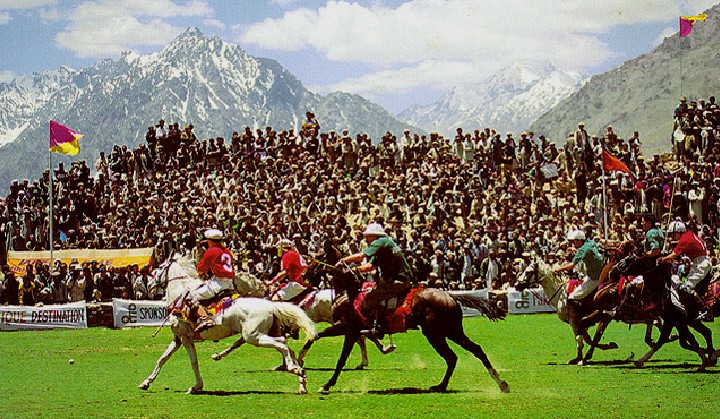
Shandur Polo Festival is an annual sporting contest held high in the mountains of northern Pakistan. Riders representing Chitral and Gilgit-Baltistan meet each July to play freestyle polo on a rocky, high-altitude field, accompanied by traditional folk tunes, regional dancing and an open-air tent village.
When is Shandur Polo Festival kept?
Shandur Polo Festival is kept on annually over three days in early July.
The Shandur Polo Festival brings together horsemen from Chitral and Gilgit-Baltistan for three days of spirited competition in northern Pakistan. Staged at an altitude of 3,700 metres, this annual event features fast-paced, freestyle matches with minimal gear and no referee intervention. Local supporters travel to the high mountain pass to cheer their district sides, camp in canvas tents, and enjoy regional folk music and dancing between matches.
The freestyle contest
Polo here follows loose, traditional guidelines rather than modern international standards. Matches pit six horseback riders against another six, with several substitutes ready for replacements. A match runs for sixty minutes, broken into two thirty-minute periods with a brief ten-minute rest between halves. The field is bordered by low stone ridges instead of wooden rails, creating a tight playing area that tests horsemanship. Riders rarely wear protective headgear, and horses play without leg wrappings. The side that strikes the ball into the goal the most times wins the contest, culminating in a final championship match on the third day.
Selection and tournament format
Preparation begins weeks earlier in the valleys of Chitral and Gilgit. Local panels hold trial fixtures to assess the agility of the horses and the skill of the riders before picking the final squads. Both districts enter multiple tiers of teams, labelled from A to D, ensuring that several levels of competitors get onto the pitch. The tiered structure creates a full schedule of games leading up to the main trophy face-off. During the mid-match pauses, local performers take to the ground, entertaining the seated crowds with regional folk dance and traditional instrumentation.
Founding and local history
Colonel Evelyn Hey Cobb initiated the mountain polo contest in 1930. According to local accounts, Cobb wanted to compensate a helpful local figure named Kakakhail, who turned down personal wealth and requested that nearby rivers receive fish instead. Cobb arranged for live trout to be brought from Britain and released into the Ghizer River. That decision led to the creation of a regional fisheries department. Today, the festival is backed by the authorities of Khyber Pakhtunkhwa and Gilgit-Baltistan along with the Frontier Corps, sustaining a sporting tradition rooted in historical cavalry exercises.
How Shandur Polo Festival is kept
Supporters and riders gather on the high plateau where a temporary tent camp is pitched for several days. Juries select the finest players from Gilgit and Chitral across four team tiers. Matches take place across three consecutive days, with six riders per side competing on the stone-edged turf. During half-time breaks, folk musicians play and dancers perform for the spectators. The team with the highest goal tally takes the match, building towards the deciding championship game on the final afternoon.
When and where
The festival takes place every year during the second week of July, starting on 7 July and ending with the final match on 9 July.
Matches are held on the Shandur plateau, perched at 3,700 metres in the Golaghmuli Valley along the border between Chitral District and Gupis-Yasin District in northern Pakistan.
Questions people ask about Shandur Polo Festival
When is Shandur Polo Festival kept?
Shandur Polo Festival is kept on annually over three days in early July.
What is the Shandur Polo Festival?
It is a three-day sporting event in northern Pakistan where equestrian teams from Chitral and Gilgit-Baltistan play freestyle polo on a mountain plateau.
Where and when does the festival take place?
The games happen annually from 7 July to 9 July at the Shandur pitch, situated at an altitude of 3,700 metres along the border of Chitral and Gupis-Yasin.
How do the rules differ from standard polo?
Matches are played under freestyle rules without formal referees, using low stone boundary walls. Riders often skip helmets, and horses run without protective leg wraps.
Who organises and funds the event?
The event is jointly managed and funded by the regional administrations of Khyber Pakhtunkhwa and Gilgit-Baltistan, with assistance provided by the Frontier Corps.
See also
 NowruzThe Iranian new year at the March equinox, kept with fire, greenery and picnics
 HoliA spring festival of colours and bonfires that marks the end of winter and the triumph of good over evil.
 Maha ShivaratriA Hindu night of fasting and vigil dedicated to Shiva, marking his divine union with Parvati.
 Raksha BandhanA Hindu festival where sisters tie a protective thread on their brothers' wrists to mark their bond.
Good reading and sources
- GILGIT: Scouts accused of expanding encroachmentsDawn, Article
- GILGIT: Scouts accused of expanding encroachmentsDawn, Article
- Shandur Polo Festival on WikipediaEncyclopedia
- More photos on Wikimedia CommonsPhotos and video
- Wikidata recordOpen data
The facts on this page come from the Wikipedia article "Shandur Polo Festival", written by its contributors and used under the CC BY-SA 4.0 licence, and from its Wikidata record (CC0). EveryParampara rewrote the text in its own words, with AI assistance, and compares every page with the article to make sure no passage is copied. It may be reused under the same CC BY-SA 4.0 licence with a link back.
It may contain mistakes. Traditions differ from one family, village and community to the next, and the people who keep them know them best. If something is wrong, tell us. Last refreshed 2026-10-04.
More from Pakistan
All the traditions of Pakistan 🇮🇳 India and 2 morePehlwani
A traditional discipline of clay-pit wrestling across the Indian subcontinent.Game
🇮🇷 Iran and 7 moreNowruzنوروز
The Iranian new year at the March equinox, kept with fire, greenery and picnicsSeasonal
🇮🇳 Mathura, India and 5 moreHoliहोली (Hindi)
A spring festival of colours and bonfires that marks the end of winter and the triumph of good over evil.Festival
🇮🇳 India and 2 morePehlwani
A traditional discipline of clay-pit wrestling across the Indian subcontinent.Game
🇮🇷 Iran and 7 moreNowruzنوروز
The Iranian new year at the March equinox, kept with fire, greenery and picnicsSeasonal
🇮🇳 Mathura, India and 5 moreHoliहोली (Hindi)
A spring festival of colours and bonfires that marks the end of winter and the triumph of good over evil.Festival
 🇨🇳 China and 5 morePostpartum confinement
A period of rest, nourishment, and seclusion for mothers after giving birth.Rite of passage
🇨🇳 China and 5 morePostpartum confinement
A period of rest, nourishment, and seclusion for mothers after giving birth.Rite of passage
The same idea elsewhere
All of this kind 🇺🇸 Fairbanks, United States and 2 moreWorld Eskimo-Indian Olympics
An annual Arctic gathering of traditional survival games, athletics, and cultural artsGame
🇺🇸 Fairbanks, United States and 2 moreWorld Eskimo-Indian Olympics
An annual Arctic gathering of traditional survival games, athletics, and cultural artsGame
 🇨🇭 Aproz, Switzerland and 2 moreCombat de Reines
An annual Swiss pushing contest where Hérens cows compete for herd dominanceGame
🇨🇭 Aproz, Switzerland and 2 moreCombat de Reines
An annual Swiss pushing contest where Hérens cows compete for herd dominanceGame
 🇲🇽 MexicoRarájipari
A traditional endurance running ball game of the Rarámuri people in northern MexicoGame
🇲🇽 MexicoRarájipari
A traditional endurance running ball game of the Rarámuri people in northern MexicoGame
 🇸🇪 Mora, SwedenVasaloppet
A 90 km cross-country ski race from Sälen to Mora, run every March since 1922Game
🇸🇪 Mora, SwedenVasaloppet
A 90 km cross-country ski race from Sälen to Mora, run every March since 1922Game