Spiritual and religiousMiddle EastJewish
Shofar
In its own language: שׁוֹפָר
A ram's horn blown in synagogue to mark the Jewish new year and the end of Yom Kippur
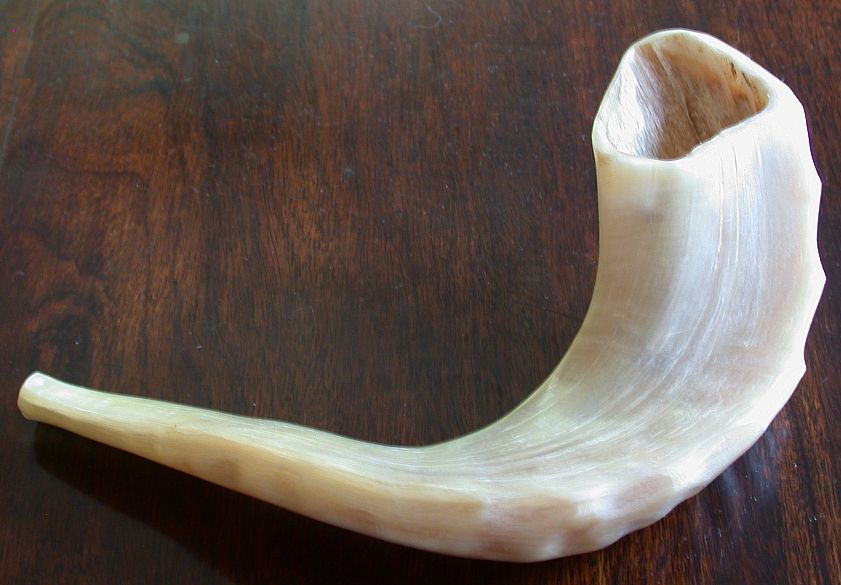
The shofar is a horn, usually from a ram, kept for Jewish ritual. It is blown in the synagogue on Rosh Hashanah and again at the close of Yom Kippur, and on weekday mornings during Elul, the month before the new year.
When is Shofar marked?
Shofar is kept as part of Rosh Hashanah, which runs from 2 to 3 October 2027.
The shofar is a horn, most often a ram's, sounded in Jewish worship. Its blasts open the new year at Rosh Hashanah and close the long fast of Yom Kippur, and they sound each weekday morning through Elul, the month of preparation before. There are no keys or valves: the player's lips shape every note. To hear it, Jewish law teaches, is to carry out a commandment.
What the shofar is
The shofar is an old horn instrument kept for Jewish religious use. Most are made from a ram's horn, though the tradition allows other animals as well. It has no keys, slides or valves, so the player shapes every note with the lips and the breath, and the sound sits closer to a bugle than to a flute. No two are alike in size or shape, because the animal chosen and the amount of finishing work both vary. Sephardi horns often carry a carved mouthpiece like a small trumpet's, while Ashkenazi ones do not. Jewish law treats the shofar as an object used to carry out a commandment, not as something holy in itself.
Bible and temple
The Hebrew Bible, the Talmud and later rabbinic writers all mention it. At Mount Sinai, the book of Exodus says, a blast came out of the thick cloud and made the Israelites tremble. The horn announced the start of a month and of the Jubilee, the fiftieth year. It signalled war, went with processions, and David brought it into the temple orchestra. Joshua's soldiers blew horns around Jericho, and troops heard the call from a hilltop before battle. The trumpets of Numbers 10 are a different instrument, the ḥaṣoṣrah. In the Temple at Jerusalem the shofar took the centre on Rosh Hashanah, a trumpet on either side; on fast days the trumpets held the middle.
Sounds and the duty
The duty is to hear the blasts, not to produce them. The Torah mentions blowing in connection with the high holidays three times, and the sages drew from this that three sets are needed. Each complex sound has a plain note before and after it, giving nine in all. Because the exact complex sound was in doubt, three versions were kept, so the day holds series of nine, nine and twelve. On Rosh Hashanah the custom is a hundred or a hundred and one blasts; thirty of them are the core obligation, and most of the rest come during the Mussaf prayer.
Who blows the horn
The sounder is called the ba'al tekiah, the master of the blast, and the role is an honour. Any adult Jewish man the congregation accepts may take it, and he should be learned in Torah and God-fearing. Someone who is not himself obliged cannot discharge the duty for a person who is. Women and children are exempt, because the commandment belongs to a fixed time, but they are encouraged to come and listen. When the blower aims that all who hear will fulfil the commandment, anyone listening with that same intention does fulfil it; standing still is taken as intent to hear.
Horns and making
According to the Talmud any animal of the cattle family may supply a shofar except the cow, and a ram is preferred. The horn is keratin around a bony core, with cartilage inside that can be removed; antler is solid bone and cannot be hollowed, so it is never used. In practice Ashkenazi and Sephardi communities blow a domestic ram's horn, and Jews of Yemen blow the horn of a kudu. Moroccan shofars are flat with one wide bend. No ritual slaughter is needed. One legal work ranks horns: a curved ram first, then other curved kinds, then straight ones, then a non-kosher animal, and a cow's not at all. A crack that spoils the sound disqualifies a shofar, and so does paint or silver plating added for show.
How Shofar is kept
The congregation gathers in the synagogue. The ba'al tekiah, the appointed sounder, lifts the horn and blows the set patterns: a long plain note, then the complex sounds, then the plain note again, repeated in three cycles. Worshippers stand and listen, since hearing is the duty. On Rosh Hashanah this happens about a hundred times through the day, most of them during the Mussaf prayer. Through Elul the horn sounds on weekday mornings to wake people to the coming year, and it is blown once more at the close of Yom Kippur, after the fast ends. On Shabbat it is not blown.
When and where
The shofar belongs to the autumn high holidays. Its main day is Rosh Hashanah, the Jewish new year, which opens the month of Tishrei. It is also heard on weekday mornings throughout Elul, the month before, and at the evening end of Yom Kippur. On Shabbat, including a Shabbat that falls on Rosh Hashanah, it stays silent.
It is kept wherever Jewish communities pray, and its best-known setting is the synagogue. Its early ceremonial use belongs to the Temple in Jerusalem. After the Temple was destroyed, sounding it on Shabbat was limited to wherever the Sanhedrin sat, and it stopped once that body ended. Today the person who blows may stand in any congregation, Ashkenazi, Sephardi, Yemeni or Moroccan.
What Shofar means
Saadia Gaon, a medieval sage, collected reasons for the rite. The blasts, he taught, recall the making of the world, the start of a new year, the revelation at Sinai, the words of the prophets, the loss of the Temple and the binding of Isaac. They stir awe of God and of the day of judgement. They also point to a future gathering of exiles, to redemption and to the rising of the dead.


Days Shofar is marked
Questions people ask about Shofar
When is Shofar marked?
Shofar is kept as part of Rosh Hashanah, which runs from 2 to 3 October 2027.
What is a shofar?
It is a horn, most often a ram's, kept for Jewish ritual and sounded in the synagogue. It has no valves or keys, so the player controls the pitch with the lips. Jewish law counts it as an object used for a commandment rather than as a holy thing in itself.
Who is allowed to blow it?
The sounder is called the ba'al tekiah, and the duty is an honour. Any adult Jewish man whom the congregation accepts may do it, and he is expected to know Torah and to fear God. Women and children are not obliged to hear the blasts but are encouraged to attend.
Why are there so many blasts?
The Torah links blowing with the high holidays three times, so the sages required three sets. Because the exact complex sound was uncertain, three versions were kept, giving series of nine, nine and twelve notes. About a hundred blasts sound on Rosh Hashanah, and thirty are the main obligation.
Does a recording count?
No. A shofar heard from inside a pit or cave counts only when the listener hears the original sound, not the echo. Most modern authorities reason from this that radio or internet sound does not fulfil the commandment, though they advise asking a rabbi in an urgent case.
See also
 Yom KippurThe holiest day in Judaism, dedicated to fasting, prayer and atonement
 Rosh HashanahThe Jewish New Year marked by shofar horn blasts, prayer and sweet foods
 MuharramThe sacred opening month of the Islamic year, observed through remembrance and fasting
 TashlikhA Jewish new year rite of casting sins into flowing water, kept by the waterside
Good reading and sources
- Shofar on WikipediaEncyclopedia
- More photos on Wikimedia CommonsPhotos and video
- Wikidata recordOpen data
The facts on this page come from the Wikipedia article "Shofar", written by its contributors and used under the CC BY-SA 4.0 licence, and from its Wikidata record (CC0). EveryParampara rewrote the text in its own words, with AI assistance, and compares every page with the article to make sure no passage is copied. It may be reused under the same CC BY-SA 4.0 licence with a link back.
It may contain mistakes. Traditions differ from one family, village and community to the next, and the people who keep them know them best. If something is wrong, tell us. Last refreshed 2026-10-05.
More from Israel
All the traditions of Israel
🇮🇱 Jerusalem, IsraelYom Kippurיוֹם כִּפּוּר
The holiest day in Judaism, dedicated to fasting, prayer and atonementSpiritual · Fasting and breaking the fast
🇮🇱 IsraelRosh Hashanahרֹאשׁ הַשָּׁנָה
The Jewish New Year marked by shofar horn blasts, prayer and sweet foodsSpiritual
🇩🇪 Germany and 3 moreTashlikhתשליך
A Jewish new year rite of casting sins into flowing water, kept by the watersideSpiritual
🇮🇱 Israel and 1 moreHigh Holy Daysיָמִים נוֹרָאִים
The Jewish year's ten days of repentance, from Rosh Hashanah to Yom KippurSpiritual
The same idea elsewhere
New Year compared 🇮🇳 Ayodhya, India and 7 moreDiwaliदीपावली (Dīpāvalī)
A five-day festival of lights celebrated across India and its diaspora to mark the victory of light over darkness.Festival · Feasts and festival meals
🇮🇳 Ayodhya, India and 7 moreDiwaliदीपावली (Dīpāvalī)
A five-day festival of lights celebrated across India and its diaspora to mark the victory of light over darkness.Festival · Feasts and festival meals
 🇪🇬 Egypt and 5 moreMawlidمولد (Mawlid)
An annual festival marking the birth of the Prophet Muhammad, marked by poetry, processions and feasts.Festival · Feasts and festival meals
🇪🇬 Egypt and 5 moreMawlidمولد (Mawlid)
An annual festival marking the birth of the Prophet Muhammad, marked by poetry, processions and feasts.Festival · Feasts and festival meals
 🇮🇳 Mathura, India and 5 moreHoliहोली (Hindi)
A spring festival of colours and bonfires that marks the end of winter and the triumph of good over evil.Festival
🇹🇭 ThailandThai solar calendarปฏิทินสุริยคติไทย
The official solar calendar of Thailand, numbered in the Buddhist EraSeasonal
🇮🇳 Mathura, India and 5 moreHoliहोली (Hindi)
A spring festival of colours and bonfires that marks the end of winter and the triumph of good over evil.Festival
🇹🇭 ThailandThai solar calendarปฏิทินสุริยคติไทย
The official solar calendar of Thailand, numbered in the Buddhist EraSeasonal