Games, sport and playEast Asia
Shogi
In its own language: 将棋 (shōgi)
Japan's two-player strategy game, where captured pieces change sides and return

Shogi is a two-player strategy board game from Japan, played on an 81-square board with 20 pieces a side. Captured pieces change hands and can be dropped back into play, a rule unlike chess. It grew from the Indian game chaturanga, reached Japan by way of China or Korea, and has been played in its present form since the 15th century.
Shogi is a board game for two people, played in Japan and known in English as Japanese chess. Forty pieces stand on an eighty-one square board, and each side has twenty. What sets it apart from other chess-like games is that pieces you capture join your own army and can be placed back on the board. Players call it a mind sport, and it is followed closely in Japan.
What it is
Shogi is a strategy game for two players. A board of nine rows and nine columns gives eighty-one squares, and each side begins with twenty flat pieces. There is no colour difference between the two armies: instead the pieces point toward the opponent, so their direction shows who owns them. The Japanese name breaks into two parts, shō, meaning general, and gi, meaning a board game. In English the game is often called Japanese chess. When people say shogi today they usually mean the standard form, hon-shōgi, rather than older varieties such as chu shogi or the newer ones.
Origins and history
The game's earliest ancestor is chaturanga, a board game from India that dates to the sixth century. From there it is thought to have travelled to Japan through China or Korea, at some point after the Nara period. A document from 1210, the Nichūreki, records a related game that had no drop rule. The version played now existed by the fifteenth century. Nobody knows exactly when the drop rule appeared: one suggestion places it in the fifteenth century and ties it to mercenary samurai who changed sides after being taken in battle. Among chess-like games, it is the earliest known to use it.
How a game is played
Before play, each player arranges the pieces in three rows on their own side. The king sits in the middle, with gold and silver generals, knights and lances spread to either edge; the bishop and rook stand on the second row, and nine pawns fill the third. A toss of five pawns decides who moves first, and in a series the players take turns at going first. The aim is to checkmate the opposing king. Most pieces step one square at a time, though the lance, bishop and rook travel any distance along a line. Knights are the only pieces that can leap over others. Players snap a piece down with the fingers when they move it.
Promotion and drops
The far three rows form a promotion zone, marked on the board by pairs of small dots. A piece that moves into, through or within that zone may be turned over, showing a second character on its back. Promotion is usually a choice, but a pawn or lance on the last row, or a knight on either of the last two, has to promote. Captured pieces are not lost. They join the capturing player's reserve and can be dropped back onto the board on a later turn. Dropping is what makes shogi distinctive, and it is not a feature of Western chess.
Pieces and their look
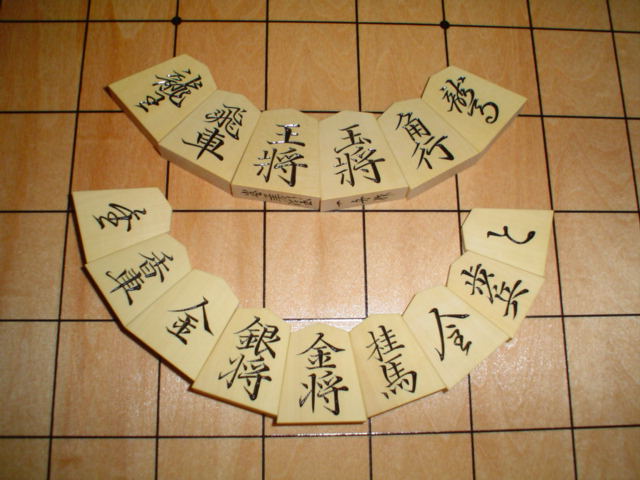
Each piece carries its name in two kanji, usually in black ink. Turn a piece over and one or two more characters appear, often in red in sets made for amateurs, marking it as promoted. The promoted bishop and rook are sometimes called horse and dragon in English, following the Japanese names; a promoted pawn is a tokin. Because the characters can put off newcomers, makers have also produced pieces with chess-style symbols, English captions or letters, drawings of how each piece moves, and even animal cartoons. Many players pick up the characters quickly, helped by the fact that stronger pieces are cut larger.
How Shogi is kept
Two players sit facing each other. The pieces are set out in three rows, and a toss of five pawns settles who begins. Black, as English speakers call the first player, moves one piece, then White replies, and so on. A turn is either a move on the board, which may include a capture or a promotion, or the drop of a piece held in reserve. Captures change hands rather than leaving play. The game ends when one king is checkmated. Pieces are placed with a snap of the fingers, partly so the opponent notices the move.
When and where
There is no fixed season or date. Shogi is played throughout the year, in clubs, at home and in professional matches. A game may take half an hour, or run for two hours or more. When several games are played in one sitting, the players take turns at moving first.
Shogi belongs to Japan, where it is the board game with the widest following and where the professional game is centred. Players outside Japan learn the rules in translation, and pieces with English captions or chess-style symbols have been made for them. Other games in the same family are found across Asia, among them chaturanga in India, xiangqi in China, janggi in Korea, makruk in Thailand and Western chess in Europe.
What Shogi means
For the people who play it, shogi is a mind sport as much as a pastime, and the drop rule gives it a character of its own: nothing taken is ever gone for good, since a captured piece may return to the board on the other side. Players find the game unusually decisive, because drawn results are rare when compared with international chess, and the advantage of moving first matters less than in that game. The snapping of a piece announces a move with care and attention.


Questions people ask about Shogi
What is shogi?
A board game for two people, with eighty-one squares and twenty pieces a side. Each player's pieces point toward the opponent rather than being a different colour. Captured pieces switch sides and can be dropped back into play later. In English it is often called Japanese chess, and in Japanese the name means a general's board game.
When and where is it played?
All year round, and mostly in Japan, where professional matches and clubs keep it going. A single game usually takes between thirty minutes and two hours. Players outside Japan take it up too, using sets with English letters or chess-style symbols. No season or festival is attached to it.
How is shogi different from chess?
Three things stand out. Captured pieces are kept and may be dropped back on the board as your own. Pieces are not coloured; they face the opponent to show ownership, and they promote by turning over. And draws almost never happen, only a few in every hundred professional games, compared with many more in international chess.
Who moves first?
The first player is decided by tossing five pawns before the game. If more of them land promoted side up, the player who tossed takes the second move. English speakers call the two sides Black and White, following chess, even though the pieces are the same colour. In a series, players alternate who starts.
What does the board look like?
A grid of nine rows and nine columns, so eighty-one plain rectangles with no colouring. Two small dots on each side mark the promotion zone, the far three rows. Each side has twenty wedge-shaped pieces in slightly different sizes, from a single king down to nine pawns.
See also
 KendoA Japanese martial art of swordsmanship using bamboo swords and protective armour
 CujuAn ancient Chinese kicking game played without hands using a stuffed or air-filled ball
 KarutaJapanese playing cards from the 16th century, still raced over poems each New Year
 KyūdōThe Japanese martial art of archery, practiced with an asymmetrical longbow
Good reading and sources
- Shogi on WikipediaEncyclopedia
- More photos on Wikimedia CommonsPhotos and video
- Wikidata recordOpen data
The facts on this page come from the Wikipedia article "Shogi", written by its contributors and used under the CC BY-SA 4.0 licence, and from its Wikidata record (CC0). EveryParampara rewrote the text in its own words, with AI assistance, and compares every page with the article to make sure no passage is copied. It may be reused under the same CC BY-SA 4.0 licence with a link back.
It may contain mistakes. Traditions differ from one family, village and community to the next, and the people who keep them know them best. If something is wrong, tell us. Last refreshed 2026-10-05.
More from Japan
All the traditions of Japan
🇨🇳 China and 2 moreCuju蹴鞠
An ancient Chinese kicking game played without hands using a stuffed or air-filled ballGame
🇯🇵 Japan and 2 moreKyūdō弓道
The Japanese martial art of archery, practiced with an asymmetrical longbowGame
🇯🇵 Kyoto, JapanKendo剣道
A Japanese martial art of swordsmanship using bamboo swords and protective armourGame
🇯🇵 Ōmuta, JapanKarutaかるた
Japanese playing cards from the 16th century, still raced over poems each New YearGame
The same idea elsewhere
All of this kind 🇺🇸 Fairbanks, United States and 2 moreWorld Eskimo-Indian Olympics
An annual Arctic gathering of traditional survival games, athletics, and cultural artsGame
🇺🇸 Fairbanks, United States and 2 moreWorld Eskimo-Indian Olympics
An annual Arctic gathering of traditional survival games, athletics, and cultural artsGame
 🇲🇽 MexicoRarájipari
A traditional endurance running ball game of the Rarámuri people in northern MexicoGame
🇲🇽 MexicoRarájipari
A traditional endurance running ball game of the Rarámuri people in northern MexicoGame
 🇨🇭 Aproz, Switzerland and 2 moreCombat de Reines
An annual Swiss pushing contest where Hérens cows compete for herd dominanceGame
🇨🇭 Aproz, Switzerland and 2 moreCombat de Reines
An annual Swiss pushing contest where Hérens cows compete for herd dominanceGame
 🇸🇪 Mora, SwedenVasaloppet
A 90 km cross-country ski race from Sälen to Mora, run every March since 1922Game
🇸🇪 Mora, SwedenVasaloppet
A 90 km cross-country ski race from Sälen to Mora, run every March since 1922Game