Spiritual and religiousMiddle EastJewish
Simchat Torah
In its own language: שִׂמְחַת תּוֹרָה
The day Jewish communities finish the Torah reading and start it again, with dancing

A Jewish holiday marking the end of the yearly cycle of public Torah readings and the start of the next. It falls in Tishrei on Shemini Atzeret, right after Sukkot: in Israel both are one day, while most communities outside Israel keep Simchat Torah a day later, with dancing, singing and readings from the Torah's last and first portions.
When is Simchat Torah in 2027?
Simchat Torah 2027 runs from 23 to 24 October 2027. Other years: 2026, 3 to 4 October 2026; 2028, 12 to 13 October 2028.
Simchat Torah is the day Jewish communities finish reading the Torah aloud in synagogue and begin again from the first words of Genesis. The name means rejoicing with the Torah. It closes the autumn festival of Shemini Atzeret, which follows Sukkot. Scrolls come out of the ark, worshippers dance with them, and every member is offered a turn at the reading.
What it is
Simchat Torah, also written Simhat Torah and pronounced Simchas Torah by Ashkenazi Jews, is a Jewish holiday devoted to the Torah, the handwritten scroll of teaching read aloud in synagogue through the year. On this day the yearly reading reaches its end and begins again. The holiday belongs to Shemini Atzeret, the eighth day of assembly that comes straight after Sukkot. In Orthodox and Conservative synagogues it is the one night of the year when the scrolls leave the ark and are read after dark. The Hebrew name speaks of rejoicing in the Torah.
Origins and history
The name Simchat Torah is fairly recent. In the Talmud the day still appears as Shemini Atzeret. Dancing and celebration around the scrolls grew from the early Rishonic period: a responsa exchange recorded in the eleventh century by Isaac ibn Ghayyat asks whether scrolls should be removed from the ark, and the reply allows dancing because it honours the Torah. Mediaeval writers describe feasts and sweets for finishing the reading. Some communities had a special prophetic reading by the ninth century. Reading Genesis straight after Deuteronomy was added in the thirteenth century and set down in the Shulhan Arukh, written around 1565.
In the synagogue
The evening service opens the celebration. Every scroll is lifted from the ark and carried around the room seven times. These circuits are called hakafot. The singing and dancing often continue well beyond the seven rounds and can spill into the street. In Orthodox and Conservative synagogues each circuit is announced with a melody asking God to save, and the chants that follow praise the Torah, speak of the goodness of God, long for the Messiah and pray for the House of David and the Temple in Jerusalem. The next morning brings the same seven circuits, then readings from three scrolls.
Honours at the reading
Synagogues try to give every eligible member a turn at the Torah reading, an aliyah. The first five aliyot may be repeated, or people called up in groups, or extra services arranged, so that nobody is left out. The person who receives the final aliyah of Deuteronomy carries the title Hatan Torah, the Torah groom, and the one who begins Genesis is the Hatan Bereishit. Where women are called to the Torah, they are known as Kallat Torah and Kallat Bereishit. Custom once reserved these honours for wealthy patrons; Modern Orthodox congregations usually give them to Torah scholars. Children receive their own aliyah.
Dancing and modesty
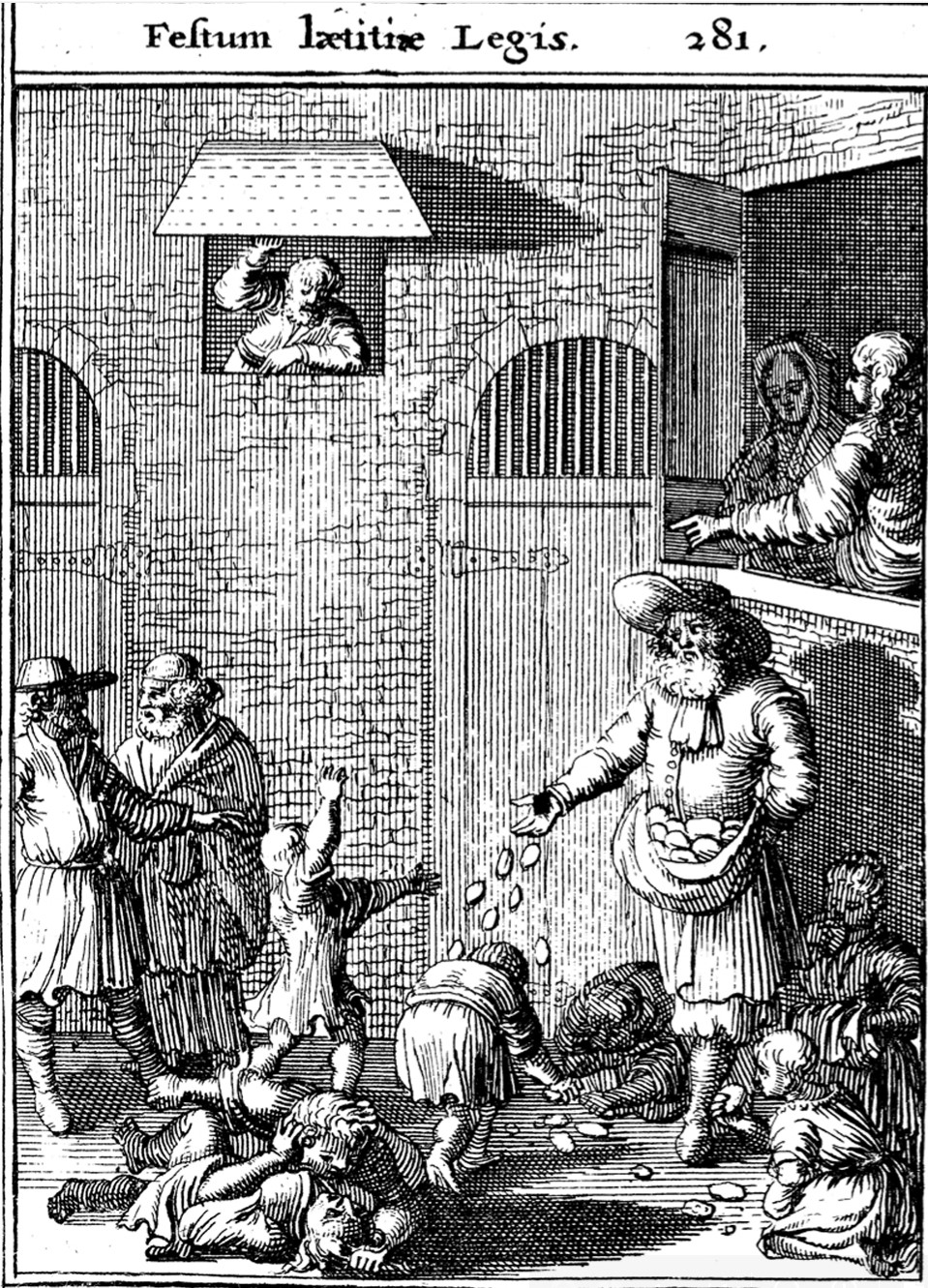
How the dancing is arranged differs by community. In Orthodox synagogues men and boys do most of the dancing, though children, including young girls, may join their fathers. Women and older girls often dance in their own circles, sometimes holding a scroll, or watch from behind a mechitza, the partition kept for tzniut, or modesty. Conservative and Progressive congregations have men and women dancing together. Some synagogues carry the scrolls outside, and the dancing can last far into the night. Children are given flags, candies and other treats. In Chabad Hasidic thought, the dancer becomes the Torah's feet.
How Simchat Torah is kept
The evening service begins with the ark opened and every scroll carried out. Seven circuits, the hakafot, go around the sanctuary, with singing, dancing and invocations asking God to save and to answer. Children receive flags and treats. After the circuits, part of the closing portion of Deuteronomy may be read. The next morning follows the same pattern of seven circuits, then three scrolls are read: the end of Deuteronomy, the start of Genesis, and the Maftir from Numbers. Honours are given out, including a group aliyah for children, and work is not permitted on the day.
When and where
It falls in the Hebrew month of Tishrei, in September or October, at the close of the seven days of Sukkot. Shemini Atzeret follows Sukkot at once. In Israel, and in Reform congregations elsewhere, the two are one day. Most communities outside Israel keep Shemini Atzeret over two days, with Simchat Torah on the second.
Simchat Torah is kept wherever Jewish communities pray with a Torah scroll, strongest in the synagogues of Israel and the diaspora. In Israel many communities hold Hakafot Shniyot, second circuits, on the evening after the holiday, a custom begun by Rabbi Yedidya Frankel, a former Chief Rabbi of Tel Aviv. Orthodox, Conservative and Progressive congregations each keep it in their own way.
What Simchat Torah means
For those who keep it, the day expresses love of the Torah and the idea that finishing is not an ending. Because Jewish custom holds that a completion should be followed at once by a beginning, the last lines of Deuteronomy give way immediately to Genesis. The dancing lifts the scroll, which is normally handled with care, into the arms of the whole community. Chabad Hasidic thought pictures the dancing Jew as the feet of the Torah, bearing it through the world. Feasts on this day are made to honour the completion of the reading.


Days Simchat Torah is marked
Simchat Torah dates: 2026, 2027, 2028
| Year | Simchat Torah date |
|---|---|
| 2026 | 3 to 4 October 2026 |
| 2027 | 23 to 24 October 2027 |
| 2028 | 12 to 13 October 2028 |
Questions people ask about Simchat Torah
When is Simchat Torah in 2027?
Simchat Torah 2027 runs from 23 to 24 October 2027. Other years: 2026, 3 to 4 October 2026; 2028, 12 to 13 October 2028.
What is Simchat Torah?
It is a Jewish holiday that ends the year's public reading of the Torah and starts the next cycle. Scrolls are taken from the ark, the congregation dances with them in seven circuits, and the last portion of Deuteronomy is read closely followed by the opening of Genesis.
Where is it kept?
Wherever Jewish communities pray from a Torah scroll, in Israel and across the diaspora. It is central in Orthodox and Conservative synagogues, and Reform congregations keep it too. In Israel, many communities hold second circuits, Hakafot Shniyot, on the following evening.
Why does it include children?
The custom brings the youngest into the reading. Congregations set aside a special aliyah for them. A single prayer shawl (tallit) may be stretched over the children's heads while the blessing over the Torah is pronounced, and the community then blesses them with a verse from Jacob's blessing of Ephraim and Manasseh.
What do the honours mean?
The person who receives the final aliyah of Deuteronomy is known as the Hatan Torah, the Torah groom, and the one who begins Genesis as the Hatan Bereishit, the Genesis groom. Where women are called up, the parallel titles are Kallat Torah and Kallat Bereishit.
See also
 PassoverA Jewish spring festival celebrating freedom from slavery with ritual meals
 Yom KippurThe holiest day in Judaism, dedicated to fasting, prayer and atonement
 Rosh HashanahThe Jewish New Year marked by shofar horn blasts, prayer and sweet foods
 SukkotA seven-day autumn Jewish festival of temporary booths, harvest prayers and hospitality
Good reading and sources
- Encyclopaedia BritannicaArticle
- Rebecca bat Meir TiktinerJewish Virtual Library, Article
- Rebecca bat Meir TiktinerJewish Virtual Library, Article
- Simchat Torah on WikipediaEncyclopedia
- More photos on Wikimedia CommonsPhotos and video
- Wikidata recordOpen data
The facts on this page come from the Wikipedia article "Simchat Torah", written by its contributors and used under the CC BY-SA 4.0 licence, and from its Wikidata record (CC0). EveryParampara rewrote the text in its own words, with AI assistance, and compares every page with the article to make sure no passage is copied. It may be reused under the same CC BY-SA 4.0 licence with a link back.
It may contain mistakes. Traditions differ from one family, village and community to the next, and the people who keep them know them best. If something is wrong, tell us. Last refreshed 2026-10-05.
More from Israel
All the traditions of Israel
🇮🇱 Jerusalem, IsraelPassoverפסח
A Jewish spring festival celebrating freedom from slavery with ritual mealsSpiritual · Dinner
🇮🇱 Jerusalem, IsraelYom Kippurיוֹם כִּפּוּר
The holiest day in Judaism, dedicated to fasting, prayer and atonementSpiritual · Fasting and breaking the fast
🇮🇱 IsraelRosh Hashanahרֹאשׁ הַשָּׁנָה
The Jewish New Year marked by shofar horn blasts, prayer and sweet foodsSpiritual
🇮🇱 Jerusalem, IsraelSukkotסוכות
A seven-day autumn Jewish festival of temporary booths, harvest prayers and hospitalitySpiritual
The same idea elsewhere
All of this kind 🇦🇺 Australia and 5 moreGood Friday
A solemn Christian holy day commemorating the crucifixion and death of Jesus Christ.Spiritual · Fasting and breaking the fast
🇦🇺 Australia and 5 moreGood Friday
A solemn Christian holy day commemorating the crucifixion and death of Jesus Christ.Spiritual · Fasting and breaking the fast
 🇵🇭 Philippines and 5 moreHoly WeekἉγία καὶ Μεγάλη Ἑβδομάς
The solemn seven days leading to Easter, recalling the final week and Passion of JesusSpiritual · Fasting and breaking the fast
🇵🇭 Philippines and 5 moreHoly WeekἉγία καὶ Μεγάλη Ἑβδομάς
The solemn seven days leading to Easter, recalling the final week and Passion of JesusSpiritual · Fasting and breaking the fast
 🇺🇸 New York, United States and 4 moreFeast of the Ascension
The fortieth day of Easter, when Christians remember Jesus being taken up into heavenSpiritual
🇺🇸 New York, United States and 4 moreFeast of the Ascension
The fortieth day of Easter, when Christians remember Jesus being taken up into heavenSpiritual
 🇪🇸 Valencia, Spain and 5 moreFeast of Corpus ChristiCorpus Domini
A Christian feast celebrating the presence of Christ in the bread and wine of the EucharistSpiritual
🇪🇸 Valencia, Spain and 5 moreFeast of Corpus ChristiCorpus Domini
A Christian feast celebrating the presence of Christ in the bread and wine of the EucharistSpiritual