Festivals and celebrationsEuropeChristian
Sinterklaas
In its own language: Sinterklaas / Sint-Nicolaas
A Dutch winter feast on 5 and 6 December, when Saint Nicholas brings gifts to children

Sinterklaas is a gift-giving feast built around a legendary bishop, Saint Nicholas, who is said to arrive by steamboat from Spain in November. It is kept above all in the Netherlands and Belgium, with the main presents on 5 December in the Netherlands and on 6 December in Belgium and neighbouring regions.
When is Sinterklaas marked?
Sinterklaas is kept as part of St Nicholas Day, which is on Sunday, 6 December 2026.
Sinterklaas is a winter feast kept in the Netherlands, Belgium and neighbouring regions, and the legendary figure at its centre. He is modelled on Saint Nicholas, a bishop of Myra, and is said to sail from Spain each November to bring presents to children. Families mark the high point on 5 or 6 December, with sweets, jokes and poems.
Who Sinterklaas is
Sinterklaas is a legendary man, not a living person, and his name also covers a whole season of visits, songs and small presents. He is pictured as an older figure with white hair and a full beard, dressed the way a bishop would be: a white tunic beneath a long red outer robe, a tall red hat called a mitre, a ruby ring, and a shepherd's staff with a curled top. He carries a large red book, which in the stories holds notes on how children have behaved during the year. People say his home is Spain, though the reasons for that are discussed rather than settled.
Origins and history
The figure grew from Saint Nicholas, bishop of Myra, who lived from roughly 270 to 343. Myra lies in what is now Turkey. In 1087 half of his relics are said to have been taken to the Italian city of Bari, and the feast marks his name day. A helper in Moorish dress first appeared in print in a book published in Amsterdam in 1850 by the schoolteacher Jan Schenkman, though the custom itself reaches back at least to the early 19th century. Sinterklaas is also one of the strands that fed into Santa Claus.
The November arrival
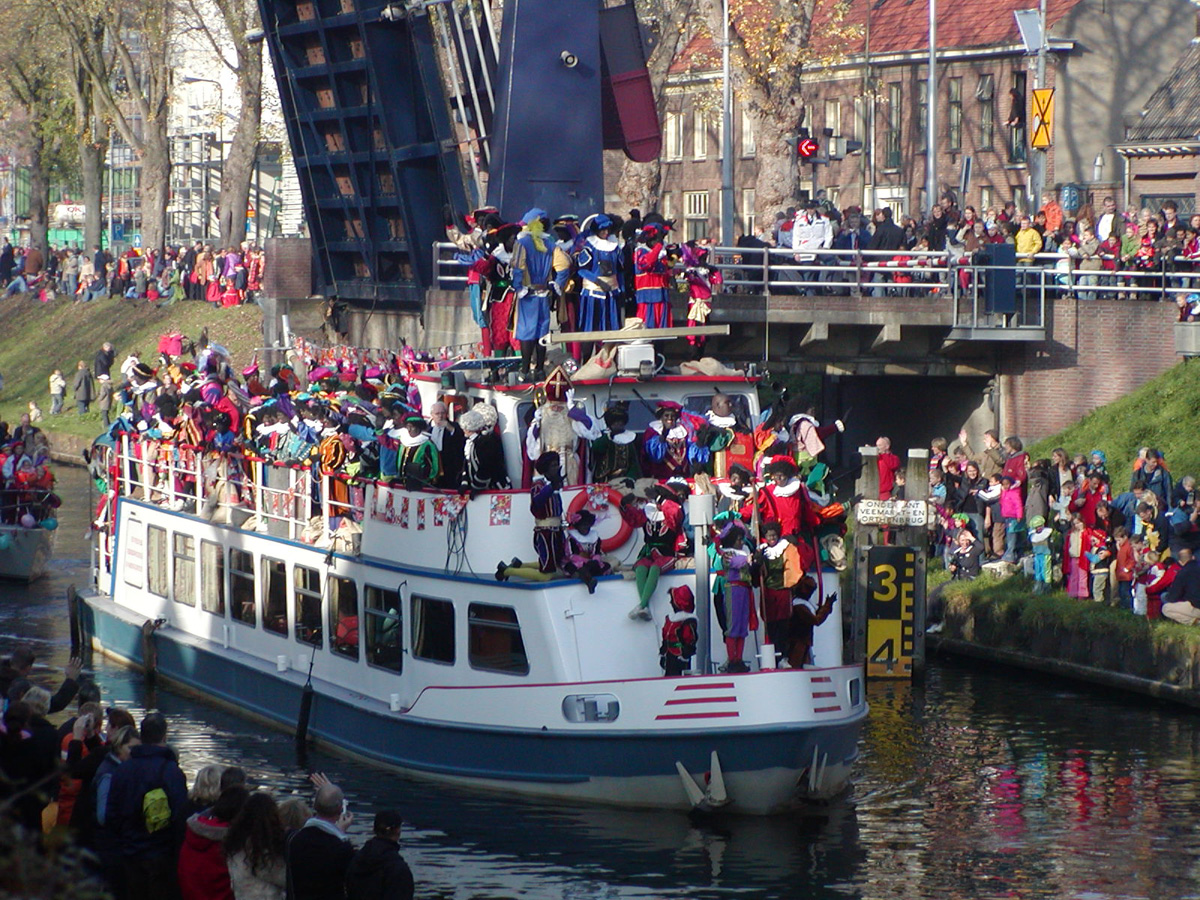
Each year the season opens in the middle of November, on the first Saturday after 11 November, Saint Martin's Day. Sinterklaas is said to come by steamboat from Spain and to land at a seaside port. In the Netherlands a different port is chosen every year, while in Belgium the landing always happens at Antwerp. He then rides a white horse through the streets as children cheer and sing, and his helpers toss small cookies and sweets into the crowd. Television carries the event live in both countries, and towns hold their own smaller arrivals afterwards.
Shoes, gifts and poems
In the weeks before the feast Sinterklaas is said to visit schools, hospitals and shops, and to ride across the rooftops at night. Children set out one shoe with a song, and often a snack for the horse, then find a small treat in it the next morning. The chief evening is 5 December, known as Pakjesavond, or packages evening. Adults pretend the presents come from Sinterklaas and his helpers, sometimes leaving a note that seems to reveal where the sack is hidden. Gifts arrive with comic poems that gently tease the person receiving them.
A contested helper
Sinterklaas travels with helpers called Zwarte Piet, who wore Moorish-style clothing, a lace collar and a feathered cap, with the face painted black. From the 2010s the character drew editorials, documentaries, protests and clashes at festivals. Many cities and broadcasters now show helpers with only smudges of soot on the cheeks, called soot-smudge Petes or chimney Petes. Surveys in 2013 and 2018 found that most Dutch respondents did not see the figure as racist, but by 2020 backing for the older appearance had fallen sharply.
How Sinterklaas is kept
The season opens with the televised landing by boat in mid-November, followed by local arrivals over the next days or weekends. In the weeks after that, Sinterklaas turns up at schools, hospitals and shops. Children leave out a shoe with a song and find a treat in it the next morning. On 5 December families gather for Pakjesavond: presents appear, often hidden or wrapped as a joke, and each is read out with a teasing poem. In Belgium and the southern Netherlands, children find their gifts on 6 December instead. Then the figure leaves and the season is over.
When and where
The heart of the feast is 5 December in the Netherlands, where the evening is called Pakjesavond. In Belgium, Luxembourg, western Germany and northern France the presents arrive on 6 December, Saint Nicholas's name day. The season itself begins earlier, with the arrival by steamboat in mid-November, on the first Saturday after Saint Martin's Day.
It is kept most strongly in the Netherlands and Belgium. It is also celebrated in Luxembourg, western Germany and northern France, including French Flanders, Lorraine, Alsace and Artois. Some territories of the former Dutch Empire keep it as well, Aruba among them. In the Netherlands it is followed by people of many backgrounds, among them Dutch Jews and Muslims.
What Sinterklaas means
The feast belongs to children, and to the idea that good behaviour is noticed and answered with a gift. Saint Nicholas is the patron of children, so the presents are framed as his attention to them. The poem that comes with each present turns affection into teasing, and the shared pretence lets adults and children play the same game. For many Dutch and Belgian households, the evening also marks the beginning of winter.



Days Sinterklaas is marked
Questions people ask about Sinterklaas
When is Sinterklaas marked?
Sinterklaas is kept as part of St Nicholas Day, which is on Sunday, 6 December 2026.
What is Sinterklaas?
It is a Dutch winter feast and the legendary figure at its centre. He is based on Saint Nicholas, bishop of Myra, and is shown as an old man in bishop's robes who arrives by boat from Spain and brings presents to children.
Where is it celebrated?
Chiefly in the Netherlands and Belgium. It is also kept in Luxembourg, western Germany and northern France, and in some former Dutch colonies including Aruba.
Who is Zwarte Piet?
Sinterklaas's helper, dressed in Moorish-style clothes with a feathered cap. The black-painted face has been widely debated since the 2010s, and many cities and broadcasters now show helpers with soot smudges on the cheeks instead.
Is it connected to Christmas?
In one direction, yes: Sinterklaas is one of the sources of the Santa Claus figure. The Dutch feast itself is separate and comes earlier, on 5 and 6 December.
See also
 ChristmasA festival of Jesus's birth, kept on 25 December with gifts, lights and shared meals
 Christmas treeA decorated evergreen or artificial tree placed indoors to mark the Christmas season.
 Christmas EveThe evening before Christmas, marked by church services, family meals, and gift preparations across Christian cultures.
 PicnicA meal taken outdoors in a park or scenic spot, often shared with friends and family.
Good reading and sources
- Sinterklaas on WikipediaEncyclopedia
- More photos on Wikimedia CommonsPhotos and video
- Wikidata recordOpen data
The facts on this page come from the Wikipedia article "Sinterklaas", written by its contributors and used under the CC BY-SA 4.0 licence, and from its Wikidata record (CC0). EveryParampara rewrote the text in its own words, with AI assistance, and compares every page with the article to make sure no passage is copied. It may be reused under the same CC BY-SA 4.0 licence with a link back.
It may contain mistakes. Traditions differ from one family, village and community to the next, and the people who keep them know them best. If something is wrong, tell us. Last refreshed 2026-10-05.
More from the Netherlands
All the traditions of the Netherlands 🇩🇪 Germany and 7 moreSt. Martin's Day
A feast on November 11 marking the end of harvest and the start of winter with lantern processions and roasted goose.Festival · Dinner
🇩🇪 Germany and 7 moreSt. Martin's Day
A feast on November 11 marking the end of harvest and the start of winter with lantern processions and roasted goose.Festival · Dinner
 🇳🇱 Amsterdam, NetherlandsKing's DayKoningsdag
A Dutch national holiday celebrating the monarch's birthday with street markets and orange attire.Festival
🇳🇱 Amsterdam, NetherlandsKing's DayKoningsdag
A Dutch national holiday celebrating the monarch's birthday with street markets and orange attire.Festival
 🇸🇷 Paramaribo, Suriname and 1 moreKetikotiKeti Koti
An annual Emancipation Day marking the end of slavery in Suriname and the NetherlandsFestival
🇸🇷 Paramaribo, Suriname and 1 moreKetikotiKeti Koti
An annual Emancipation Day marking the end of slavery in Suriname and the NetherlandsFestival
 🇮🇷 Iran and 4 moreSizdah Bedarسیزدهبدر
An open-air picnic holiday concluding the Iranian New Year celebrationsFestival
🇮🇷 Iran and 4 moreSizdah Bedarسیزدهبدر
An open-air picnic holiday concluding the Iranian New Year celebrationsFestival
The same idea elsewhere
All of this kind 🇹🇷 Turkey and 5 moreEid al-Fitrعيد الفطر
The feast that ends Ramadan, opened with morning prayers, sweets and visits homeFestival · Feasts and festival meals
🇹🇷 Turkey and 5 moreEid al-Fitrعيد الفطر
The feast that ends Ramadan, opened with morning prayers, sweets and visits homeFestival · Feasts and festival meals
 🇮🇳 Ayodhya, India and 7 moreDiwaliदीपावली (Dīpāvalī)
A five-day festival of lights celebrated across India and its diaspora to mark the victory of light over darkness.Festival · Feasts and festival meals
🇮🇳 Ayodhya, India and 7 moreDiwaliदीपावली (Dīpāvalī)
A five-day festival of lights celebrated across India and its diaspora to mark the victory of light over darkness.Festival · Feasts and festival meals
 🇮🇱 Jerusalem, Israel and 1 moreHanukkahחֲנֻכָּה
An eight-day Jewish festival marking the rededication of the Second Temple in Jerusalem and the miracle of a single day'Festival
🇮🇱 Jerusalem, Israel and 1 moreHanukkahחֲנֻכָּה
An eight-day Jewish festival marking the rededication of the Second Temple in Jerusalem and the miracle of a single day'Festival
 🇪🇬 Egypt and 5 moreMawlidمولد (Mawlid)
An annual festival marking the birth of the Prophet Muhammad, marked by poetry, processions and feasts.Festival · Feasts and festival meals
🇪🇬 Egypt and 5 moreMawlidمولد (Mawlid)
An annual festival marking the birth of the Prophet Muhammad, marked by poetry, processions and feasts.Festival · Feasts and festival meals