Festivals and celebrationsSoutheast AsiaBuddhistHindu
Songkran
In its own language: สงกรานต์
The three-day Thai New Year festival marked by water rituals and blessings for elders

Songkran is the traditional solar New Year festival in Thailand, celebrated every April across the country with temple rituals, family reunions and community water throwing. People wash Buddha statues, pour water over elders' hands for blessings, and build sand stupas at temples before joining water fights that fill the streets.
When is Songkran in 2027?
Songkran 2027 runs from 13 to 15 April 2027. Other years: 2026, 13 to 15 April 2026; 2028, 13 to 15 April 2028.
Songkran marks the arrival of the traditional solar New Year in Thailand. Rooted in Buddhist and astrological cycles, the three-day holiday welcomes the sun's passage into Aries each April. Thai families gather to honor their elders, seek merit at local temples, and cleanse away the misfortunes of the previous year. Through sacred water blessings and lively street-wide water fights, communities celebrate renewal and the beginning of a fresh calendar cycle.
The three festive days
The traditional celebration unfolds across three distinct stages. The first day, Maha Songkran on 13 April, marks the exit of the old year as the sun enters Aries in the sidereal zodiac. The following day, Wan Nao, serves as a quiet middle interlude between cycles. Celebrations culminate on 15 April with Wan Thaloeng Sok, the formal dawn of the new year. While Thailand adopted 1 January as its civic New Year in 1940, Songkran remains the spiritual heart of the national calendar. On these dates, people clean their homes, make merit at Buddhist temples, and prepare offerings for monks to start the new cycle with clear intentions.
Rituals of water
Water lies at the center of Songkran observance. At temples like Wat Ratchabophit and Wat Pho in Bangkok, worshipers pour perfumed water over Buddha statues in a rite called Song Nam Phra. Devotees also carry sand into temple courtyards to shape decorative sand stupas, replenishing the dirt carried away on visitors' footwear during the year. At home, families observe Rot Nam Dam Hua, gently trickling water over the palms of parents and older relatives to ask for forgiveness and blessings. In public squares and along ancient city walls, such as those in Chiang Mai, reverence gives way to exuberant street battles where revelers drench each other and dab cooling white paste on faces.
Astrology and royal proclamations
Songkran derives its name from the Sanskrit word saṅkrānti, describing the sun's passage between zodiacal constellations. Historically, court astrologers calculated the start of the year through mathematical treatises adapted from ancient Indian astronomy, tracking time from the start of the Kali Yuga. The palace traditionally published an official notification known as Prakat Songkran, announcing the exact moment the new solar year would begin along with forecasts for rainfall, crops, and governance. Today, printed lunisolar calendars still feature the mythical figure Nang Songkran riding her symbolic animal. Astrologers continue to release seasonal forecasts, while regional councils sometimes hold observances tied to traditional astronomical calculations.
Global recognition and change
Over the decades, the timing and scope of Songkran have evolved. In 1888 the Thai New Year was moved to 1 April before aligning with the international date of 1 January in 1940, leaving Songkran as a cherished cultural holiday. To give workers time to travel home to their native provinces, the government has frequently extended the statutory break across several extra days. In 2023, UNESCO inscribed Songkran on its Representative List of the Intangible Cultural Heritage of Humanity, recognizing its community bonds and shared heritage. The festival has also grown into an international attraction, welcoming travelers from across the globe into its water-splashed streets.
How Songkran is kept
Celebrations open with visits to Buddhist monasteries, where devotees present food to monks, bathe Buddha images with scented water, and construct decorative sand pagodas in temple grounds. Within families, younger members perform Rot Nam Dam Hua by pouring water over the hands of elders to express respect and receive New Year blessings. In neighborhoods and thoroughfares, people of all ages take to the outdoors with buckets, water guns, and hoses. Passersby playfully splash one another and smear scented talcum powder on cheeks as an act of good fortune, turning towns and cities into massive public water celebrations.
When and where
Songkran is observed annually from 13 to 15 April. The timing corresponds to the sun entering the constellation of Aries in the sidereal zodiac. While the Thai government fixed the standard national holiday dates in 1989, holiday periods are sometimes lengthened by official decree to give families additional travel time.
The festival is celebrated throughout Thailand, in both rural villages and major urban centers. Prominent gatherings take place in Bangkok at revered temples such as Wat Pho, along the ancient city walls of Chiang Mai in the north, and in provincial towns like Ban Khung Taphao in Uttaradit.
What Songkran means
Water serves as a powerful symbol of purification, renewal, and spiritual cleansing. Pouring water over Buddha statues and family elders washes away the bad deeds and misfortune of the previous year while welcoming blessings for the future. Building sand stupas at temples returns the earth taken away under visitors' shoes and demonstrates Buddhist devotion. In traditional folklore, respecting elders and maintaining moral discipline preserves social harmony and restores divine favor to the land.


Days Songkran is marked
Songkran dates: 2026, 2027, 2028
| Year | Songkran date |
|---|---|
| 2026 | 13 to 15 April 2026 |
| 2027 | 13 to 15 April 2027 |
| 2028 | 13 to 15 April 2028 |
Questions people ask about Songkran
When is Songkran in 2027?
Songkran 2027 runs from 13 to 15 April 2027. Other years: 2026, 13 to 15 April 2026; 2028, 13 to 15 April 2028.
What is Songkran?
Songkran is the traditional Thai New Year festival. Rooted in Buddhist and solar traditions, it marks the sun's astrological transition into Aries. The holiday is celebrated with temple merit-making, pouring water over the hands of elders for blessings, and widespread public water fights.
Why do people splash water during Songkran?
Water splashing began as a ritual of cleansing and renewal. Pouring water over Buddha images and elders symbolizes washing away bad luck from the past year. In public streets, throwing water has grown into a joyous communal activity to share blessings and welcome the new season.
What is the Rot Nam Dam Hua ceremony?
Rot Nam Dam Hua is a family ritual performed during Songkran. Younger relatives gently pour scented water over the hands of parents and community elders. This gesture shows deep respect, asks for forgiveness for past faults, and invites elders to give words of blessing.
See also
 VesakA day to honor the birth, awakening, and passing of the Buddha, kept by Buddhists across Asia.
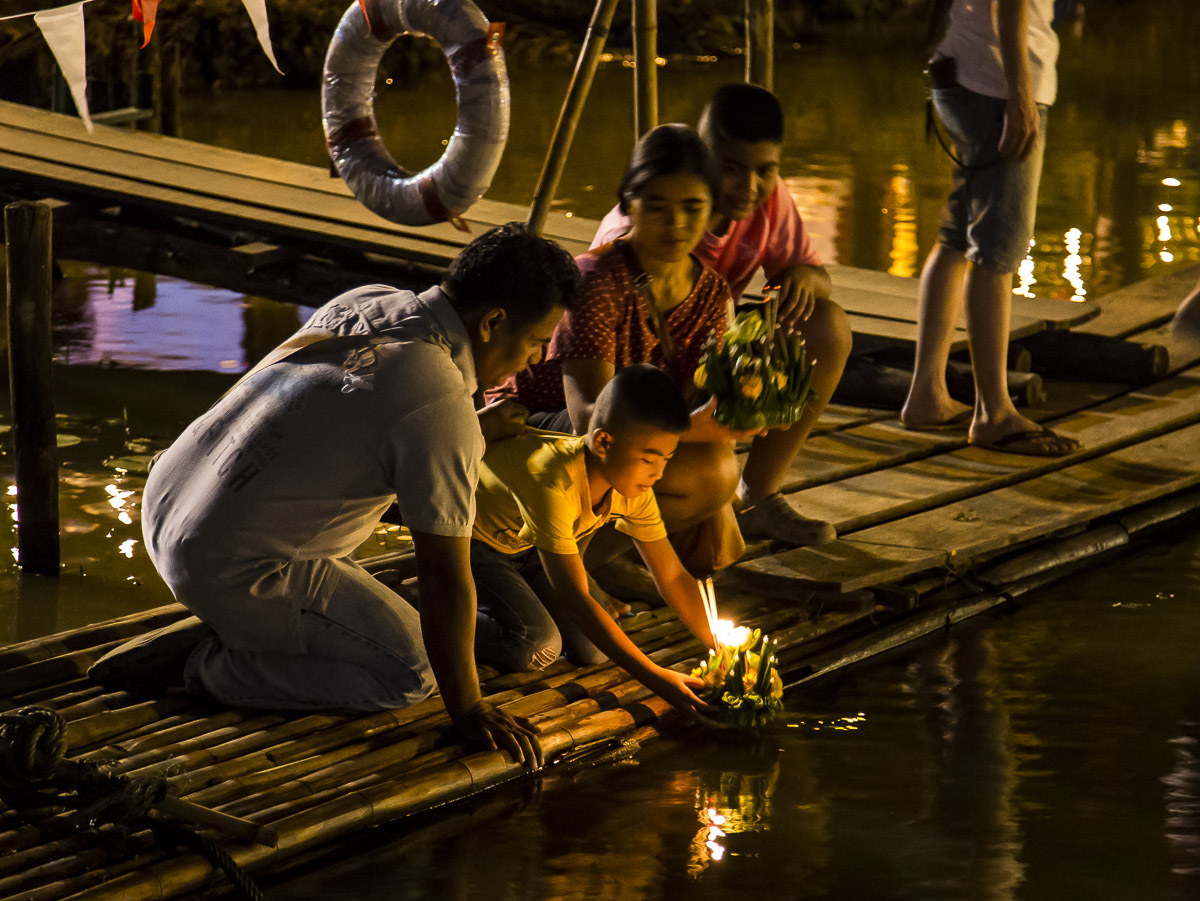 Loy KrathongA Thai festival of floating leaf baskets on rivers to honor water and release negativity.
 KathinaA Buddhist season of offering new robes and gifts to monks after the rains retreat
 Royal Ploughing CeremonyA royal agricultural rite opening the rice season across mainland Southeast Asia
Good reading and sources
- Songkran in Thailand, traditional Thai New Year festivalUNESCO, Heritage listing
- Songkran in Thailand, traditional Thai New Year festivalUNESCO, Article
- Songkran (Thailand) on WikipediaEncyclopedia
- More photos on Wikimedia CommonsPhotos and video
- Wikidata recordOpen data
The facts on this page come from the Wikipedia article "Songkran (Thailand)", written by its contributors and used under the CC BY-SA 4.0 licence, and from its Wikidata record (CC0). EveryParampara rewrote the text in its own words, with AI assistance, and compares every page with the article to make sure no passage is copied. It may be reused under the same CC BY-SA 4.0 licence with a link back.
It may contain mistakes. Traditions differ from one family, village and community to the next, and the people who keep them know them best. If something is wrong, tell us. Last refreshed 2026-10-04.
More from Thailand
All the traditions of Thailand
🇱🇰 Colombo, Sri Lanka and 5 moreVesakVisakha Bucha (Thailand), Visakha Bouxa (Laos), Full Moon Day of Kason (Myanmar)
A day to honor the birth, awakening, and passing of the Buddha, kept by Buddhists across Asia.Festival
🇹🇭 Chiang Mai, Thailand and 5 moreLoy Krathongลอยกระทง
A Thai festival of floating leaf baskets on rivers to honor water and release negativity.Festival
 🇹🇭 Dan Sai, ThailandPhi Ta Khonผีตาโขน
A three-day festival in Dan Sai, north-east Thailand, of ghost masks and merit-makingFestival
🇹🇭 Dan Sai, ThailandPhi Ta Khonผีตาโขน
A three-day festival in Dan Sai, north-east Thailand, of ghost masks and merit-makingFestival
 🇹🇭 Phon Phisai, Thailand and 1 moreNaga fireballsบั้งไฟพญานาค (bang fai phaya nak)
A festival of glowing orbs rising from the Mekong River, attributed to a mythical serpent.Festival
🇹🇭 Phon Phisai, Thailand and 1 moreNaga fireballsบั้งไฟพญานาค (bang fai phaya nak)
A festival of glowing orbs rising from the Mekong River, attributed to a mythical serpent.Festival
The same idea elsewhere
New Year compared 🇧🇹 Bhutan and 4 moreLosarལོ་གསར་
The Tibetan Buddhist New Year festival of renewal, offerings, and family feastsSeasonal · Feasts and festival meals
🇧🇹 Bhutan and 4 moreLosarལོ་གསར་
The Tibetan Buddhist New Year festival of renewal, offerings, and family feastsSeasonal · Feasts and festival meals
 🇮🇳 India and 1 moreUgadiఉగాది
A South Indian New Year feast celebrating life with sweet, sour, and bitter tastesSeasonal
🇮🇳 India and 1 moreUgadiఉగాది
A South Indian New Year feast celebrating life with sweet, sour, and bitter tastesSeasonal
 🇮🇳 India and 1 moreCheti Chandچيٽي چنڊ
The Sindhi New Year festival celebrating the arrival of spring and JhulelalSeasonal · Feasts and festival meals
🇮🇳 India and 1 moreCheti Chandچيٽي چنڊ
The Sindhi New Year festival celebrating the arrival of spring and JhulelalSeasonal · Feasts and festival meals
 🇮🇳 Guwahati, IndiaBohag Bihu
A multi-day Assamese New Year festival of cattle rites, music, gifts and feastsSeasonal · Feasts and festival meals
🇮🇳 Guwahati, IndiaBohag Bihu
A multi-day Assamese New Year festival of cattle rites, music, gifts and feastsSeasonal · Feasts and festival meals