Spiritual and religiousMiddle EastMuslim
Sufi whirling
A Sufi meditation in which dervishes spin in circles to turn toward God
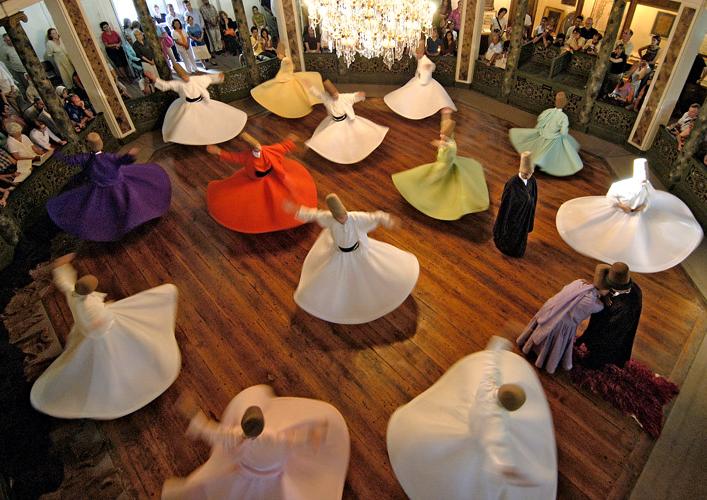
Sufi whirling is a physically active meditation practised by Sufi dervishes, above all in the Mevlevi order that grew from the poet Rumi in the 13th century. Within the sema worship ceremony the semazen spins in repeated circles to music, leaving the ego aside in the hope of a closer connection with Allah.
When is Sufi whirling kept?
Sufi whirling is kept on inside the sema ceremony, held through the year. In Turkey, public ritual whirling has been permitted for two weeks each year since 1954..
Sufi whirling is a moving meditation kept by Sufi dervishes, most closely associated with the Mevlevi order that the poet Rumi founded in the 13th century. Inside the sema, a worship ceremony, a dervish called a semazen spins in slow circles to music, setting aside the ego and turning the heart toward Allah.
What it is
Sufi whirling is a form of meditation that uses the body rather than stillness. It grew among certain Sufi groups and is still kept by dervishes of the Mevlevi order and by others such as the Rifa'i-Marufi. The whirling happens inside the sema, a worship ceremony. By listening to music and spinning in circles, a dervish called a semazen tries to leave behind the nafs, the ego and its personal desires, and so come closer to Allah. Outsiders have sometimes called the state it produces an ecstatic trance. Sufis have described the circling as a picture of the planets of the Solar System turning around the Sun. The place of sama, sacred listening, in worship has been argued over for centuries.
Origins and history
The whirling dervishes were founded as an order by the mystic poet Rumi in the 13th century. Sufi brotherhoods, called turuk or tariqas, were led by a sheikh whom members followed through set disciplines, and a member was known as a darwish. Each order keeps a silsila, a chain running from the member through every teacher back to the Prophet, revered by Sufis as the originator of Sufism. The custom of sama spread from Baghdad around the 9th century CE and later took root in Persian, Turkish and Indian Islam. In 1925 Turkey dissolved all Sufi brotherhoods by decree; the Mevlevi survived in small villages and, from 1954, received permission to whirl for tourists for two weeks a year. UNESCO listed the Mevlevi Sema Ceremony in 2005.
Inside the sema
The sheikh leads the ceremony and stands in the most honoured corner of the floor. The dervishes pass him three times, greeting him each time, and then the circling begins. The turn is made on the left foot, which stays flat on the ground and forms the centre of the rotation, while the right foot drives each full step. If one dervish becomes too lost in the movement, a Sufi in charge of good order touches his robe gently to steady him. The music opens with a hymn in praise of the Prophet written by Rumi, and closes with short, lively songs, some of them in Turkish.
Dress and meaning
Before whirling, a Mevlevi dervish wears a tennure, a sleeveless white frock, under a long-sleeved jacket called a destegul, held with a belt, and a black overcoat. The overcoat is taken off before the turning starts, a sign of rebirth into the truth. A felt cap called a sikke is worn with a turban, a mark of the Mevlevi order. Sufis read meaning into each part: the cap stands for the tombstone of the ego, the white skirt for its shroud. The dervish begins with arms crossed, showing the oneness of God, then opens them, right hand to the sky, left hand toward the earth.
Regional forms
In Egypt, the Mevlevi turning was adapted into tanoura, named after the colourful skirt the whirler wears, one colour for each Sufi order. It belongs to Sufi festivals but is also danced by non-Sufis as a folk or concert dance, and the skirt helps the dancer keep balance. In Pakistan, at shrines such as the Lal shrine in Sehwan, the practice is called Dhamaal and is open to any devotee, priest or pilgrim. A drum and bells lead into it, and pilgrims raise their hands and skip in place until the faster beat carries them into trance. Outside the Islamic world, whirling also appears in stage and belly-dance performances.
How Sufi whirling is kept
A sheikh leads. The dervishes greet him three times as they pass, then begin to turn on the left foot, the right foot driving each full circle. The right arm rises toward the sky, the left turns to the earth, and the eyes rest on the left hand. Some wear the Mevlevi tennure under a jacket and a felt cap. Music runs through the ceremony. A dervish who becomes too enraptured is touched gently on the robe by a Sufi who keeps good order. Only men took part for most of its history; some communities now admit women.
When and where
Sufi whirling is not tied to a single date in the year. It takes place within the sema ceremony, whenever an order gathers to hold one. In Turkey, ritual whirling for the public has been allowed for two weeks a year, by permission granted to the Mevlevi order in 1954.
It is strongest in Turkey, where the Mevlevi order has its home and where the sema ceremony was recognised by UNESCO in 2005. Egypt keeps its own form, tanoura, danced at Sufi festivals. In Pakistan, Dhamaal is performed at Sufi shrines, among them the Lal shrine in Sehwan, Sindh. Whirlers also perform on stages and in belly-dance shows outside the Islamic world.
What Sufi whirling means
For those who keep it, the turning is not a display. It is dhikr, the remembrance of Allah, done with the whole body. The dervish spins to leave the self behind, to lose ego and personal want, and to draw nearer to God. Each garment carries a meaning: the felt cap as the ego's tombstone, the white skirt as its shroud, the black cloak set aside as rebirth into truth. The arms open, receiving from above and giving to the earth. The dervish circles round the heart, moving from right to left, a Sufi image of embracing all humanity in love.


Questions people ask about Sufi whirling
When is Sufi whirling kept?
Sufi whirling is kept on inside the sema ceremony, held through the year. In Turkey, public ritual whirling has been permitted for two weeks each year since 1954..
What is Sufi whirling?
It is a moving meditation kept by Sufi dervishes, above all the Mevlevi order. A dervish called a semazen spins in circles to music inside the sema, a worship ceremony, hoping to set the ego aside and come closer to Allah.
Where is it kept?
Turkey is its main home, where the Mevlevi order traces back to Rumi. Egypt has its own form, tanoura, and in Pakistan Dhamaal is performed at Sufi shrines such as the Lal shrine in Sehwan, Sindh. Whirling also appears on stages abroad.
Why do the dervishes wear those clothes?
The white tennure and the felt sikke are not costume. Sufis explain the cap as the tombstone of the ego and the skirt as its shroud. The black cloak is removed before the turning starts, a sign of spiritual rebirth into the truth.
Can anyone whirl?
Historically only men were permitted to take part in the ceremony, though some communities now allow women. In Pakistan, Dhamaal at Sufi shrines is open to any devotee, whether priest or pilgrim.
See also
 Eid al-FitrThe feast that ends Ramadan, opened with morning prayers, sweets and visits home
 Mevlevi OrderA Sufi tradition from Konya known for its whirling ceremony and devotion to Rumi's teachings.
 Holy FireA fire ceremony in Jerusalem each year, kept by Orthodox Christians before Easter
 Ramadan in TurkeyA holy month of fasting, prayer, and community meals, observed across Turkey with unique local customs.
Good reading and sources
- Damadam mast Qalandar is a cry of rebellion against established ordersDawn, Article
- Damadam mast Qalandar is a cry of rebellion against established ordersDawn, Article
- Sufi whirling on WikipediaEncyclopedia
- More photos on Wikimedia CommonsPhotos and video
- Wikidata recordOpen data
The facts on this page come from the Wikipedia article "Sufi whirling", written by its contributors and used under the CC BY-SA 4.0 licence, and from its Wikidata record (CC0). EveryParampara rewrote the text in its own words, with AI assistance, and compares every page with the article to make sure no passage is copied. It may be reused under the same CC BY-SA 4.0 licence with a link back.
It may contain mistakes. Traditions differ from one family, village and community to the next, and the people who keep them know them best. If something is wrong, tell us. Last refreshed 2026-10-05.
More from Turkey
All the traditions of Turkey
🇹🇷 Konya, Turkey and 4 moreMevlevi OrderMevlevilik
A Sufi tradition from Konya known for its whirling ceremony and devotion to Rumi's teachings.Spiritual
🇹🇷 TurkeyRamadan in Turkey
A holy month of fasting, prayer, and community meals, observed across Turkey with unique local customs.Spiritual · Fasting and breaking the fast
🇹🇷 Turkey and 1 moreSamaSema (Turkish); سَماع (Persian)
A Sufi rite of listening, music and turning, kept by Mevlevi and other Sufi ordersSpiritual
 🇦🇲 Yerevan, Armenia and 6 moreArmenian Genocide Remembrance DayՄեծ Եղեռնի զոհերի հիշատակի օր
An annual day of mourning and remembrance for the victims of the 1915 Armenian Genocide.Spiritual
🇦🇲 Yerevan, Armenia and 6 moreArmenian Genocide Remembrance DayՄեծ Եղեռնի զոհերի հիշատակի օր
An annual day of mourning and remembrance for the victims of the 1915 Armenian Genocide.Spiritual
The same idea elsewhere
All of this kind 🇦🇺 Australia and 5 moreGood Friday
A solemn Christian holy day commemorating the crucifixion and death of Jesus Christ.Spiritual · Fasting and breaking the fast
🇦🇺 Australia and 5 moreGood Friday
A solemn Christian holy day commemorating the crucifixion and death of Jesus Christ.Spiritual · Fasting and breaking the fast
 🇵🇭 Philippines and 5 moreHoly WeekἉγία καὶ Μεγάλη Ἑβδομάς
The solemn seven days leading to Easter, recalling the final week and Passion of JesusSpiritual · Fasting and breaking the fast
🇵🇭 Philippines and 5 moreHoly WeekἉγία καὶ Μεγάλη Ἑβδομάς
The solemn seven days leading to Easter, recalling the final week and Passion of JesusSpiritual · Fasting and breaking the fast
 🇺🇸 New York, United States and 4 moreFeast of the Ascension
The fortieth day of Easter, when Christians remember Jesus being taken up into heavenSpiritual
🇺🇸 New York, United States and 4 moreFeast of the Ascension
The fortieth day of Easter, when Christians remember Jesus being taken up into heavenSpiritual
 🇪🇸 Valencia, Spain and 5 moreFeast of Corpus ChristiCorpus Domini
A Christian feast celebrating the presence of Christ in the bread and wine of the EucharistSpiritual
🇪🇸 Valencia, Spain and 5 moreFeast of Corpus ChristiCorpus Domini
A Christian feast celebrating the presence of Christ in the bread and wine of the EucharistSpiritual