Music, dance and storytellingEurope
Teškoto
In its own language: Тешкото
A Macedonian line dance that expresses the hardship and resilience of people in western Macedonia.

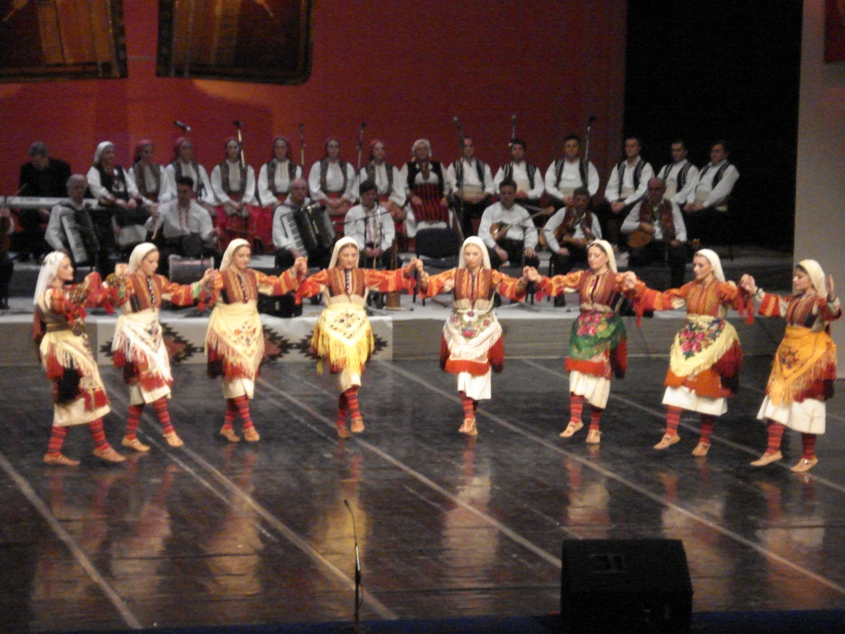
Teškoto is a folk dance from the Mijak region of western North Macedonia. It portrays the struggles of those who left their homes for better lives. The dance is kept alive through festivals like the Galičnik Wedding Festival and performances by groups such as Tanec.
When is Teškoto kept?
Teškoto is kept at cultural festivals and weddings.
Teškoto is a traditional line dance from western North Macedonia. It tells the story of hardship and migration. Dancers move in a line, led by an improviser. The music shifts from slow steps to fast rhythms. This dance honors the resilience of the Mijak community.
Origins and meaning
The dance emerged when locals left their villages seeking work elsewhere. It reflects the difficulties they faced during this period. Over time, it became a way to remember past suffering. The name means 'the hard one' in Macedonian. It captures the weight of leaving home and the pain of separation. The performance serves as a historical record of these experiences.
How the dance works
Performers form a line and follow a leader. The leader uses visual cues to guide the group. The dance starts with slow, precise movements. Dancers lift their legs and step carefully. As the music speeds up, the tempo increases. The final section is fast and energetic. Musicians must watch the dancers closely to keep pace. This requires skill and attention from everyone involved.
Cultural presence
Teškoto is central to the Tanec ensemble since 1949. It appears at the Galičnik Wedding Festival annually. This festival takes place in one of the oldest villages in the country. The dance has also inspired literature, such as a poem by Blaže Koneski. A monument dedicated to the dance stands in Skopje. It represents a key part of regional identity.
How Teškoto is kept
Dancers form a line in the Reka region. A leader guides them with subtle movements. The group performs slow steps before speeding up. Musicians play traditional instruments to match the rhythm. The dance is performed at weddings and cultural events. It connects communities across ethnic lines.
When and where
It is performed at various times throughout the year. Major appearances include the Galičnik Wedding Festival. The dance is also featured in national competitions. These events help preserve the tradition for new generations.
The dance originates in the Mijak region of western North Macedonia. It is strongly associated with villages like Galičnik and Lazaropole. Performances also occur in Skopje. The tradition extends into parts of Albania where Mijak people live.
What Teškoto means
The dance symbolizes the struggle of migration. It honors those who left for better opportunities. The slow movements represent the burden of leaving home. The fast ending shows resilience and energy. It keeps the memory of hardship alive in a positive way.

Questions people ask about Teškoto
When is Teškoto kept?
Teškoto is kept at cultural festivals and weddings.
What does Teškoto mean?
The name translates to 'the hard one'. It refers to the difficult life of people who migrated from their villages. The dance expresses the pain and strength of this experience.
Where is this dance from?
It comes from the Mijak ethnographic region in western North Macedonia. Villages like Galičnik are central to its practice. The tradition is also found in neighboring areas of Albania.
Who performs Teškoto?
Members of the Mijak community perform the dance. It is also danced by Torbeši people. Traditional musicians from Debar provide the accompaniment. The Tanec ensemble popularized it nationally.
See also
 CălușariAn acrobatic Romanian spring dance and ritual brotherhood tied to folklore and healing
 NowruzThe Iranian new year at the March equinox, kept with fire, greenery and picnicsAs-salamu alaykumA traditional Arabic greeting of peace exchanged in daily life and prayer
 HıdırellezA spring festival marking the meeting of two prophets, celebrated across Turkey and the Balkans.
Good reading and sources
The facts on this page come from the Wikipedia article "Teškoto", written by its contributors and used under the CC BY-SA 4.0 licence, and from its Wikidata record (CC0). EveryParampara rewrote the text in its own words, with AI assistance, and compares every page with the article to make sure no passage is copied. It may be reused under the same CC BY-SA 4.0 licence with a link back.
It may contain mistakes. Traditions differ from one family, village and community to the next, and the people who keep them know them best. If something is wrong, tell us. Last refreshed 2026-10-04.
More from North Macedonia
All the traditions of North Macedonia
🇷🇴 Romania and 3 moreCălușariCălușarii
An acrobatic Romanian spring dance and ritual brotherhood tied to folklore and healingPerformance
🇦🇱 Gjirokastër, Albania and 2 moreAlbanian iso-polyphonyIso-polifonia
Multi-part Albanian singing with a held drone, kept across the southPerformance
 🇷🇴 Bucharest, Romania and 7 moreHorahoră (Romanian), хоро (Bulgarian), оро (Macedonian), הורה (Hebrew)
A circle dance from Southeast Europe, danced at weddings and festivalsPerformance
🇹🇷 Turkey and 6 moreHıdırellez
A spring festival marking the meeting of two prophets, celebrated across Turkey and the Balkans.Festival · Feasts and festival meals
🇷🇴 Bucharest, Romania and 7 moreHorahoră (Romanian), хоро (Bulgarian), оро (Macedonian), הורה (Hebrew)
A circle dance from Southeast Europe, danced at weddings and festivalsPerformance
🇹🇷 Turkey and 6 moreHıdırellez
A spring festival marking the meeting of two prophets, celebrated across Turkey and the Balkans.Festival · Feasts and festival meals
The same idea elsewhere
All of this kind 🇹🇷 Kayseri, Turkey and 4 moreHalay
A traditional line and circle folk dance kept across Turkey, Azerbaijan, Armenia, Iran, and Syria.Performance
🇹🇷 Kayseri, Turkey and 4 moreHalay
A traditional line and circle folk dance kept across Turkey, Azerbaijan, Armenia, Iran, and Syria.Performance
 🇳🇿 Auckland, New ZealandPoi
A Māori performing art of swinging tethered weights in rhythmical patterns.Performance
🇳🇿 Auckland, New ZealandPoi
A Māori performing art of swinging tethered weights in rhythmical patterns.Performance
 🇵🇭 Philippines and 1 morePangalay
A traditional fingernail dance of the Tausūg and Bajau peoples in the Sulu Archipelago and Sabah.Performance
🇵🇭 Philippines and 1 morePangalay
A traditional fingernail dance of the Tausūg and Bajau peoples in the Sulu Archipelago and Sabah.Performance