Life-cycle ritesSouth AsiaHindu
Upanayana
In its own language: उपनयन (Sanskrit)
A Hindu rite of passage that begins a child's study and marks a second birth
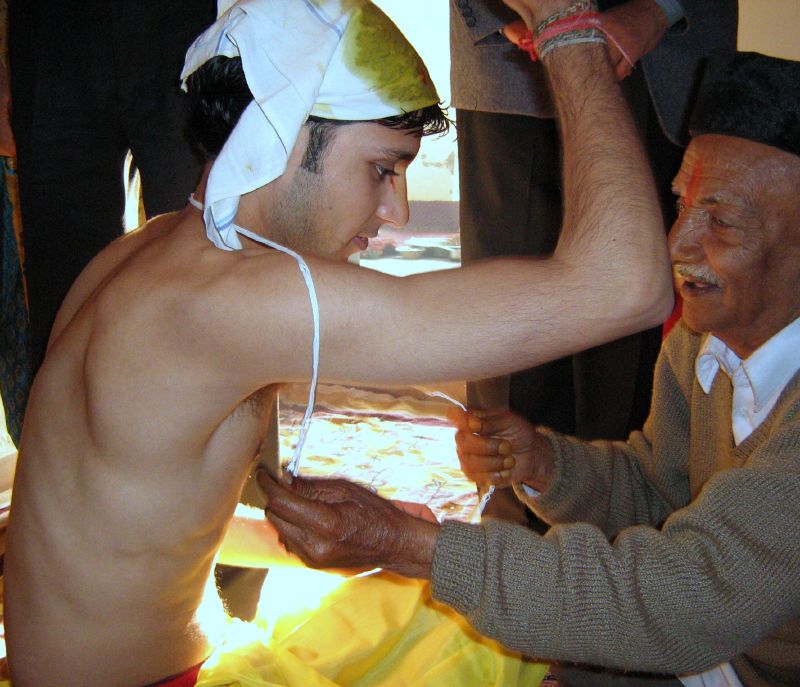
Upanayana is a Hindu rite of passage, one of the saṃskāras, in which a teacher accepts a student and formal study begins. It is kept by families of the Brāhmaṇa, Kṣatriya and Vaiśya varnas in India and Nepal, usually before adulthood, and it centres on the giving of the sacred thread and the recitation of the Gāyatrī Mantra.
When is Upanayana kept?
Upanayana is kept on usually before adulthood, most often around the age of eight to twelve.
Upanayana is a Hindu rite of passage that marks the start of a child's formal education and a second, spiritual birth. A teacher accepts the student, gives a sacred thread, and the Gāyatrī Mantra is recited. Families in India and Nepal keep it in many different forms, most often before the child reaches adulthood.
What it is
Upanayana is one of the Hindu saṃskāras, the rites that mark stages of a life. It is the moment a teacher, a guru or acharya, takes on a student and brings that student into a school of Hindu learning. Many communities call it a second birth: the child who goes through it becomes dvija, twice born. The first birth is physical, the second belongs to the mind and spirit. For Brāhmaṇa, Kṣatriya and Vaiśya boys it has long been counted the most important of the rites, the point at which a young person enters adulthood together with its duties. The usual age is before adulthood.
Names and forms
The rite has a different name in nearly every language of the regions where it is kept. In the north it is janeu or janeo; in Maharashtra munja, and munji in Konkani; in Tamil country pūṇūl or upanayanam; in Nepal bratabandha, and chhewar among the Newar. Odia speakers say brataghara, Assamese logun dioni, Bengali poite. What is often called the sacred thread ceremony is also known as punal kalyanam, an auspicious thread ceremony, and as Brahmopadeśa. A variation called Mauñjibandhana takes its name from muñja grass tied round the waist. Another, vratabandha, means being bound to an observance.
Origins and texts
The ritual appears in the Gṛhyasūtras and Dharmasūtras and in the Dharmaśāstras, and a few times in the Saṃhitās. In the Atharvaveda and in the later Sutra period it meant that a teacher took responsibility for a student and that schooling began. A preceptor could be a guru, an ācharya, an upādhyāya or a ṛtvik. Later the goddess Sarasvatī or Sāvitrī came to be part of the ceremony, with the teacher as the one who joined her to the student. Teaching reached beyond scripture into crafts and arts, described in the Śilpa Śāstras, and Suśruta and Charaka set out initiations for students of medicine.
The sacred thread
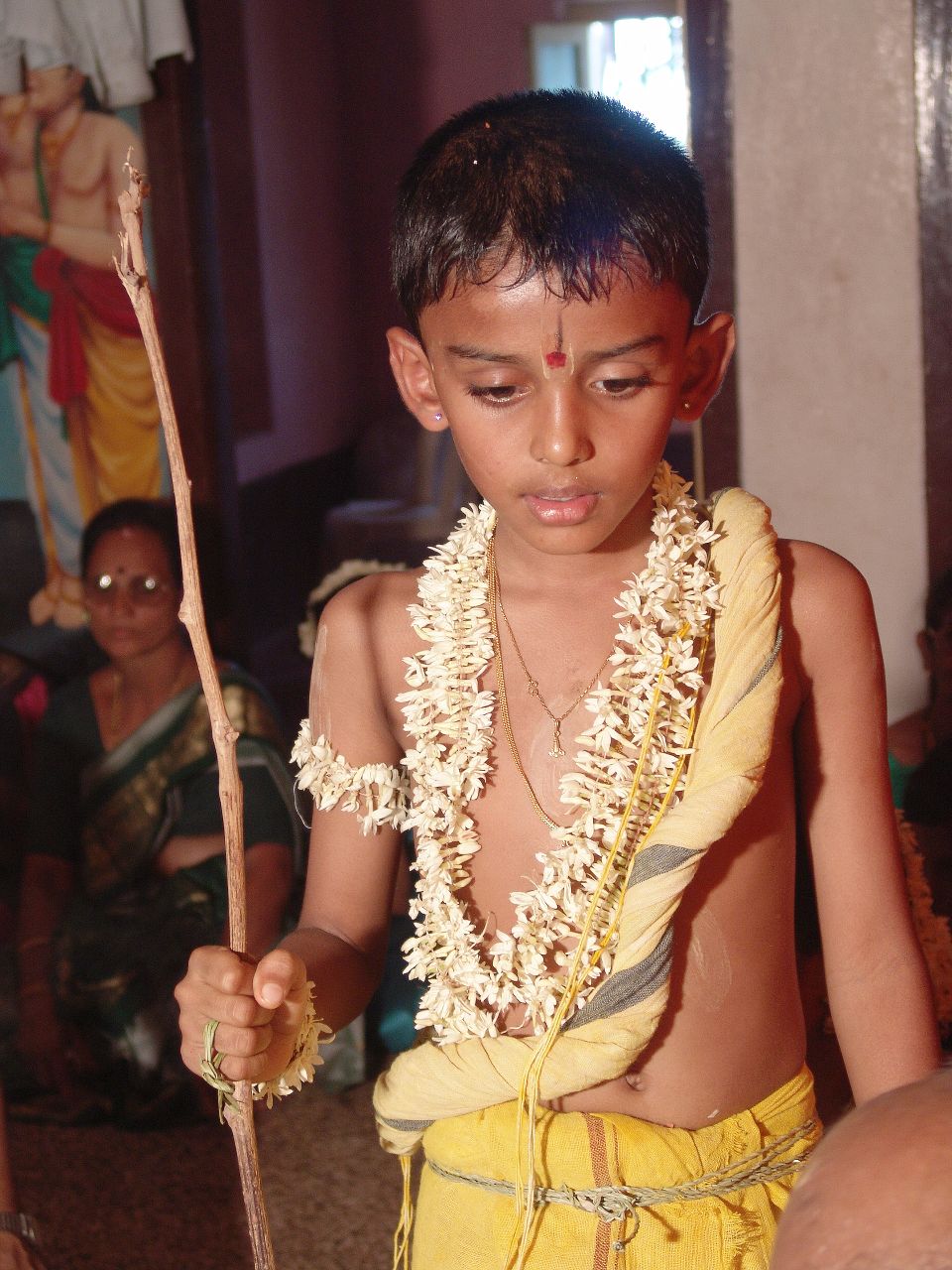
The yajñopavīta, also called janeu, is the thread a boy receives at the ceremony and wears afterwards. Its name comes from yajña, sacrifice, and upavīta, worn, so it means something worn for the sacrifice. With it come a daṇḍa, a staff, and a mekhala, a girdle. Commonly it is three cotton strands, each made of nine threads. Among Tamil families each strand stands for one of the Tridevī, Sarasvatī, Lakṣmī and Pārvatī, while another tradition reads the nine threads as male deities such as Agni, Bhaga and Chandra. Once the strand was an upper garment rather than a cord; a thread proved easier to manage.
Age, varna and women
Medieval texts give a different age for each varna: about eight for Brāhmaṇas, eleven for Kṣatriyas and twelve for Vaiśyas. One ancient sutra, the Apastamba Gṛhya Sutra, sets twenty-four as the latest age, while the Gautama Gṛhya Sūtra and others allow any age. Śūdras had no share in the Vedic rite. Some texts let girls of the three varnas begin Vedic study after upanayana, at eight, and call them Brahmavadinī; a girl who married instead, the Sadyovadhu, completed a symbolic form of the rite within the wedding. Today it is open to anyone at any age.
How Upanayana is kept
A family invites a teacher and gathers for the ceremony. The teacher gives the child the yajñopavīta, the sacred thread, to wear, and often a daṇḍa, a staff, and a mekhala, a girdle, as well. The child asks for alms, the ceremonial bhikṣa, which over the centuries grew into a sizeable part of the day. The initiation itself is fixed at the moment the Gāyatrī Mantra is recited. Four days after the first rituals the last one, Medhajanana, is held, and the spiritual birth is complete. The Samavartanam, a convocation, closes the course of study.
When and where
Upanayana usually comes before a child grows up. Old texts suggest eight for a Brāhmaṇa boy, eleven for a Kṣatriya, twelve for a Vaiśya, and some set twenty-four as the outer limit; others say age does not matter. A prior rite, Vidyārambhaṃ, marks the start of literacy, and upanayana follows it.
It is kept in Hindu homes in India and Nepal, and it is strongest among the Brāhmaṇa, Kṣatriya and Vaiśya families whose teachers live nearby. Practice differs a great deal from region to region, so a ceremony in one place rarely looks exactly like one elsewhere. It can also be held at a student's own home when the child is taught there.
What Upanayana means
Those who keep upanayana say a person is born twice: once to the body and once to knowledge. The thread is a reminder of why the student is studying and a sign, visible to others, that this person has taken a second birth. The teacher stands for the link between the student and the goddess of learning, and the whole rite places a young life under the care of education, discipline and duty.


Questions people ask about Upanayana
When is Upanayana kept?
Upanayana is kept on usually before adulthood, most often around the age of eight to twelve.
What is upanayana?
It is a Hindu rite of passage, one of the saṃskāras, in which a teacher accepts a student and formal religious study begins. Many communities treat it as a second, spiritual birth, and the sacred thread given at the ceremony is worn afterwards.
Where is it kept?
In Hindu families in India and Nepal, under many local names and with wide local differences. It can take place at the student's own home when the child is schooled there.
What is the sacred thread?
The yajñopavīta, often called janeu, is a strand worn after the rite. Its name means something worn for the sacrifice. It is commonly three cotton strands of nine threads each, and the daṇḍa staff and mekhala girdle may be given with it.
Do girls go through it?
Some texts say girls of the three varnas did, at about eight, and were then called Brahmavadinī and could begin Vedic study. A girl who married instead, the Sadyovadhu, completed a symbolic form of the rite within the wedding.
See also
 Tribal youth dormitoryA communal house where a tribe's unmarried young people sleep, learn and serve
 GarbaA Gujarati circle dance performed around a sacred flame during the festival of Navratri
 Postpartum confinementA period of rest, nourishment, and seclusion for mothers after giving birth.
 PeʻaThe traditional Samoan rite of full-body tattooing for men, tapped by master artists
Good reading and sources
- Encyclopaedia BritannicaArticle
- Correct textbooks or face agitation, say Lingayat mathsThe Hindu, Article
- Correct textbooks or face agitation, say Lingayat mathsThe Hindu, Article
- Upanayana on WikipediaEncyclopedia
- More photos on Wikimedia CommonsPhotos and video
- Wikidata recordOpen data
The facts on this page come from the Wikipedia article "Upanayana", written by its contributors and used under the CC BY-SA 4.0 licence, and from its Wikidata record (CC0). EveryParampara rewrote the text in its own words, with AI assistance, and compares every page with the article to make sure no passage is copied. It may be reused under the same CC BY-SA 4.0 licence with a link back.
It may contain mistakes. Traditions differ from one family, village and community to the next, and the people who keep them know them best. If something is wrong, tell us. Last refreshed 2026-10-05.
More from India
All the traditions of India
🇮🇳 India and 5 moreTribal youth dormitoryMorung
A communal house where a tribe's unmarried young people sleep, learn and serveRite of passage
🇮🇳 IndiaVision quest
A coming-of-age fast and vigil, kept by some Native American peoplesRite of passage
🇮🇳 IndiaRitu Kala SamskaramRitushuddhi
A South Indian Hindu coming-of-age ceremony for girls after their first period.Rite of passage
 🇯🇵 Kyoto, Japan and 5 moreTeeth blackening
A custom of dyeing teeth black to mark adulthood and beauty in parts of Asia and Oceania.Rite of passage
🇯🇵 Kyoto, Japan and 5 moreTeeth blackening
A custom of dyeing teeth black to mark adulthood and beauty in parts of Asia and Oceania.Rite of passage
The same idea elsewhere
Coming of age compared 🇪🇬 Egypt and 5 moreTraditional tattooing
The ancient custom of marking the skin for protection, healing, status and sacred ritesDress
🇼🇸 Samoa and 1 morePeʻa
The traditional Samoan rite of full-body tattooing for men, tapped by master artistsRite of passage
🇪🇬 Egypt and 5 moreTraditional tattooing
The ancient custom of marking the skin for protection, healing, status and sacred ritesDress
🇼🇸 Samoa and 1 morePeʻa
The traditional Samoan rite of full-body tattooing for men, tapped by master artistsRite of passage
 🇵🇬 Maprik, Papua New GuineaHaus Tambaran
A sacred house of the Sepik peoples, used for ancestor worship and male initiationSpiritual
🇵🇬 Maprik, Papua New GuineaHaus Tambaran
A sacred house of the Sepik peoples, used for ancestor worship and male initiationSpiritual
 🇮🇱 IsraelTallitטלית
A four-cornered Jewish prayer shawl with ritual fringes worn during worshipSpiritual
🇮🇱 IsraelTallitטלית
A four-cornered Jewish prayer shawl with ritual fringes worn during worshipSpiritual