Life-cycle ritesSouth AsiaHindu
Vidyarambham
In its own language: विद्यारम्भ
A Hindu rite of passage introducing young children to reading, writing and the arts
Vidyarambham is a Hindu initiation ceremony performed in India to introduce young children to letters and formal education. Celebrated widely on Vijayadashami, elders honour the goddess Saraswati while guiding a child's finger to write their first words in grains.
When is Vidyarambham marked?
Vidyarambham is kept as part of Dussehra, which is on Tuesday, 20 October 2026.
Vidyarambham is a Hindu initiation ritual where children take their first steps into learning and literacy. Dedicated to Saraswati, the goddess of wisdom, this rite marks the transition into formal education. During the ceremony, an elder or instructor guides the child's hand to draw sacred words and alphabet letters in grains, seeking blessings before the young student enters school or starts training in arts and music.
The initiation ritual
The rite generally takes place after a child reaches four years of age. A bed of raw rice grains or whole wheat is spread over a fresh banana leaf before a sacred altar. The father or an instructor chants a sacred phrase, such as the Panchaksharam or Ashtaksharam mantra. Guiding the child's index finger, the adult traces the syllables of the prayer across the grain bed. After tracing the mantra, the child writes the alphabet of their mother tongue into the grain. Once this first lesson is finished, the child is ready to start formal schooling.
Origins and development
Ancient Indian texts, including the Arthashastra from around the first or second century, describe this ceremony taking place after the ritual tonsure or hair-cutting. It occurred prior to the upanayana initiation, though it became widespread as a separate practice later. In early times, when Sanskrit was predominantly a spoken tongue, early childhood reading and writing did not need a separate preparatory ceremony. Historically, families conducted this introduction to letters when a youngster was between five and seven years old.
Reverence and offerings
Because the ceremony falls on Vijayadashami, the final day of Navaratri, it connects closely with the worship of Saraswati and the Ayudha Puja ritual, when work tools and instruments are ritually resumed. Participants also show reverence to teachers and mentors through gurudakshina, a traditional token of respect. Families offer their instructors areca nuts, betel leaves, a monetary gift, and fresh clothing such as a sari or a dhoti, honouring their role in guiding the child's educational journey.
Regional variations
The rite is widely observed across southern India, including Kerala, Karnataka, Tamil Nadu, Andhra Pradesh and Telangana. In Kerala, children are also introduced to musical training, dance and folk arts during the festival. In Telangana, many families bring their children to the Gnana Saraswati Temple located in Basar. In the eastern state of Odisha, where it is known as Khadi Chuan, the ceremony takes place on different holy days, specifically Ganesh Chaturthi and Vasant Panchami.
How Vidyarambham is kept
Families gather at home or in temples, laying out a banana leaf piled with uncooked rice or whole wheat. An elder or teacher chants a traditional mantra and holds the child's hand, using their finger to trace the sacred words into the grain. The child then writes the letters of their native script. Afterwards, the family presents the teacher with betel leaves, areca nuts, clothing and a small offering of money before preparing the child for formal schooling.
When and where
Vidyarambham is most commonly held on Vijayadashami, the tenth and closing day of the Navaratri festival. Families may also select an auspicious time, known as a muhurta. In Odisha, people celebrate the rite on the festivals of Ganesh Chaturthi and Vasant Panchami.
The tradition is especially popular in the South Indian states of Kerala, Karnataka, Tamil Nadu, Andhra Pradesh and Telangana, as well as in Odisha. It is performed in household shrines and at major pilgrimage sites such as the Gnana Saraswati Temple in Basar, Telangana.
What Vidyarambham means
The ceremony marks a child's auspicious threshold into literacy, knowledge and cultural arts. Dedicated to the goddess Saraswati, it links the act of learning with divine blessing. Writing the first letters into grain signifies respect for language, while gifts presented to teachers highlight the enduring value placed on mentorship and guidance.
Days Vidyarambham is marked
Questions people ask about Vidyarambham
When is Vidyarambham marked?
Vidyarambham is kept as part of Dussehra, which is on Tuesday, 20 October 2026.
What is Vidyarambham?
Vidyarambham is a Hindu initiation rite where young children are introduced to the alphabet and writing before starting school. It marks the commencement of their education under the blessings of the goddess Saraswati.
How is the writing ritual performed?
A father or teacher holds the child's finger to trace sacred mantras and native letters across a layer of raw rice or wheat spread on a banana leaf.
What gifts are given to teachers during the ceremony?
Families offer a token of respect called gurudakshina, which includes betel leaves, areca nuts, a modest monetary gift, and new garments like a dhoti or sari.
See also
 SaptapadiThe seven-step ritual that finalizes a Hindu marriage, observed across India.
 Tribal youth dormitoryA communal house where a tribe's unmarried young people sleep, learn and serve
 Postpartum confinementA period of rest, nourishment, and seclusion for mothers after giving birth.
 MatchmakingThe custom of using a trusted intermediary to introduce partners for marriage
Good reading and sources
The facts on this page come from the Wikipedia article "Vidyāraṃbhaṃ", written by its contributors and used under the CC BY-SA 4.0 licence, and from its Wikidata record (CC0). EveryParampara rewrote the text in its own words, with AI assistance, and compares every page with the article to make sure no passage is copied. It may be reused under the same CC BY-SA 4.0 licence with a link back.
It may contain mistakes. Traditions differ from one family, village and community to the next, and the people who keep them know them best. If something is wrong, tell us. Last refreshed 2026-10-06.
More from India
All the traditions of India
🇮🇳 IndiaSaptapadiसप्तपदी (Sanskrit), सात फेरे (Marathi)
The seven-step ritual that finalizes a Hindu marriage, observed across India.Rite of passage
🇮🇳 India and 5 moreTribal youth dormitoryMorung
A communal house where a tribe's unmarried young people sleep, learn and serveRite of passage
🇨🇳 China and 5 morePostpartum confinement
A period of rest, nourishment, and seclusion for mothers after giving birth.Rite of passage
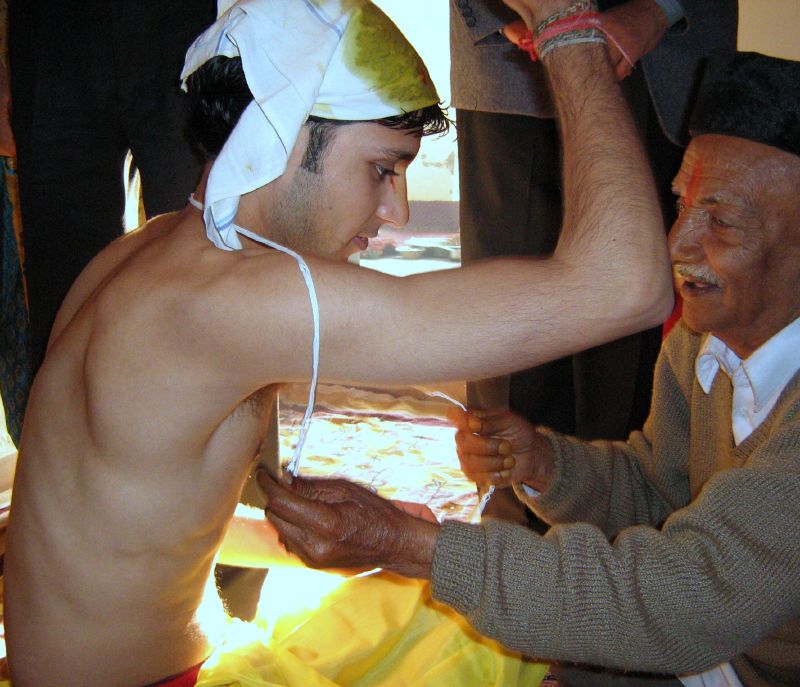 🇮🇳 India and 1 moreUpanayanaउपनयन (Sanskrit)
A Hindu rite of passage that begins a child's study and marks a second birthRite of passage
🇮🇳 India and 1 moreUpanayanaउपनयन (Sanskrit)
A Hindu rite of passage that begins a child's study and marks a second birthRite of passage
The same idea elsewhere
All of this kind 🇼🇸 Samoa and 1 morePeʻa
The traditional Samoan rite of full-body tattooing for men, tapped by master artistsRite of passage
🇺🇬 UgandaKwanjula
A formal marriage introduction ritual of the Baganda people in Uganda, where families meet to exchange gifts and seek blRite of passage
🇼🇸 Samoa and 1 morePeʻa
The traditional Samoan rite of full-body tattooing for men, tapped by master artistsRite of passage
🇺🇬 UgandaKwanjula
A formal marriage introduction ritual of the Baganda people in Uganda, where families meet to exchange gifts and seek blRite of passage
 🇺🇸 United States and 1 moreIslamic marriageنِكَاح
The sacred contract, agreement and wedding celebration forming an Islamic marriageRite of passage · Feasts and festival meals
🇺🇸 United States and 1 moreIslamic marriageنِكَاح
The sacred contract, agreement and wedding celebration forming an Islamic marriageRite of passage · Feasts and festival meals