Crafts and makingSouth AsiaIndigenous and traditional
Warli painting
Sacred white rice paste murals made on red clay walls in western India

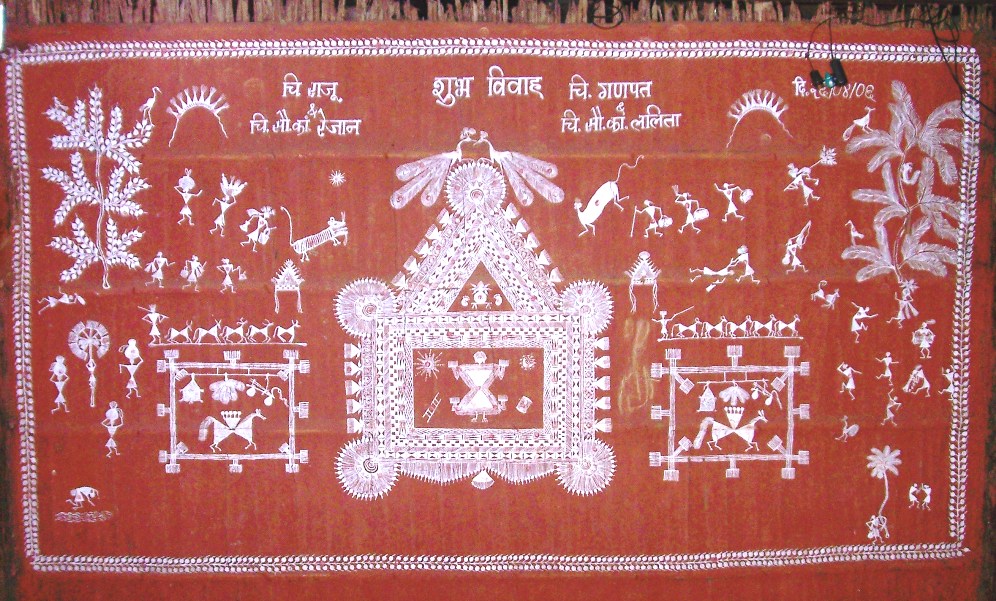
Warli painting is a traditional mural craft practiced by the Warli people of Maharashtra in western India. Traditionally created by women on clay hut walls for weddings and harvests, these artworks use white rice paste and geometric shapes to illustrate daily village life and nature.
When is Warli painting kept?
Warli painting is kept during weddings, harvests, and seasonal festivals.
Warli painting is a traditional mural art practiced by the Warli people of the North Sahyadri Range in western India. Traditionally created by women on the clay walls of their homes, these paintings use white rice pigment and basic geometric shapes. The art portrays farming life, wildlife, and reverence for Mother Nature, turning domestic huts into sacred storytelling spaces for weddings, harvests, and community rituals.
Natural materials and tools
The foundation of a Warli painting begins with the wall of a village hut. Builders craft these surfaces from earth, branches, and crushed red brick, giving the background a warm red ochre shade. Artists then mix rice flour with water and gum to produce a plain white paint. For a brush, they chew the tip of a small bamboo twig until its fibres separate into soft bristles. Because these murals are created to celebrate milestones like harvests and marriages, painters apply their work with the expectation that future generations will look upon it.
Shapes and sacred motifs
Warli visual language relies on circles, triangles, and squares. Circles represent the sun and moon, while triangles depict pointed trees and rugged mountains. Human inventions like fields or sacred spaces appear as squares, known as chauk or chaukat. Inside the devotional Devchauk, painters place Palghat, the mother goddess who represents fraternity. Human figures are formed by connecting two triangles at their apexes to show the pelvis and torso. This dual shape evokes the equilibrium of the universe while giving lively movement to dancers, farmers, and hunters.
Music and the circle dance
Community celebrations and dances frequently appear along the borders of ritual murals. Central to many paintings is the tarpa dance, where village men take turns playing a wind instrument shaped like a trumpet. Dancers link their hands and wind around the musician in a sweeping spiral that echoes the continuous circle of life. The musician acts like a snake charmer, playing distinct notes that tell the leading dancer whether to turn clockwise or counterclockwise. Performers never turn their backs to the tarpa, winding into the audience as they move.
Evolution beyond the wall
Warli art has roots thought to reach back as far as the tenth century, long serving to pass down lore without written text. It changed dramatically during the 1970s through the work of artist Jivya Soma Mashe and his son Balu Mashe in the Thane district. They began painting outside ritual contexts purely for artistic expression, transferring the style onto canvas and paper. Modern initiatives have secured geographical indication status for the craft, helping protect the intellectual property of the Warli community while sustaining local artists.
How Warli painting is kept
When a wedding or harvest festival arrives, village women prepare the hut walls with a smooth coat of mud, red brick, and soil. Working with a frayed bamboo stick, the painters dip into white rice paste to draw a central sacred square. Around this core motif, they paint scenes of communal life, adding hunters, farmers, domestic livestock, and circular dancers. Every scene is built using simple triangles, circles, and lines, capturing shared stories and honoring the spirits of nature.
When and where
Traditionally, Warli murals are painted during significant milestones and seasonal occasions. Families decorate their homes to celebrate weddings, harvest gatherings, and local festivals, creating the imagery to mark the event and preserve stories for future generations.
Warli painting is rooted in the North Sahyadri Range of Maharashtra, India. It is actively practiced across settlements and towns such as Dahanu, Talasari, Jawhar, Palghar, and Mokhada, located outside Mumbai.
What Warli painting means
The imagery reflects deep reverence for Mother Nature and the balance of the universe. Triangles joined at their tips symbolize cosmic equilibrium, with inverted widths distinguishing men from women. The central square represents protected land and sacred enclosures, housing the mother goddess Palghat. In dance scenes, the spiral formation around the tarpa player represents the circle of life, while circles and triangles honour the sun, moon, and mountain landscapes.



Questions people ask about Warli painting
When is Warli painting kept?
Warli painting is kept during weddings, harvests, and seasonal festivals.
What is Warli painting?
Warli painting is a traditional folk art created by the Warli people of western India. Drawn primarily with white rice paste on ochre clay walls, it uses basic geometric figures like circles, triangles, and squares to portray daily farming life, folklore, and reverence for nature.
Where did Warli art originate?
The tradition comes from the North Sahyadri Range in Maharashtra, India. It remains widely practiced in rural regions and towns such as Palghar, Dahanu, Talasari, Jawhar, and Mokhada, situated north of Mumbai.
What materials do Warli artists use?
Artists paint on hut walls prepared with earth, branches, and red brick. They make a white pigment by mixing ground rice flour with water and gum, using a chewed bamboo stick as a makeshift paintbrush.
What does the tarpa dance represent in the paintings?
The tarpa dance depicts men and women linking hands in a spiral around a trumpet player. This circular movement symbolizes the circle of life, with the dancers weaving like a snake as the musician directs their steps.
See also
 PhulkariGeometric and floral threadwork embroidered by Punjabi women on handwoven cotton.
 Persian gardenAn ancient tradition of creating walled, geometric sanctuaries of shade and flowing water
 HoliA spring festival of colours and bonfires that marks the end of winter and the triumph of good over evil.
 Akhand PathThe unbroken, continuous reading of the entire Sikh scripture over two days
Good reading and sources
- Telling stories and drawing life - Indian Warli Community projects at the V&A Museum of ChildhoodV&A, Article
- Telling stories and drawing life - Indian Warli Community projects at the V&A Museum of ChildhoodV&A, Article
- Warli painting on WikipediaEncyclopedia
- More photos on Wikimedia CommonsPhotos and video
- Wikidata recordOpen data
The facts on this page come from the Wikipedia article "Warli painting", written by its contributors and used under the CC BY-SA 4.0 licence, and from its Wikidata record (CC0). EveryParampara rewrote the text in its own words, with AI assistance, and compares every page with the article to make sure no passage is copied. It may be reused under the same CC BY-SA 4.0 licence with a link back.
It may contain mistakes. Traditions differ from one family, village and community to the next, and the people who keep them know them best. If something is wrong, tell us. Last refreshed 2026-10-04.
More from India
All the traditions of India
🇮🇷 Isfahan, Iran and 3 morePersian gardenباغ ایرانی
An ancient tradition of creating walled, geometric sanctuaries of shade and flowing waterCraft
🇮🇳 India and 1 morePhulkariਫੁਲਕਾਰੀ
Geometric and floral threadwork embroidered by Punjabi women on handwoven cotton.Craft
 🇮🇩 Bali, Indonesia and 5 moreIkat
A resist-dyeing craft from Southeast Asia, where yarns are tied and dyed before weavingCraft
🇮🇩 Bali, Indonesia and 5 moreIkat
A resist-dyeing craft from Southeast Asia, where yarns are tied and dyed before weavingCraft
 🇮🇷 Iran and 4 moreZardoziزردوزی (zarduzi)
Heavy gold and silver embroidery on silk or velvet, worked in Iran, India and beyondCraft
🇮🇷 Iran and 4 moreZardoziزردوزی (zarduzi)
Heavy gold and silver embroidery on silk or velvet, worked in Iran, India and beyondCraft
The same idea elsewhere
Harvest and thanksgiving compared 🇹🇱 Timor-LesteUma Lulik
Sacred ancestral clan houses and ritual shrines in East TimorSpiritual
🇹🇱 Timor-LesteUma Lulik
Sacred ancestral clan houses and ritual shrines in East TimorSpiritual
 🇲🇦 Rabat, Morocco and 5 moreFantasiaالفانتازيا
A North African equestrian display of synchronized charging and simultaneous rifle fireGame
🇲🇦 Rabat, Morocco and 5 moreFantasiaالفانتازيا
A North African equestrian display of synchronized charging and simultaneous rifle fireGame
 🇨🇳 Yining, China and 1 moreMeshrepمەشرەپ
A Uyghur gathering of music, poetry, dance and moral counsel at harvest and weddingsPerformance
🇨🇳 Yining, China and 1 moreMeshrepمەشرەپ
A Uyghur gathering of music, poetry, dance and moral counsel at harvest and weddingsPerformance
 🇮🇱 Jerusalem, IsraelPassoverפסח
A Jewish spring festival celebrating freedom from slavery with ritual mealsSpiritual · Dinner
🇮🇱 Jerusalem, IsraelPassoverפסח
A Jewish spring festival celebrating freedom from slavery with ritual mealsSpiritual · Dinner