Music, dance and storytellingEast AsiaBuddhistShinto, Taoist and folk Chinese
Xi'an guyue
In its own language: 西安鼓乐
Ritual wind and percussion music from Xi'an, played sitting or walking

Xi'an guyue is the ritual wind and percussion music of Xi'an, in Shaanxi Province, China. Amateur ensembles kept it going before the 1960s. It has sitting and walking ways of playing, and three lines of transmission: Buddhist, Daoist and secular. UNESCO listed it in 2009.
Xi'an guyue is a ritual music of Xi'an, in Shaanxi Province, China, played by wind and percussion ensembles. English writers sometimes call it Xi'an drum music, a name that misleads, because the ensemble is not only drums. Amateur groups kept the genre alive. UNESCO listed it in 2009. Its pieces come down through Buddhist, Daoist and secular lines.
What it is
Xi'an guyue is ritual music from Xi'an, a city in Shaanxi Province, China. A wind and percussion ensemble plays it, and the genre takes its name from the city. Amateur groups, rather than professional players, carried it before the 1960s. Performers work in two ways: sitting, and walking, and the walking kind adds a chorus. The sound belongs to temple life and to neighbourhood groups rather than to concert halls. Its stylistic root is ritual music. The instruments are simply grouped as wind and percussion. In English the genre is sometimes labelled Xi'an drum music, a name that hides how much of the sound comes from wind instruments.
Lines of transmission
Guyue passes down through three repertoires, each named for the tradition that carried it. Seng is the Buddhist line, Dao the Daoist line, and Su the secular one. That division concerns transmission, not the sound of one performance. Manuscripts written in gongche, a Chinese notation, record the music. Old books also list instruments that ensembles no longer use: the pipa, a plucked lute, and the daqin, which is probably the zheng. Three bodies of pieces therefore exist side by side, and a group's place in one of them shapes what it performs.
Origins and history
People often link Xi'an guyue with the Tang dynasty, because of the prestige and the history that go with it. Researchers are careful here: the music as it survives has more in common with the late Ming and Qing dynasties. One famous figure is An Laixu (1895-1977), a Daoist master at Xi'an's Chenghuangmiao, the City God temple. Manuscripts gathered in the 1950s go back as far as 1689, but nobody now knows how to perform pieces that old. The 1930s and 1940s were a high point, and the Cultural Revolution of the 1960s and 1970s sharply cut the number of ensembles and temples.
Today and change
After the Cultural Revolution, Xi'an guyue came back, but in a changed shape. From the 1980s it returned more as historical preservation, academic research and tourism than as religious practice. In 2009 UNESCO inscribed it on the Representative List of the Intangible Cultural Heritage of Humanity as the Xi'an wind and percussion ensemble, with China as the state party. Study of the genre continues. A 2005 dissertation at the School of Oriental and African Studies in London asked whether music of this kind is better understood as a living fossil or as a flowing river.
How Xi'an guyue is kept
Amateur ensembles are the keepers, and the players work on wind and percussion instruments. Pieces are played in two settings: sitting, and walking, with the walking form adding voices in chorus. Which pieces a group plays depends on the repertoire it inherits, Buddhist, Daoist or secular. Manuscripts in gongche notation carry the music between generations. Groups once travelled between the temples of the region, and those meetings carried a competitive edge. Newer support for the genre comes from preservation and study, which shapes how it is staged now.
When and where
Xi'an guyue belongs to Xi'an, in Shaanxi Province, China, and takes its name from the city. It grew out of temple life, and one documented home is the Chenghuangmiao, Xi'an's City God temple, where the Daoist master An Laixu was based. Ensembles also worked across the region's temples, moving from one to another in the 1930s and 1940s.
What Xi'an guyue means
For the people who keep it, Xi'an guyue is ritual music first. It belongs with temple worship, and its repertoires carry the names of the traditions that handed them down: Buddhist, Daoist and secular. The aura of the Tang dynasty gives the genre much of its standing, even though researchers place the surviving music closer to the late Ming and Qing. The manuscripts matter as much as the sound. They are the proof of how far back the practice reaches, and a reminder that some of it can no longer be played.

Questions people ask about Xi'an guyue
What is Xi'an guyue?
It is the ritual music of Xi'an, in Shaanxi Province, China, played by an ensemble of wind and percussion instruments. The genre is named after the city. It passes down in three repertoires, Buddhist, Daoist and secular, and UNESCO recognised it in 2009.
Where is it kept?
Its home is Xi'an, in Shaanxi Province, China. The music grew out of temple life, and the Chenghuangmiao, the city's City God temple, is tied to it through the Daoist master An Laixu. Ensembles once travelled between temples of the region.
Is it the same as Xi'an drum music?
Xi'an drum music is another name for the genre, and a misleading one, since the ensemble uses wind instruments as well as percussion. Chinese sources call it Xi'an guyue, or Shaanxi guyue, after the province.
What are the sitting and walking forms?
Performers work in two ways. In the sitting form the ensemble plays in place. In the walking form the players move, and a chorus joins them. Alongside this, the music is divided by transmission into three repertoires: Buddhist, Daoist and secular.
Is it still performed today?
Yes. Amateur ensembles carried it before the 1960s. After the Cultural Revolution reduced ensembles and temples in the sixties and seventies, it returned from the 1980s, more as historical preservation, academic research and tourism than as religious practice.
See also
 KizombaA close, slow couple dance from Angola, named after a Kimbundu word for party
 Chinese operaA sung, danced and acrobatic theatre from China, in over a hundred regional styles
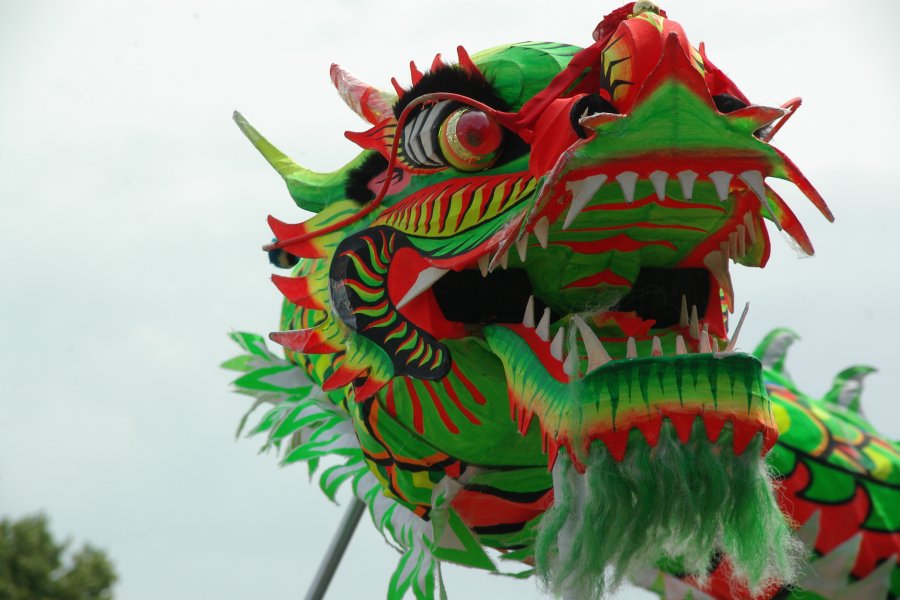 Dragon danceA long dragon puppet on poles, danced by a team at Chinese New Year and other festivals
 Glove puppetryA traditional theatre of cloth-bodied puppets with carved wooden heads and live music
Good reading and sources
- Xi'an guyue on WikipediaEncyclopedia
- More photos on Wikimedia CommonsPhotos and video
- Wikidata recordOpen data
The facts on this page come from the Wikipedia article "Xi'an guyue", written by its contributors and used under the CC BY-SA 4.0 licence, and from its Wikidata record (CC0). EveryParampara rewrote the text in its own words, with AI assistance, and compares every page with the article to make sure no passage is copied. It may be reused under the same CC BY-SA 4.0 licence with a link back.
It may contain mistakes. Traditions differ from one family, village and community to the next, and the people who keep them know them best. If something is wrong, tell us. Last refreshed 2026-10-09.
More from China
All the traditions of China 🇹🇼 Yilan, Taiwan and 4 moreTaiwanese opera歌仔戲
A Taiwanese theatrical art of Hokkien balladry, stylized staging, and expressive song.Performance
🇹🇼 Yilan, Taiwan and 4 moreTaiwanese opera歌仔戲
A Taiwanese theatrical art of Hokkien balladry, stylized staging, and expressive song.Performance
 🇨🇳 China and 5 moreLion dance舞獅
A dynamic ritual dance featuring costumed lions, drums and martial acrobaticsPerformance
🇨🇳 Quanzhou, China and 3 moreGlove puppetry布袋戲
A traditional theatre of cloth-bodied puppets with carved wooden heads and live musicPerformance
🇨🇳 China and 5 moreLion dance舞獅
A dynamic ritual dance featuring costumed lions, drums and martial acrobaticsPerformance
🇨🇳 Quanzhou, China and 3 moreGlove puppetry布袋戲
A traditional theatre of cloth-bodied puppets with carved wooden heads and live musicPerformance
 🇨🇳 China and 5 moreShadow play
A storytelling art using flat puppets and light to cast moving silhouettes on a screen.Performance
🇨🇳 China and 5 moreShadow play
A storytelling art using flat puppets and light to cast moving silhouettes on a screen.Performance
The same idea elsewhere
All of this kind 🇹🇷 Kayseri, Turkey and 4 moreHalay
A traditional line and circle folk dance kept across Turkey, Azerbaijan, Armenia, Iran, and Syria.Performance
🇧🇷 BrazilBaião
A syncopated folk rhythm and partnered dance from northeastern BrazilPerformance
🇹🇷 Kayseri, Turkey and 4 moreHalay
A traditional line and circle folk dance kept across Turkey, Azerbaijan, Armenia, Iran, and Syria.Performance
🇧🇷 BrazilBaião
A syncopated folk rhythm and partnered dance from northeastern BrazilPerformance
 🇺🇦 Kyiv, UkraineBanduraБандура
A Ukrainian plucked string instrument played to accompany epic songs and folk balladsPerformance
🇺🇦 Kyiv, UkraineBanduraБандура
A Ukrainian plucked string instrument played to accompany epic songs and folk balladsPerformance
 🇳🇿 Auckland, New ZealandPoi
A Māori performing art of swinging tethered weights in rhythmical patterns.Performance
🇳🇿 Auckland, New ZealandPoi
A Māori performing art of swinging tethered weights in rhythmical patterns.Performance