Folklore and beliefEast AsiaShinto, Taoist and folk Chinese
Yin and yang
In its own language: 陰陽
Two opposite but complementary forces that Chinese thought sees in all things

Yin and yang is an idea from ancient Chinese philosophy: two forces that are opposite yet complementary, each holding a seed of the other. It has shaped Chinese thought for more than two thousand years, runs through medicine, martial arts, divination and the I Ching, and is part of life in Japan as well.
When is Yin and yang kept?
Yin and yang is kept on not tied to a date or season; used all year round.
Yin and yang is an old Chinese idea of two cosmic forces that are opposite yet dependent on each other. Neither can exist alone; each holds a trace of the other, and their turning together keeps the world in motion. The idea runs through philosophy, medicine, martial arts and divination, and it began as a way of reading hillsides, sunlight and shade.
The two forces
Yin and yang are not good and evil. They are two halves of one turning movement. Yin is the cool, still, shaded, drawing-in side; yang is the warm, moving, bright, spreading-out side. The words began as plain geography: yin was the north face of a hill, yang the south face, two sides of the same slope. Nothing is purely one or the other. Light gives way to dark, dark to light, and each carries a small seed of its opposite. Chinese thought applies the pair to seasons, weather, landscape, the body, the mind, and to change over days, years and ages.
Origins and history
Archaeologists found the oldest known image of this kind on an urn-shaped coffin at Ruzhou, from the Yangshao culture, around 4500 BCE. The design is not the familiar circle: two black shapes turn in opposite directions, and the find may point to an early concern with death and the netherworld that is now unclear. The philosophical use of the two words came much later. Joseph Needham placed its start at about the start of the 4th century BCE. Zou Yan, who lived from about 305 to 240 BCE, is the thinker most tied to the school named after yin and yang.
In medicine and practice
Because the pair was thought to describe both the body and the world, it became a working tool. Traditional Chinese medicine treats it as a main guide, reading health as a balance between the two forces. The same idea sits at the centre of martial arts and movement practice, among them tai chi, baguazhang, qigong, kung fu and daoyin. It runs through the I Ching, the classic book of change used for divination, and through the Huangdi Neijing, a Taoist medical work. Early Chinese science and technology also drew on it, seeing natural opposites such as fire and water, or expanding and contracting, as signs of the pair.
Words, names and places
Both words came into English as loanwords. The Oxford English Dictionary records yin and yang from 1671, yin-yang from 1850, and yang-yin from 1959. English speakers usually keep that order, but Chinese normally puts the positive word first, as in heaven and earth or men and women. Yinyang is an exception, and scholars have offered several explanations, among them ease of speech. The words also live in place names. Hengyang lies south of Mount Heng and Luoyang north of the Luo River, so each name carries the sunny side of the land. In western Japan the same characters divide the San'in region in the north from San'yō in the south.
The circle symbol
The best known picture of the idea is a circle split by a curved S-shaped line into a dark half and a light half, with a dot of the opposite colour inside each. This diagram is a taijitu, and in English it is often called the yin and yang symbol. The dark side stands for yin and the light for yang, and the dots show that each holds a trace of the other. Many versions of the design exist, and the neat rounded shape familiar today is only one of them.
How Yin and yang is kept
There is no fixed rite or calendar. The idea is kept by using it. A physician reads a patient's signs as a balance of the two forces. A martial artist or qigong practitioner softens one movement and firms the next. A diviner casts the I Ching and follows its changing lines. Taoists and Confucians argued for centuries over what the pair means: Taoist metaphysics treats moral opposites as perceptual rather than real, while Confucian ethics, especially in Dong Zhongshu's writing, gives them a moral weight. The words also stay in daily speech, in names for sunlight and shade.
When and where
Yin and yang is not tied to a date or a season; it is a way of thinking used all year. Its story is dated by texts and finds: an image on a coffin at Ruzhou around 4500 BCE, philosophical use beginning about the start of the 4th century BCE, and the work of Zou Yan and Dong Zhongshu in the centuries after.
The idea belongs to China, where it grew out of philosophy, medicine and the reading of landscape. It also became part of life in Japan, where the same characters name the San'in and San'yō regions of western Honshu. Chinese place names carry it widely: Hengyang in Hunan, Luoyang in Henan and Huayin in Shaanxi each take their second character from the sunny or shady side of a hill or river.
What Yin and yang means
For those who keep it, yin and yang says that nothing stands alone. Health, weather, seasons and moods are read as movements between two poles that need each other, so illness or bad fortune is a matter of imbalance rather than a separate enemy. In Taoist metaphysics the pair is an indivisible whole, and judgments of good and bad are seen as perceptual rather than real. Confucian thinkers instead gave the two sides a moral weight. Many people simply take it as a reminder that change is constant and that opposites belong together.
Questions people ask about Yin and yang
When is Yin and yang kept?
Yin and yang is kept on not tied to a date or season; used all year round.
What is yin and yang?
It is an idea from ancient Chinese philosophy. Yin and yang are two cosmic forces that are opposite yet complementary, each supporting and containing the other. Together they form one system that keeps changing. The pair is not a contest between good and evil; both halves are needed for the whole to hold together.
Where does it come from?
It comes from China. The words first meant the shady and sunny sides of a hill. An image on an urn-shaped coffin found at Ruzhou, from the Yangshao culture around 4500 BCE, is the oldest iconography known. Philosophical use of the terms began about the start of the 4th century BCE.
Is it a religion?
Not exactly. It comes from Chinese philosophy and is woven into Taoist metaphysics, Confucian ethics and Chinese folk belief, as well as traditional medicine and martial arts. Many people use the idea without belonging to any religious group. Taoists and Confucians have read it in different ways.
What does the black and white circle mean?
The circle, called a taijitu, is split by an S-shaped line into a dark half and a light half, with a dot of the opposite colour in each. The dark stands for yin and the light for yang. The dots show that each force contains a seed of the other, and that neither is complete alone.
See also
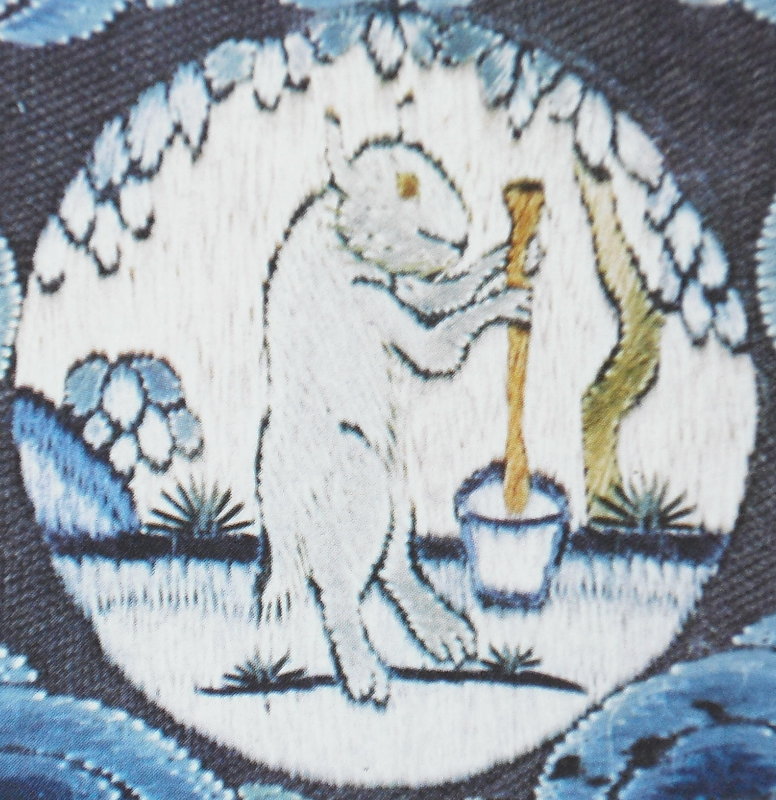 Moon rabbitA hare seen in the Moon's dark patches, pounding rice cakes or the elixir of life
 ZangfuA Chinese medicine view of organs as networks of qi, blood and five phasesSymbolic starsHelpful and harmful influences read from the Chinese calendar's stems and branches
 Daruma dollA round Japanese wishing doll: fill one eye to set a goal, the other to mark it done.
Good reading and sources
- Yin and yang on WikipediaEncyclopedia
- More photos on Wikimedia CommonsPhotos and video
- Wikidata recordOpen data
The facts on this page come from the Wikipedia article "Yin and yang", written by its contributors and used under the CC BY-SA 4.0 licence, and from its Wikidata record (CC0). EveryParampara rewrote the text in its own words, with AI assistance, and compares every page with the article to make sure no passage is copied. It may be reused under the same CC BY-SA 4.0 licence with a link back.
It may contain mistakes. Traditions differ from one family, village and community to the next, and the people who keep them know them best. If something is wrong, tell us. Last refreshed 2026-10-09.
More from China
All the traditions of China 🇯🇵 Tokyo, Japan and 2 moreManeki-neko招き猫
A lucky cat figurine, paw raised, kept by shop doors and in homes across JapanFolklore
🇨🇳 China and 5 moreMoon rabbit月兔
A hare seen in the Moon's dark patches, pounding rice cakes or the elixir of lifeFolklore
🇨🇳 Beijing, ChinaZangfu臟腑 (simplified 脏腑; zàngfǔ)
A Chinese medicine view of organs as networks of qi, blood and five phasesFolklore
🇨🇳 ChinaSymbolic stars神煞
Helpful and harmful influences read from the Chinese calendar's stems and branchesFolklore
🇯🇵 Tokyo, Japan and 2 moreManeki-neko招き猫
A lucky cat figurine, paw raised, kept by shop doors and in homes across JapanFolklore
🇨🇳 China and 5 moreMoon rabbit月兔
A hare seen in the Moon's dark patches, pounding rice cakes or the elixir of lifeFolklore
🇨🇳 Beijing, ChinaZangfu臟腑 (simplified 脏腑; zàngfǔ)
A Chinese medicine view of organs as networks of qi, blood and five phasesFolklore
🇨🇳 ChinaSymbolic stars神煞
Helpful and harmful influences read from the Chinese calendar's stems and branchesFolklore
The same idea elsewhere
Healing, luck and protection compared 🇩🇪 Germany and 5 moreChristmas tree
A decorated evergreen or artificial tree placed indoors to mark the Christmas season.Festival
🇩🇪 Germany and 5 moreChristmas tree
A decorated evergreen or artificial tree placed indoors to mark the Christmas season.Festival
 🇫🇷 France and 5 moreCandlemas
A Christian feast of candle blessings marking the end of the Christmas seasonSpiritual
🇫🇷 France and 5 moreCandlemas
A Christian feast of candle blessings marking the end of the Christmas seasonSpiritual
 🇮🇪 Ireland and 2 moreJack-o'-lantern
A carved pumpkin lantern lit with a candle to brighten and protect Halloween nightsFolklore
🇮🇪 Ireland and 2 moreJack-o'-lantern
A carved pumpkin lantern lit with a candle to brighten and protect Halloween nightsFolklore
 🇺🇸 United States and 4 moreFriday the 13th
A Western folk superstition regarding the unluckiness of a Friday falling on the 13th.Folklore
🇺🇸 United States and 4 moreFriday the 13th
A Western folk superstition regarding the unluckiness of a Friday falling on the 13th.Folklore